Schools & Mindfulness – How Can It Be Integrated Successfully?
In a world shaped by constant distractions and high pressure to perform, mindfulness is a valuable tool in education. Integrating mindfulness into everyday school life can not only help to improve pupils' concentration and mental health, but also have a positive influence on the whole school climate. In this article, you will find out how mindfulness can be integrated into everyday school life and what benefits this brings for how people get along together.

 · 4 min read
Schools & Mindfulness – How Can It Be Integrated Successfully?
Why is mindfulness important at school?
In a world shaped by constant distractions, pressure to perform and digital stimuli, mindfulness can be a valuable tool. It offers a way to find calm, to focus and to strengthen your own emotional stability. Studies show that regular mindfulness exercises improve pupils’ attention and self-regulation and reduce stress (Tang et al., 2010; Cajochen, 2024).
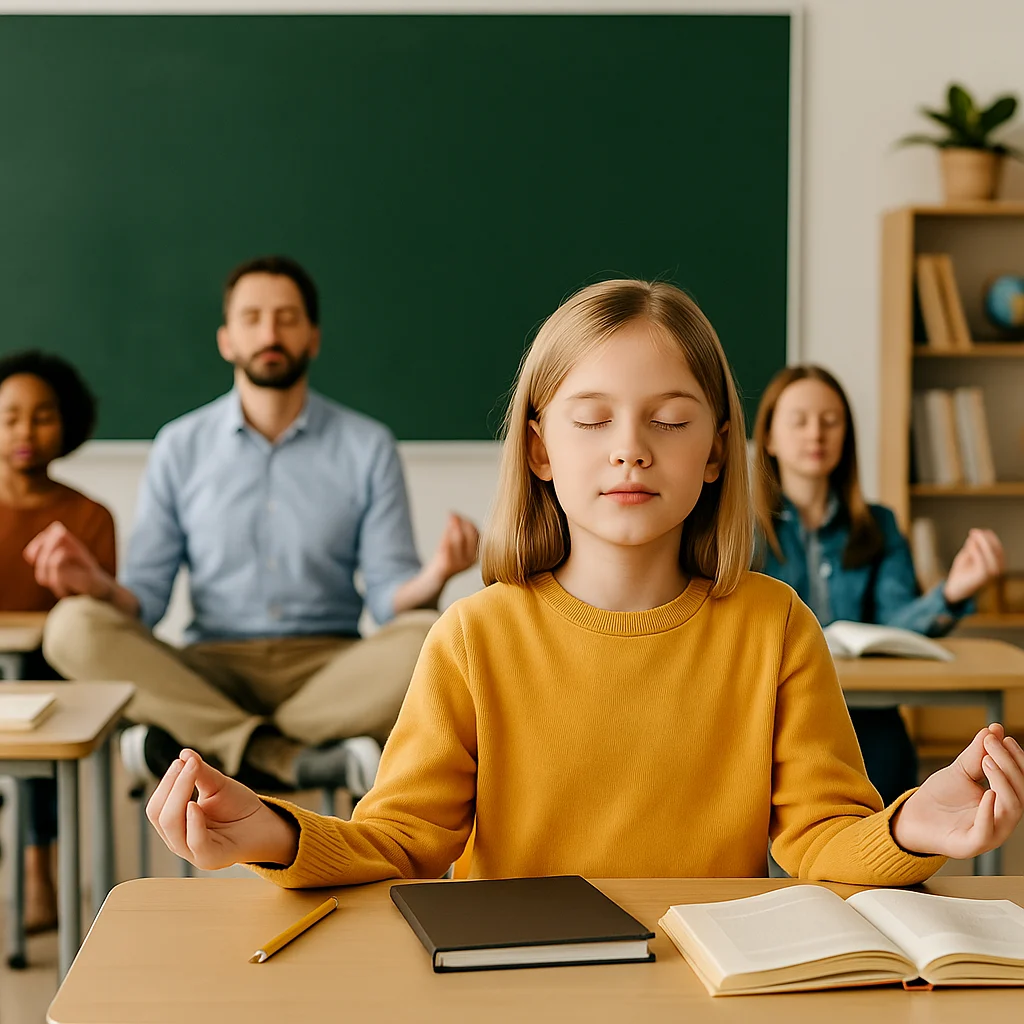
Even short sessions of five to ten minutes can help to clear the mind and sharpen focus for lessons. This is not about perfection or performance, but about building mindful moments into the school day. Mindfulness has an effect on both learning and social interaction, and it creates a positive learning environment.
How can mindfulness exercises be built into lessons?
Mindfulness exercises are flexible and can be used in a variety of situations during the school day. A short morning circle with breathing exercises, a body scan between two lessons or a brief meditation before exams can ease transitions and boost concentration.
Mindfulness exercises can also be integrated into creative subjects such as art and music. Those who pay conscious attention to sounds, colours or movements take in what they are learning more intensely and enhance their own creativity. In PE lessons, pupils can practise perceiving their own bodies. Mindful sensing while walking, jumping or stretching supports concentration and body awareness.
Project days or workshops also offer the opportunity to combine theoretical knowledge with practical exercises. This allows pupils to gain experience, reflect and notice the effect on their attention and mood. Small rituals such as breathing exercises or visualisations are just as effective as longer sessions.
What role does meditation for children play?
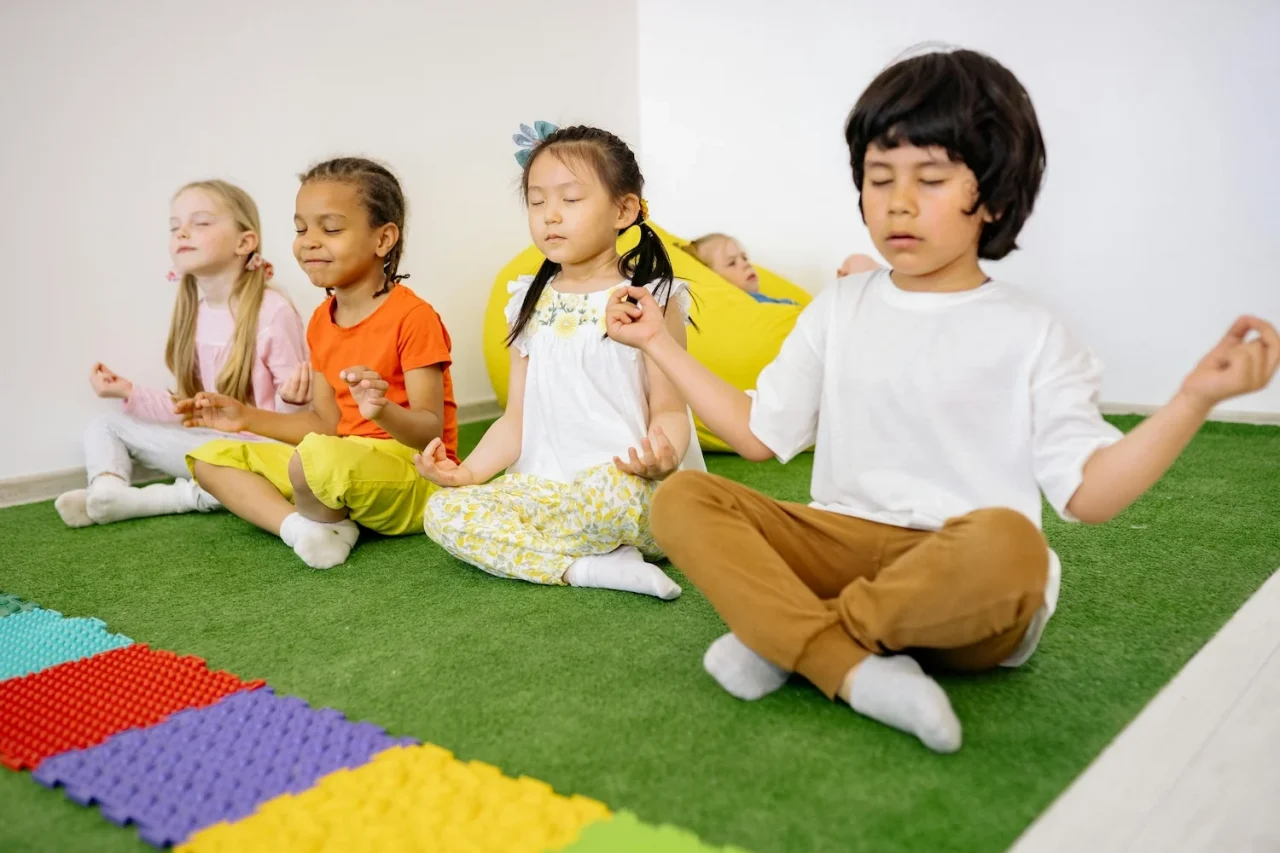
Meditation for children is a central building block of mindfulness practice at school. Age-appropriate meditation sessions help children to recognise emotions, reduce stress and improve concentration. Even short meditations of three to five minutes before a class test can reduce tension and make it easier to focus.
In addition, meditation for children strengthens social skills. Those who are consciously aware of themselves can respond to others with more empathy. Group meditations foster respectful interaction and improve the atmosphere in the classroom.
How can psychoeducation complement everyday school life?
Psychoeducation teaches knowledge about psychological processes, feelings and emotional regulation. Combined with mindfulness exercises, it helps pupils learn to recognise, understand and make constructive use of their emotions.
Practical applications such as reflection exercises, discussion groups or self-tests make the content tangible. Psychoeducation helps pupils cope better with stress, exam anxiety or conflicts in everyday life. Applied regularly, it increases pupils’ self-awareness and resilience.
If you are also interested in psychoeducation in a school context, you can find the right article for you here.
How does mindfulness support conscious media use?
Digital media are an integral part of everyday school life, but they can cause stress and overwhelm. Mindfulness helps pupils to use media more consciously.
Short exercises before or after screen time create a moment of reflection. Pupils learn to notice their emotions while using media and to understand how content affects them. Media diaries or “digital detox” days help them find a balance between the digital and the real world.
Mindfulness also fosters respectful interaction in the digital space. Young people become more aware of their words and develop more empathetic ways of communicating.

What changes in the brain can be measured?
Neuroscientific studies show that mindfulness changes the brain both structurally and functionally. Areas responsible for attention, emotional regulation and compassion are strengthened, while stress centres such as the amygdala become less active.
Through regular meditation for children and mindfulness exercises, pupils respond to stress more calmly, with greater focus and more resilience. Mindfulness practice supports not only academic performance but also the development of social and emotional skills.
What challenges arise in putting it into practice?
Integrating mindfulness into schools is not without its hurdles. Lack of time, differing needs and a lack of experience can make implementation more difficult.
Flexible solutions help to overcome these barriers: short, regularly repeated exercises adapted to age and situation increase acceptance. Continuing professional development and in-school training make implementation easier for teachers, while feedback sessions help to improve the practice continuously.
What are the benefits for everyday school life?
Regular mindfulness strengthens concentration, emotional stability and social skills. Small rituals such as meditation for children, short mindfulness exercises or reflection rounds make the school day more relaxed.
Combined with psychoeducation and conscious media use, this creates a learning environment that is calmer, more focused and more respectful. Pupils who practise regularly approach tests more calmly, are less distracted and can resolve conflicts more constructively.
Conclusion: Why should mindfulness be part of everyday school life?
Mindfulness is an effective tool for making the school day easier, improving learning and fostering positive relationships. Meditation for children, mindfulness exercises, psychoeducation and conscious media use can all be integrated flexibly into everyday life.
With small, regular rituals, practical exercises and reflection, the school day can become more relaxed, focused and balanced. Mindfulness has a positive effect on learning, behaviour and wellbeing and should be regarded as an integral part of modern education.
revised on 29/09/2025
by Katharina R. (psychology student)
If you enjoyed this article, feel free to share your thoughts in the comments or on Instagram. If you are interested in our meditation teacher training, you can find more information here. Enjoy your meditation!
Deepen your meditation practice with Mindfulife
Meditation can be more than a short break in your everyday life. If you would like to understand more deeply how meditation works, how to build a steady practice of your own and how to guide others mindfully, our meditation teacher training is the next step. There you will not only get to know meditation in theory, but also develop more confidence, clarity and trust in your own practice.
Would you like to find out more about the training first? In our weekly webinar you will get an insight and learn more about what your path to becoming a meditation teacher could look like.
For regular support in your everyday life, you can also use our online meditation studio and join guided meditations flexibly via Eversports.
We look forward to accompanying you on your journey.
You can find more mindfulness inspiration on our channels too
References
Baatz, U. (2022). Achtsamkeit: Der Boom – Hintergründe, Perspektiven, Praktiken. Vandenhoeck & Ruprecht. https://www.vandenhoeck-ruprecht-verlage.com/buch/achtsamkeit-der-boom
Cajochen, F. (2024). Achtsamkeit in der Schule und Hochschule [Bachelorarbeit]. Pädagogische Hochschule St. Gallen. https://phsg.contentdm.oclc.org/digital/collection/p15782coll2/id/3862/
Hascher, T., & Hagenauer, G. (2011). Schulisches Wohlbefinden im Jugendalter – Verläufe und Einflussfaktoren. In Jahrbuch Jugendforschung (S. 123–145). Springer Fachmedien.
Hölzel, B. K., Carmody, J., Vangel, M., Congleton, C., Yerramsetti, S. M., Gard, T., & Lazar, S. W. (2011). Mindfulness practice leads to increases in regional brain gray matter density. Psychiatry Research: Neuroimaging, 191(1), 36–43. https://doi.org/10.1016/j.pscychresns.2010.08.006
Iwers, T. (Hrsg.). (2021). Achtsamkeit in Bildungsprozessen: Professionalisierung und Praxis. Springer Fachmedien. https://doi.org/10.1007/978-3-658-30832-2
Kaltwasser, V. (2022). Bildung und Achtsamkeit: Theorie und Praxis des Kontemplativen im Bildungsprozess. Springer Fachmedien. https://doi.org/10.1007/978-3-658-30831-5
Keuffer, J. (2021). Achtsamkeit in der Schule – Qualifizierung der Trainer und Anwendung im Alltag von Lehrenden und Lernenden. In T. Iwers (Hrsg.), Achtsamkeit in Bildungsprozessen: Professionalisierung und Praxis (S. 89–102). Springer Fachmedien. https://doi.org/10.1007/978-3-658-30832-2
Neuenschwander, R. (2024). Achtsamkeit in Schule und Bildung. Springer Fachmedien.
Przybylski, A. K., & Weinstein, N. (2017). A large-scale test of the Goldilocks hypothesis: Quantifying the relations between digital-screen use and the mental well-being of adolescents. Psychological Science, 28(2), 204–215. https://doi.org/10.1177/0956797616678438
Rabkin, G. (2021). Schule als Ort gelebter Achtsamkeit: Literacy-Ansätze, kreatives Gestalten und Friedenserziehung. In T. Iwers (Hrsg.), Achtsamkeit in Bildungsprozessen: Professionalisierung und Praxis (S. 77–86). Springer Fachmedien. https://doi.org/10.1007/978-3-658-30832-2
Schramm, A. (2022). MAIDS (Meditation und Achtsamkeit in der Schule). In Achtsamkeit in Bildungsprozessen: Professionalisierung und Praxis (S. 117–130). Springer Fachmedien. https://doi.org/10.1007/978-3-658-30832-2
Tang, Y. Y., Ma, Y., Wang, J., Fan, Y., Feng, S., Lu, Q., … Posner, M. I. (2010). Short-term meditation training improves attention and self-regulation. Psychiatry Research: Neuroimaging, 191(1), 60–66. https://doi.org/10.1016/j.pscychresns.2010.08.006
UNESCO Institute for Lifelong Learning. (2025). International Review of Education – Journal of Lifelong Learning. https://www.uil.unesco.org/en/journal-international-review-education
Vogel, D., & Frischknecht-Tobler, U. (Hrsg.). (2019). Achtsamkeit in Schule und Bildung: Tagungsband. hep Verlag.
Vogel, D., Tschopp, C., & Grütter, J. (2017). DAS-Training für Studierende: Dialog und Achtsamkeit in der Schule. Ein achtsamkeitsbasiertes Training zur Förderung der sozial-emotionalen Kompetenz von (angehenden) Lehrpersonen [Forschungsbericht Nr. 60]. Pädagogische Hochschule Luzern. https://www.researchgate.net/publication/324081358_DAS-Training_fur_Studierende_Dialog_und_Achtsamkeit_in_der_Schule_Ein_achtsamkeitsbasiertes_Training_zur_Forderung_der_Sozial-emotionalen_Kompetenz_von_angehenden_Lehrpersonen_Bericht_zur_wissenschaf
Weghaupt, D. (2024). Achtsamkeit und pädagogische Professionalität in der Lehrerinnenbildung. transcript Verlag.