Walking meditation: 4 different styles and expert tips

 · 8 min read
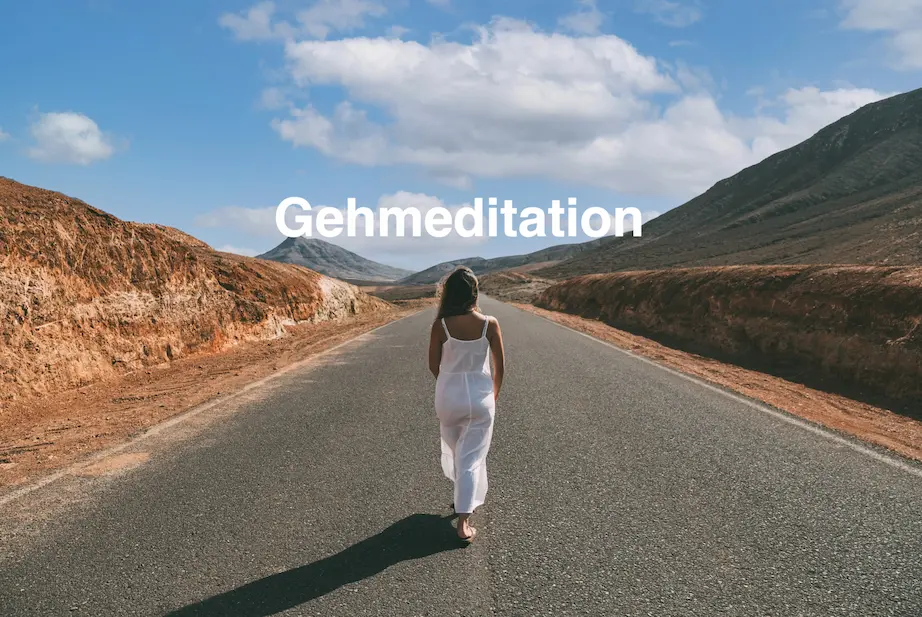
Walking meditation allows you to let go of the stress of everyday life and turn your focus to the present moment. By concentrating on your steps and your breath, you can feel a deep connection with your body. This combination of physical activity and mindfulness has many positive effects on mental health. Scientific studies have shown that regular walking meditation can increase wellbeing, reduce stress, improve concentration and even boost creativity.
What is walking meditation?
Unlike seated meditation, walking meditation is practised in motion, which makes it particularly suitable for people who find it hard to sit still for long periods. As with other types of meditation, walking meditation is about arriving in the here and now and consciously experiencing the present moment. Depending on the type of walking meditation, you cover different distances along which you bring body and mind into harmony by focusing your attention on the breath or on particular thoughts. Because walking is an automatic process, many people find it easier to access their inner world of thoughts and to arrive in the present moment while walking.
What are the benefits of walking meditation?
Walking meditation has a few key advantages, as its simple structure means it can be practised almost anywhere and at any time. This form of meditation is especially well suited to beginners who struggle with sitting for long periods, or to people who cannot stay in a seated position for very long for health reasons. Here is why you should give walking meditation a try too:
- Easy to fit into everyday life:
Walking meditation is easy to build into your daily routine, as walking is already part of our everyday lives and you need neither experience nor any special equipment. So you can use even the short walk to the bakery or the nearest bus stop for a little walking meditation. - Relaxes body and mind:
Compared with seated meditation, many people find it easier to relax during walking meditation, because they don’t have to sit still and upright but can settle down through natural movement. This type of meditation is particularly suitable when you are just starting out. - Can be practised anytime, anywhere:
There are countless places where you can practise walking meditation, whether out in nature (woods, meadows, beaches, parks), in your own garden or even in your living room. There are no limits, and you can experiment to find out where it feels best for you.
What are the drawbacks of walking meditation?
Although walking meditation offers many benefits, it is important to acknowledge that it can also come with some potential challenges. These aspects should be taken into account to allow a realistic assessment of the practice. Below are three main areas in which these challenges can arise:
- Practical challenges:
Difficulty finding a suitable place to walk: depending on where you live or your surroundings, it can be difficult to find a quiet and safe place for walking meditation. Noise, distractions or uneven surfaces can interfere with the practice. - Physical strain:
Unlike seated meditation, walking meditation requires movement and can therefore be difficult for people with physical limitations or complaints. It is important to listen to your own body and adapt the practice accordingly to avoid injury. - Mental challenges:
Difficulty quietening the mind: thoughts and inner restlessness can arise while walking, too, and make the practice harder. It takes practice and patience to calm the mind and reach a deeper level of meditation.
What effect does walking meditation have on physical health?
But what effects does meditating while walking have on the body? This question is answered by numerous studies looking at the effects of meditation and of walking meditation in particular.
When practised regularly, walking meditation not only helps you reduce stress and find inner peace and greater calm, but can also lead to improved fitness, better digestion, improved concentration and greater physical and mental resilience. Studies have also shown that walking combined with meditation can help with anxiety and can also have a positive effect on blood sugar levels.
This form of meditation can therefore be very helpful, especially in our modern world, where many people spend most of their day sitting at a desk.
The history and origins of walking meditation
Walking meditation has its origins in Zen Buddhism and has developed in various directions over the centuries. There are stricter forms, in which posture and the sequence of steps are precisely prescribed and the breath is observed, but also freer forms, in which the focus is placed on the movement of the feet or on the repeated recitation of mantras, such as “May I be happy”,. The type of route and the duration can also vary greatly from school to school.
What forms of walking meditation are there?
1. Walking meditation according to Thich Nhat Hanh
Walking meditation according to Thich Nhat Hanh is one of the freer forms and can be practised anytime and anywhere. The main aspect is to place your awareness fully on walking and to synchronise your breath with the movement. You are free to choose the pace and length of the meditation, as all that matters is perceiving your surroundings with all your senses and so arriving in the present moment.
2. Theravada Vipassana walking meditation
In this form of meditation, practised by monks of Theravada Buddhism, you walk mindfully back and forth along a path of 10 to 15 metres. This trains the mind’s concentration. Theravada Vipassana walking meditation focuses on the movements of the breath and on awareness of the body. Attention is directed by consciously noticing the breath or through a body scan . Thoughts and feelings are accepted without judging or changing them. The challenge lies in gently bringing your attention back to the meditation despite distracting thoughts. The meditator meets their body with calm and acceptance.
3. Kinhin meditation in Zen Buddhism
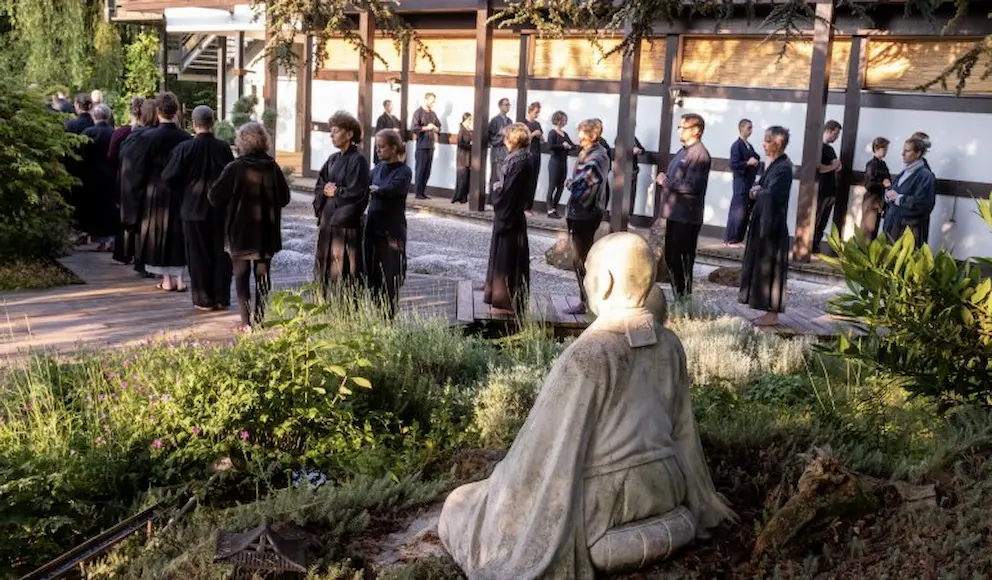
This type of meditation is practised in Zen Buddhism and, unlike the previous forms, is built into the intervals of a seated meditation. As the monks and nuns move in a circle or rectangle, their steps are brought into harmony with their breathing. Another special feature is the hand position known as “shashu”, in which the fist of one hand is covered by the palm of the other.
4. Forest bathing
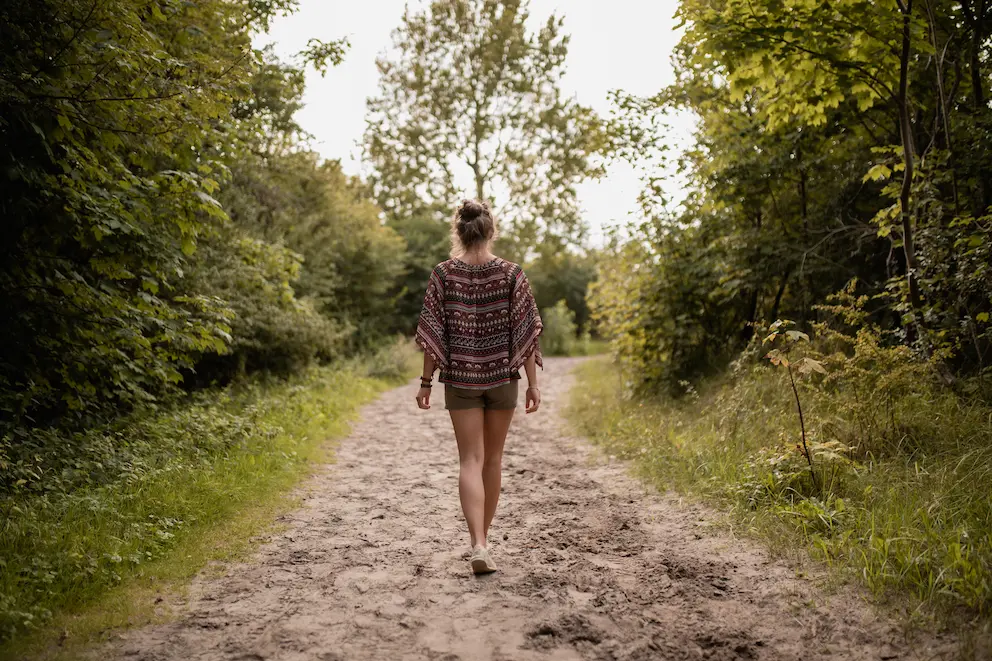
Forest bathing comes from Japan and is used to reduce stress, calm the mind and perceive the present moment. As the name suggests, this type of walking meditation takes place outdoors in nature, ideally in the woods. It is not an ordinary walk in the woods, but rather an experience of the forest in the here and now with all your senses. You walk through the forest at a slow pace and pause again and again to use your senses of smell, hearing or touch, and so arrive in the present moment.
Start your walking meditation: 6 tips and a guide for beginners
You don’t need much to meditate while walking. If the ground isn’t suitable for walking barefoot, it’s best to wear comfortable shoes so that they don’t distract you as you walk. You can set the length of the meditation entirely as you wish, but to begin with we recommend a shorter period of between 5 and 15 minutes. Whether you do your first walking meditation outdoors or indoors in your familiar surroundings is up to you. Just choose a route on which you can really concentrate on walking and won’t be too distracted. It’s also best to switch off your phone. And then you’re ready to go!
6 tips for integrating walking meditation into your daily routine
- Preparation: To begin, take a few breaths while standing to find your balance and relax. Direct your attention to your feet and feel how they rest on the ground.
- Setting off: As soon as you feel ready, you can take your first steps and slowly start walking. Try to keep your steps even and notice each step, from the moment your foot touches the ground until it rolls off. Feel how your weight presses into the sole of your foot with every step, and let your arms swing loosely.
- Breath awareness: Become aware of your breath as you walk and find out how many steps you naturally take during one inhalation and exhalation. The aim is not to force your breath into a particular rhythm, but simply to observe it and accept it as your body offers it to you.
- Sensory perception: Activate your senses as you walk and consciously take in your surroundings, for example by asking yourself what you can see, smell or hear. Take time for each individual sense and experience it to the full.
- Thoughts: If your thoughts drift off and distract you while you are walking, that is completely normal. Feel free to pause for a few moments and notice, without judgement, what is on your mind. Then consciously let the thoughts go again and return to your steps, your breath and the present moment.
- Closing: At the end of your route, take a few more moments to pause and close the meditation with a calm mind.
Final thoughts
Walking meditation offers an ideal introduction to the world of meditation. It can be practised anytime and anywhere, requires no previous experience, and there is no “wrong” or “right”. By building it into your everyday life, you may notice positive effects on body and mind after only a short time. With a few simple tips on how to practise it and fit it into your daily routine, you can start enjoying the benefits of walking meditation straight away and take the first step towards a mindful life. So, what are you waiting for? Start walking meditation now and take the first step towards a more conscious life!
Online meditation
So now you know what walking meditation is and how to do it. If you find it a little too difficult, or it doesn’t fit into your everyday life, why not take a look at our article on online meditation? See you there!
Deepen your meditation practice with Mindfulife
Meditation can be more than a short break in your everyday life. If you would like to understand more deeply how meditation works, how to build a steady practice of your own and how to guide others mindfully, our meditation teacher training is the next step. There you will not only get to know meditation in theory, but also develop more confidence, clarity and trust in your own practice.
Would you like to find out more about the training first? In our weekly webinar you will get an insight and learn more about what your path to becoming a meditation teacher could look like.
For regular support in your everyday life, you can also use our online meditation studio and join guided meditations flexibly via Eversports.
We look forward to accompanying you on your journey.
You can find more mindfulness inspiration on our channels too
References
Chatutain, A., Pattana, J., Parinsarum, T., & Lapanantasin, S. (2019). Walking meditation promotes ankle proprioception and balance performance among elderly women. Journal of Bodywork and Movement Therapies, 23(3), 652–657.
Edwards, M. K., Rosenbaum, S., & Loprinzi, P. D. (2018). Differential experimental effects of a short bout of walking, meditation, or combination of walking and meditation on state anxiety among young adults. American Journal of Health Promotion, 32(4), 949–958.
Gainey, A., Himathongkam, T., Tanaka, H., & Suksom, D. (2016). Effects of Buddhist walking meditation on glycemic control and vascular function in patients with type 2 diabetes. Complementary Therapies in Medicine, 26, 92–97.
Hassan, A., Tao, J., Li, G., Jiang, M., Aii, L., Zhihui, J., Zongfang, L., & Qibing, C. (2018). Effects of walking in bamboo forest and city environments on brainwave activity in young adults. Evidence-Based Complementary and Alternative Medicine, 2018, Article 9653857.
Prakhinkit, S., Suppapitiporn, S., Tanaka, H., & Suksom, D. (2014). Effects of Buddhist walking meditation on depression, functional fitness, and endothelium-dependent vasodilation in depressed elderly. Journal of Alternative and Complementary Medicine, 20(5), 411–416.