Starting School Without Stress – How Can I Make It Mindful?

 · 4 min read
More than 800,000 children started school in Germany last year – that is a great many people all experiencing major changes at once (Statista Research Department, 2025). Parents, families and guardians first have to prepare for this new stage, but this time can also be challenging for the brand-new schoolchildren themselves. With mindfulness, you could make starting school easier for your child!
When does school start in Germany?
The start of the school year in Germany is not uniform and often differs between the individual federal states, which also set their own holiday dates. Overall, the first days of school in 2025 fall between 11 August and 16 September – you can find an overview of all the federal states in the table below.
| 11 Aug. | Saxony, Saxony-Anhalt and Thuringia |
| 15 Aug. | Saarland |
| 16 Aug. | Bremen and Lower Saxony |
| 18 Aug. | Hesse and Rhineland-Palatinate |
| 27 Aug. | North Rhine-Westphalia |
| 4 Sept. | Hamburg |
| 8 Sept. | Brandenburg, Mecklenburg-Western Pomerania and Schleswig-Holstein |
| 15 Sept. | Baden-Württemberg and Berlin |
| 16 Sept. | Bavaria |
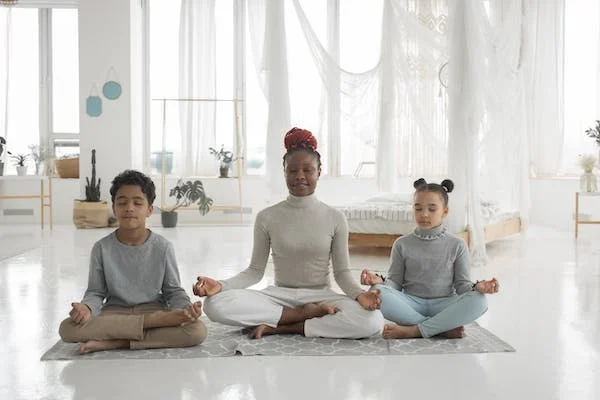
How can I use children’s meditations to shape the start of school?
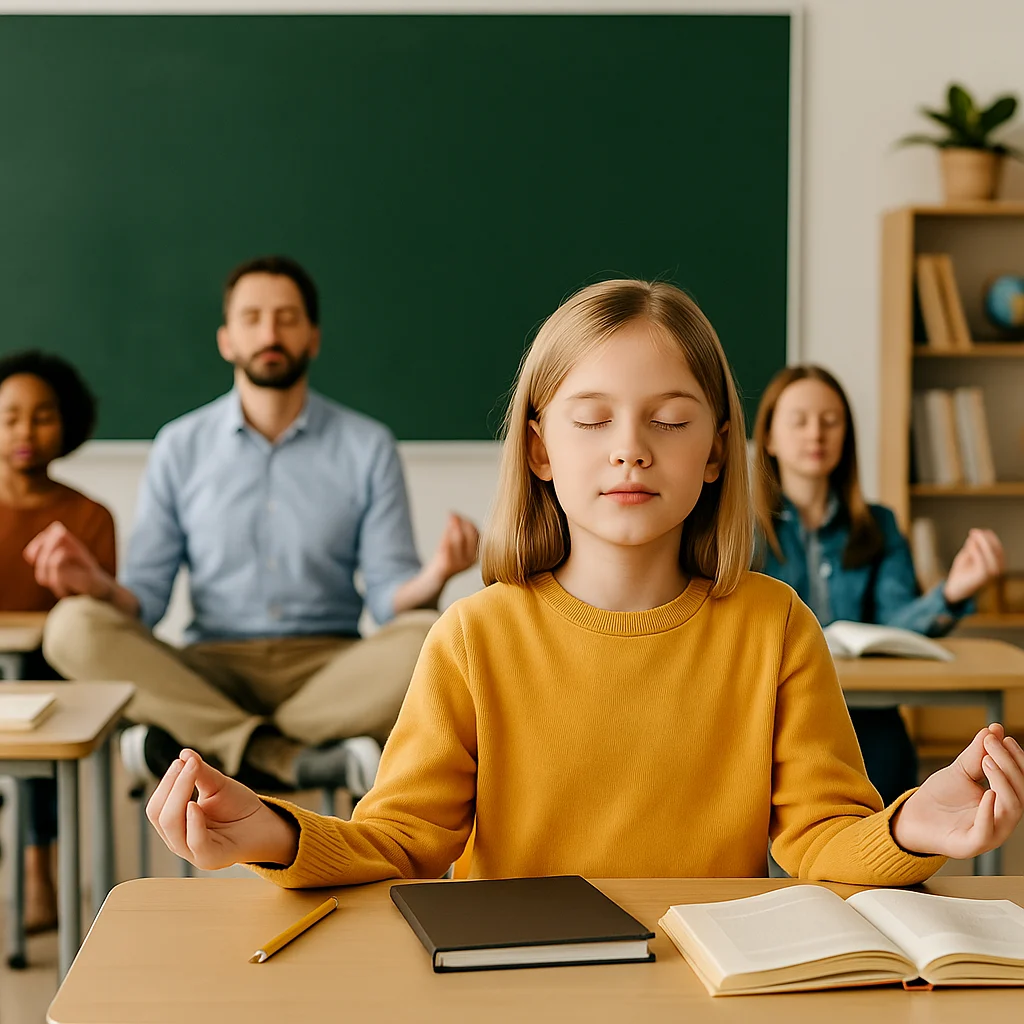
Starting school is a big event for most children. The often carefree days of nursery are replaced by a whole host of duties and rules. On top of that, there is often considerable pressure to perform. According to a DAK study, almost every second schoolchild suffers from stress (Deutsches Ärzteblatt, 2017). Meditation is a great way to help children cope with these demands. Several studies also suggest that meditation can help schoolchildren to be calmer and more relaxed, to concentrate better and to participate more attentively (Black & Fernando, 2014; Crescentini et al., 2016; Slaviero & Dip, 2017; van der Oord et al., 2012).
You can turn this into a wonderful bedtime ritual that makes it easier for your child to process the day’s experiences. Card sets with children’s meditations work really well for this!
What should I give for the start of school? What makes a good school cone?
According to historical records, the school cone (Schultüte) originated in eastern Germany in the 19th century. Originally known as a sugar cone (Zuckertüte), it provided provisions for what were usually very long journeys to school at the time. It was mostly filled with dried fruit and sweet pretzels or bread rolls. In the 20th century, the sugar cone increasingly became a kind of consolation meant to make starting school easier for children. As the myth that sugar lifts your mood was widespread back then, it was usually filled with a large amount of sweets. Today, now that the harmful effects of sugar are well known, many parents are looking for other ideas.
Here are a few more sustainable ideas for a school cone for starting school:
- Educational games: There are lots of small educational games for school starters that fit nicely into a school cone and make future learning fun (e.g. a Mini-LÜK box).
- Little activity books: Especially when starting school, many children are still highly motivated and enjoy learning. You can encourage this by filling in fun little activity books together with your child, which help to consolidate newly acquired knowledge.
- Alarm clock: Once school begins, most children have to get up considerably earlier than they did at nursery. To make getting up easier, you can pop a nice, child-friendly alarm clock into the school cone. A sunrise alarm clock, for example, wakes children up particularly gently.
- SOS bracelet: Does your child know your mobile number by heart? If not, an SOS bracelet makes a very useful gift for the school cone. This is a bracelet with your phone number on it. An SOS bracelet gives your child a sense of security, because if they ever don’t know where they are, they can turn to someone who can call their parents.
- Torch: School starts in summer, but by autumn at the latest, your child will be setting off for school in the dark. Routes to school don’t always run along well-lit streets. A torch is a good idea so that your child can make their way to school safely, even early in the morning.
- Reflectors: Being seen is particularly important for schoolchildren. Children under the age of 10 cannot yet properly judge road traffic, often walk too close to the road or cross it even though an approaching vehicle is actually far too close already. That is why it is especially important that drivers see children in good time so they can react more quickly. There are, for example, lots of small reflectors that can easily be attached to zips and the like on clothing. This helps children travel more safely on their way to school.
- Purse or wallet: At most primary schools, children regularly need to bring in small amounts of money from Year 1 onwards, whether for various school supplies or as a contribution towards school trips or shared breakfasts. To make sure the money arrives safely at school, you can give your child a child-friendly purse or wallet as soon as they start school.
- Water bottle and lunch box: Stainless steel products are especially recommended here, as they are better for the environment and also healthier for children, because they contain no plasticisers or other harmful substances.
- Plaster box: Children pick up minor injuries several times a day. So that they can take care of small wounds themselves, a little box of plasters is a must in every school bag.
Conclusion
With careful preparation for the first day of school, the whole process can be more mindful and sustainable for both the child and the family. Whether it’s a school cone filled with important, useful little things, a small bedtime ritual or regular children’s meditation – everything helps to make the transition from nursery to school more pleasant for everyone involved.
Isabell S. (Psychology student)
Deepen your meditation practice with Mindfulife
Meditation can be more than a short break in your everyday life. If you would like to understand more deeply how meditation works, how to build a steady practice of your own and how to guide others mindfully, our meditation teacher training is the next step. There you will not only get to know meditation in theory, but also develop more confidence, clarity and trust in your own practice.
Would you like to find out more about the training first? In our weekly webinar you will get an insight and learn more about what your path to becoming a meditation teacher could look like.
For regular support in your everyday life, you can also use our online meditation studio and join guided meditations flexibly via Eversports.
We look forward to accompanying you on your journey.
You can find more mindfulness inspiration on our channels too
References
Black, D. S., & Fernando, R. (2014). Mindfulness Training and Classroom Behavior Among Lower-Income and Ethnic Minority Elementary School Children. Journal of Child and Family Studies, 23(7), 1242–1246. https://doi.org/10.1007/s10826-013-9784-4
Crescentini, C., Capurso, V., Furlan, S., & Fabbro, F. (2016). Mindfulness-Oriented Meditation for Primary School Children: Effects on Attention and Psychological Well-Being. Frontiers in Psychology, 7. https://doi.org/10.3389/fpsyg.2016.00805
Deutsches Ärzteblatt (2017). Fast jeder zweite Schüler leidet unter Stress. https://www.aerzteblatt.de/news/fast-jeder-zweite-schueler-leidet-unter-stress-b8367471-ece8-4c64-85d3-87fdbff7d62e
Slaviero, T. M., & Dip, T. (2017). The impact of guided meditation on children’s behaviour, mental health and well-being. (Doctoral dissertation, Thesis, Professional Doctorate, Swinburne University of Technology, Australia]. Swinburne Research Bank. http://hdl.handle.net/1959.3/439850
Statista Research Department (2025). Anzahl der Einschulungen in Deutschland zu Beginn des Schuljahres 2024/2025 nach Bundesländern. https://de.statista.com/statistik/daten/studie/71863/umfrage/einschulungen-in-deutschland/
van der Oord, S., Bögels, S. M., & Peijnenburg, D. (2012). The Effectiveness of Mindfulness Training for Children with ADHD and Mindful Parenting for their Parents. Journal of Child and Family Studies, 21(1), 139–147. https://doi.org/10.1007/s10826-011-9457-0