Metta Meditation: More Kindness, Step by Step
Anyone can try kindness meditation and see how it enriches life with more happiness and compassion. It can leave you mentally healthier, happier and more motivated to lead a better life.

 · 7 min read
Kindness – a simple word, but one with a powerful effect. It shapes not only how we treat others, but also how we treat ourselves. In a world so often marked by stress, hurry and negativity, kindness is almost like a superpower: it brings inner peace and creates a positive, nurturing environment – for ourselves and for others.
But how can we bring more kindness into our everyday lives – especially when life is challenging? One wonderful way is kindness meditation, also known as metta meditation.
What is metta meditation?
Metta meditation – also known as loving-kindness meditation – is a practice that strengthens compassion, kindness and goodwill towards ourselves and others. The term metta comes from Pali, an ancient Indian language, and means something like loving-kindness or friendly love.
The practice originally comes from the Buddhist tradition, but it can be practised regardless of religion or spiritual belief. It is suitable for anyone who wants to cultivate more inner peace, emotional healing and an open heart.
At the heart of metta meditation lies a benevolent inner attitude: by repeating certain phrases or mantras, we cultivate a loving and compassionate stance – first towards ourselves, then towards people close to us, neutral people and even difficult people, and finally towards all living beings. This form of meditation invites us to let go of hurtful behaviour, bitterness or prejudice and instead to nurture warmth, connection and generosity.

What are the positive effects of metta meditation?
Kindness meditation may seem unfamiliar at first – yet numerous scientific studies demonstrate its positive effects on emotional and physical health.
- More self-love and compassion: If you practise metta regularly, you learn to meet yourself with kindness rather than judgement. This inner attitude leads to contentment, strengthens self-esteem and at the same time fosters warmth between people. A study by Stanford University showed that just five minutes of metta meditation a day can significantly increase feelings of social connection and positive attitudes towards strangers.
- Better relationships: As compassion grows, it becomes easier to respond calmly to conflict and to meet others with understanding. In the long run, this improves the quality of your relationships – both in your private life and at work.
- Less stress and anxiety: A loving focus calms the nervous system. Several studies show that regular kindness meditation reduces stress and anxiety and strengthens emotional balance. Barnhofer et al. (2010) also found that metta meditation can ease low mood and contribute to emotional stability.
- More positivity & joy in life: The practice fosters positive emotions such as compassion, love and peace – while also reducing negative feelings such as irritation, anger or resentment.
Over time, you will notice more happiness, contentment and lightness in everyday life – an inner sense of wellbeing that grows out of genuine kindness. - Relief from physical complaints: Metta can also have a healing effect on the body. A study by Rosenzweig et al. (2010) showed that regular practice has a positive influence on chronic pain, for example in arthritis or back problems.
How is metta meditation practised?
If you decide to bring kindness meditation into your life, here is a step-by-step guide to practising metta meditation.
1. Find a quiet place and the right posture:
- Find a quiet, undisturbed place where you can meditate.
- Settle into a comfortable position, whether on a chair or on the floor, cross-legged or in any other comfortable posture. Your back should be upright but relaxed.
- Rest your hands on your thighs or fold them in your lap.
- Close your eyes or let your gaze rest softly downwards.
- Breathe calmly and evenly – let your breath flow without controlling it.
2. Focus on your heart
- Bring your attention to the centre of your chest – the area around your heart.
- Imagine warmth, spaciousness and kindness spreading out from there.
- It may help to imagine a softly glowing light in your chest or to place a hand on your heart.
3. Repeat the metta phrases for yourself:
- ‘May I be safe.’
- ‘May I be happy.’
- ‘May I be healthy and free from worry.’
- ‘May I be content and at ease.’
4. Extending compassion to others:
- For people close to you: Think of someone you love or greatly value and repeat: ‘May you be safe. May you be happy. May you….’
- For neutral people: Now picture a neutral person you feel neither drawn to nor put off by, such as a colleague, the postman or a neighbour, and send them the same kind wishes too.
- For difficult people: Think of people you have difficulties with or don’t like, and send this person kind thoughts and wishes as well. Don’t expect it to work straight away. Kindness needs to grow – without any pressure.
- For all living beings: Finally, extend your thoughts to all people and all living beings. Wish peace, health and happiness for the whole world. You can keep using your phrases or find your own words and let your imagination guide you.
Challenges and how to deal with them
Metta meditation doesn’t always go smoothly either. It is perfectly normal for resistance, doubts or difficult feelings to come up. Here are some common challenges – and mindful ways of dealing with them:
1. Finding it hard to offer yourself compassion
We humans are often very self-critical – sometimes even our own harshest critics. That’s why many people find it difficult to send themselves loving wishes.
Tip: Imagine you were talking to your best friend: would you judge them or wish them well? Speak to yourself in the same way. Remind yourself: you, too, deserve kindness and happiness – just like everyone else.
2. Dealing with negative emotions
During meditation, anger, sadness or resistance may arise – especially when you think of difficult people. It can be challenging to send loving wishes to such people.
Tip: Let the feelings be there without judging them. Metta does not mean condoning negative behaviour – it means protecting your heart from resentment through acceptance. Be patient with yourself. Unpleasant feelings are part of the process too and are allowed to have space.
3. Patience and regular practice
Sometimes the meditation seems ‘not to work’. Perhaps you feel nothing – or wonder whether anything is changing at all.
Tip: Just as a plant grows little by little with water, kindness also grows little by little with practice. Don’t set expectations; stay open to whatever arises. Even if you feel very little – the intention to send love alone already brings about change.
Bringing kindness into everyday life
Kindness can easily flow into your everyday life. Even small, conscious moments of goodwill can change a great deal – for you and for others.
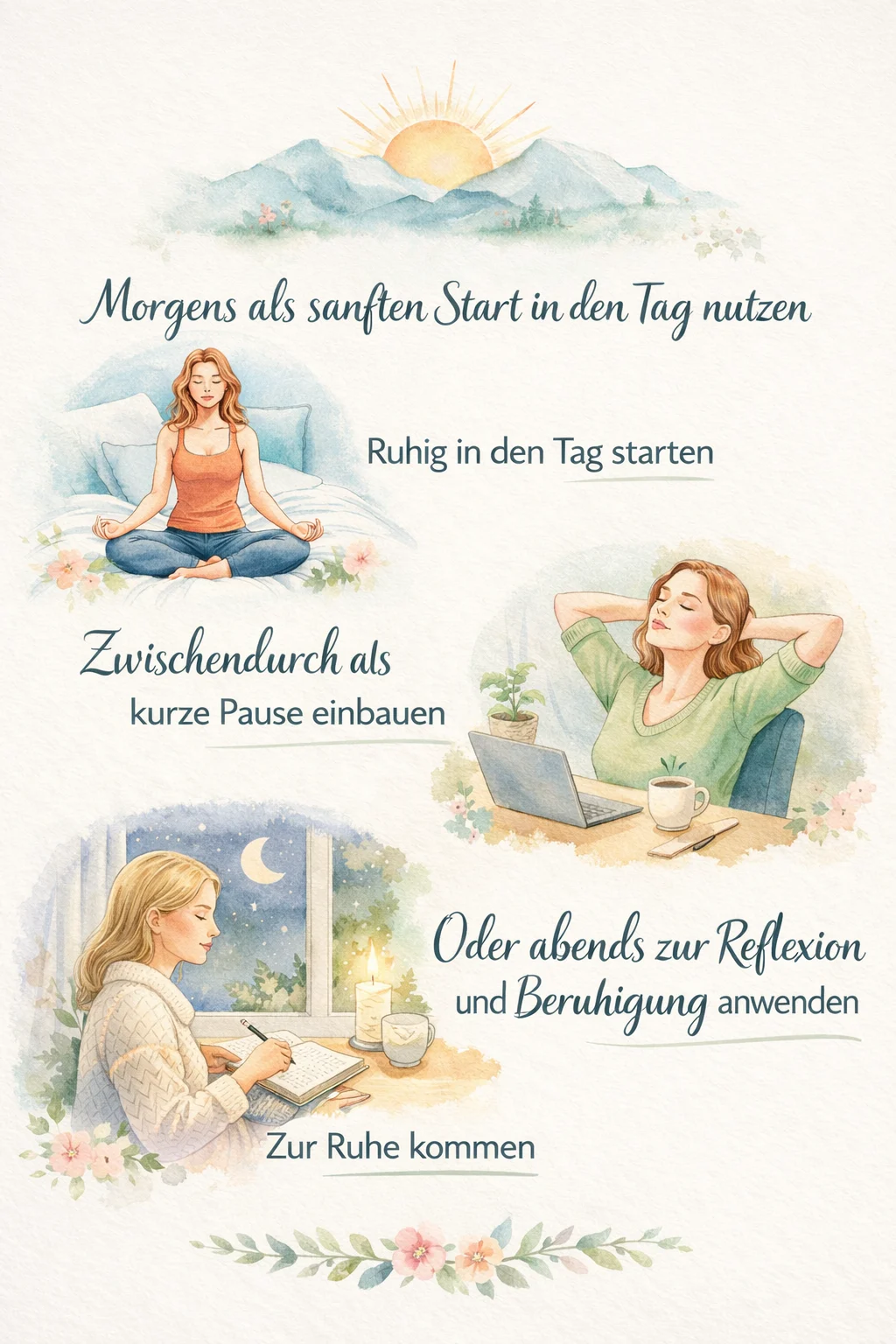
- In the morning: Before you get up, give yourself a few warm, loving thoughts. ‘May I be happy today and go through the day with kindness and ease.’ This way, you start the day mindfully and with an open heart.
- In stressful moments: When someone annoys you, take a deep breath and silently send that person a good wish. Anger costs unnecessary energy and, in the long run, harms your mental health.
- Metta in conversation: When you meet people, try to really listen instead of reacting straight away. A kind look, a genuine smile or an attentive word can often achieve more than long conversations.
- Before falling asleep: Think of three people and wish them happiness, health and contentment.
These small rituals gradually strengthen your inner attitude of compassion and kindness – without any time pressure or effort.

The metta practice can also be combined beautifully with other forms of meditation:
- Mindfulness meditation: First observe your breath before repeating your metta phrases.
- Walking meditation: With each step, silently say a phrase of kindness.
- Gratitude meditation: Combine metta with gratitude by remembering people or experiences you are grateful for.
Conclusion
Metta combines mindfulness with kindness – and that is precisely where its power lies. Mindfulness means consciously perceiving the moment and responding mindfully to our thoughts, feelings and actions. Through metta, we link this inner mindfulness with kindness and compassion – and let them flow into our behaviour. Over time, we develop a finer sense of our own emotions and begin to see and understand the feelings and needs of others more clearly. This changes how we respond: instead of acting impulsively or defensively, we increasingly choose the path of love and calm.
You don’t have to be friends with everyone, but you should always be friendly. – Exler, Georg-Wilhelm
Give it a try: every metta meditation is a small step towards more peace.
revised by Da-Yong K. (psychology student)
on 13 October 2025
Deepen your meditation practice with Mindfulife
Meditation can be more than a short break in your everyday life. If you would like to understand more deeply how meditation works, how to build a steady practice of your own and how to guide others mindfully, our meditation teacher training is the next step. There you will not only get to know meditation in theory, but also develop more confidence, clarity and trust in your own practice.
Would you like to find out more about the training first? In our weekly webinar you will get an insight and learn more about what your path to becoming a meditation teacher could look like.
For regular support in your everyday life, you can also use our online meditation studio and join guided meditations flexibly via Eversports.
We look forward to accompanying you on your journey.
You can find more mindfulness inspiration on our channels too
References
Akademie Gesundes Leben. Metta-Meditation – Liebende Güte für alle. Zuletzt abgerufen am 9. September 2025 von https://akademie-gesundes-leben.de/metta-meditation-liebende-guete-fuer-alle
Barnhofer, T., Chittka, T., Nightingale, H., Visser, C., & Crane, C. (2010). State effects of two forms of meditation on prefrontal EEG asymmetry in previously depressed individuals. Mindfulness, 1(1), 21–27. https://doi.org/10.1007/s12671-010-0004-7
Binder, A. (2024). Metta Meditation. Autoimmun Lifestyle. Zuletzt abgerufen am 9. September 2025 von https://www.autoimmun-lifestyle.com/metta-meditation/
Boob, L. Metta Meditation für Wohlwollen und Freundlichkeit. Amema. Zuletzt abgerufen am 9. September 2025 von https://www.amema.at/metta-meditation/
Hutcherson, C. A., Seppala, E. M., & Gross, J. J. (2008). Loving-kindness meditation increases social connectedness. Emotion, 8(5), 720–724. https://doi.org/10.1037/a0013237
Rosenzweig, S., Greeson, J. M., Reibel, D. K., Green, J. S., Jasser, S. A., & Beasley, D. (2010). Mindfulness-based stress reduction for chronic pain conditions: Variation in treatment outcomes and role of home meditation practice. Journal of Psychosomatic Research, 68(1), 29–36. https://doi.org/10.1016/j.jpsychores.2009.03.010