Biohacking without the self-optimisation obsession: how to come back to yourself in an age of overstimulation
Perhaps you know this feeling: you have access to everything. Information, technology, opportunities, comfort. And yet sometimes you feel empty or exhausted inside. In conversation with Alexander Metzler, expert and speaker on inner and outer balance in the digital age, one thing quickly becomes clear: This is not about biohacking in the sense of "getting the most out of yourself".

 · 6 min read
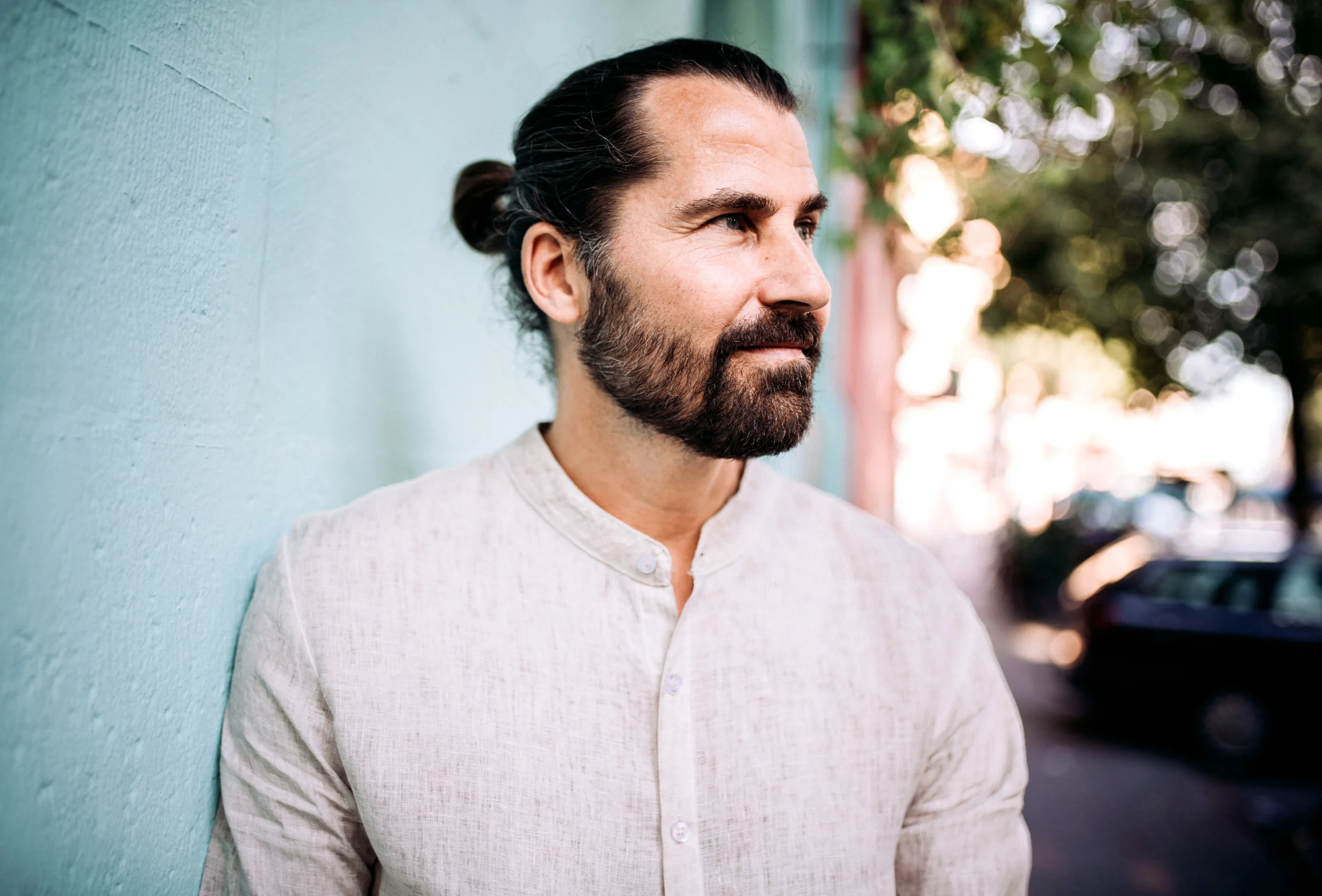
Perhaps you know this feeling: you have access to everything. Information, technology, opportunities, comfort. And yet sometimes you feel empty or exhausted inside.
In conversation with Alexander Metzler, expert and speaker on inner and outer balance in the digital age, one thing quickly becomes clear:
This is not about biohacking in the sense of “getting the most out of yourself”, but about something deeper: self-leadership. It is about biohacking without self-optimisation.
It is about how, in a world full of stimuli, you can once again consciously decide how you want to live.
Biohacking describes the deliberate use of lifestyle strategies (e.g. sleep, nutrition, exercise, light or breathing techniques) to optimise body and mind in a targeted way and to enhance your own wellbeing.
Biohacking without self-optimisation goes one step further: it is not about performance or maximum efficiency, but about consciously coming back to yourself and stabilising your nervous system.
Why do we feel empty even though we live in abundance?
Alexander says something very simple – and at the same time radical:
“No other species would think of powering through 365 days a year.”
This is exactly where biohacking without self-optimisation can help you stay stable inside, rather than just constantly functioning.
And yet that is often exactly how we live.
Always reachable. Always informed. Always on the move.
The problem is not outer wealth.
The problem is a lack of inner orientation.
When your everyday life is steered from the outside – by appointments, notifications, expectations – you slowly lose touch with your own inner guidance.
And this is precisely where the core of his philosophy begins:
Inner abundance arises when you learn to regulate yourself again.
Indeed, studies show that people are more stable and resilient when their nervous system is well balanced. Those who have learnt to calm themselves cope better with stress and challenges.
Where does self-regulation begin – in the mind or in the body?
Not in the mind.
In the body.
That is why Alexander does not start his day with the news or social media – but with light, fresh air and movement. When you consciously step outside in the morning, you send a signal to your nervous system:
I am awake. I am here. I am starting consciously.

Research shows that morning daylight stabilises our internal clock, improves sleep and can even have a positive effect on our mood.
You regulate your biorhythm.
You stabilise your stress system.
You take the lead – before the day takes over you.
And this is where it becomes clear:
In his understanding, biohacking does not mean total optimisation. It means reconnecting with yourself.
Why can cold and breathwork help with self-regulation?
In an ice bath, your body reacts immediately. Your breathing speeds up. Your system goes on high alert.
The crucial question is not: how long can you stand it?
But rather: can you stay calm while your body is signalling stress?
Perhaps you don’t need an ice bath.
But you know your own “cold water”: conflict, pressure, uncertainty.
When you learn to control your breath, you learn to control your nervous system.
And when you can regulate your nervous system, you gain inner stability.
This is where real resilience begins.
Why does presence play such a central role?
Because overstimulation constantly pulls you out of the moment.
Past. Future. Notifications. Series. Stimuli.
Yoga, nature, conscious silence – for Alexander, none of these are spiritual accessories. They are training grounds for presence. When you are in the moment, you have no capacity for rumination.
No capacity for comparison.
No capacity for chronic stress.
Presence can therefore also be seen as nervous system hygiene.
What does his depressive phase have to do with this?
Between the ages of 25 and 35, Alexander went through a severe period of depression.
And it was there that he realised: performance alone will not carry you.
When the system collapses, to-do lists don’t help.
That is when you need inner stability.
Many people only change their lifestyle when the pain becomes too great. But perhaps you don’t have to hit rock bottom before questioning your habits.
Perhaps it is enough to ask yourself honestly:
Who or what is steering my life right now – me, or the stimuli around me?
Why is media awareness a question of self-leadership?
As a media designer, Alexander knows the mechanisms behind social media. Dopamine, reward systems, endless loops. And yet he says: “I doomscroll sometimes too.” For him, the difference isn’t made by discipline. The difference comes from awareness. When you notice that you are scrolling – and ask yourself: “Do I feel better or worse afterwards?” – that is where self-leadership begins.
It is not about banning everything. It is about actively choosing again. The same principle applies to series, to the news, to constant background noise. If you don’t steer your media consumption, it steers your attention. And your attention is your lifetime.
Studies suggest that heavy smartphone and social media use may be linked to more stress and poorer sleep. Our brain is not designed to process new stimuli all the time.
It might help you to reflect:
To whom or what, and to what extent, do I really want to give my precious time?
Why is sleep so closely linked to self-determination?
Sleep also plays an important role for Alexander. Sleep is the phase in which your nervous system regenerates.
If you go to bed with screen light, tension and sensory overload, you take all of that with you into your night. Then you don’t wake up refreshed in the morning – you simply start reacting again. A calm evening is preparation for a self-determined next day. This brings us full circle to the morning routine:
How you fall asleep often determines how you wake up.
Research shows that screen light in the evening can inhibit the production of the sleep hormone melatonin. This makes it harder to fall asleep – even when we actually feel tired.
What does nutrition have to do with all this?
A great deal. Because food is a stimulus too. Eating is stimulation too.
Alexander describes himself as “flexigan” – mostly plant-based, but not dogmatic. For him, it is not about giving things up, but about awareness.
Eating more slowly.
Chewing more.
Feeling gratitude.
When you learn to eat mindfully, you train the same system as with your media consumption:
Impulse control.
Presence.
Self-leadership.
It is always the same pattern. Not more. But more consciously.
What is biohacking without self-optimisation really about?
Not ice baths.
Not yoga.
Not veganism.
It is about this one question: can you lead yourself – or are you being led?

In a world full of stimuli, inner abundance is no coincidence. It is the result of conscious choices. And perhaps the best biohacking is not boosting performance, but reduction.
Fewer stimuli.
More presence.
More connection with yourself.
More gratitude for what surrounds you.
Because when you are stable inside, you need less outer stimulation.
And that is exactly what Alexander means when he says: Inner abundance is the strongest form of resilience.
In psychology, gratitude is considered one of the strongest protective factors for mental health. People who regularly feel gratitude have been shown to be more satisfied and more resilient.
Conclusion: biohacking without self-optimisation
Biohacking does not mean getting ever more out of yourself.
It means dealing more consciously with your stimuli, your habits and your attention.
This is precisely the new definition of biohacking in the digital age.
Self-leadership arises where you learn to regulate your nervous system – not where you keep pushing yourself harder.
Inner abundance is not a performance project.
It is a decision.
Miriam Sara Senf (psychology student)
Do you feel that something here has touched you?
Then why not consciously take the time to listen to the full podcast episode with Alexander Metzler.
Perhaps that is exactly where you will find a thought that sets something in motion within you.
Deepen your meditation practice with Mindfulife
Meditation can be more than a short break in your everyday life. If you would like to understand more deeply how meditation works, how to build a steady practice of your own and how to guide others mindfully, our meditation teacher training is the next step. There you will not only get to know meditation in theory, but also develop more confidence, clarity and trust in your own practice.
Would you like to find out more about the training first? In our weekly webinar you will get an insight and learn more about what your path to becoming a meditation teacher could look like.
For regular support in your everyday life, you can also use our online meditation studio and join guided meditations flexibly via Eversports.
We look forward to accompanying you on your journey.
You can also find more mindfulness inspiration on our channels:
References
Burns, A. C., Saxena, R., Vetter, C., Phillips, A. J. K., Lane, J. M., Cain, S. W., & Czeisler, C. A. (2021). Time spent in outdoor light is associated with mood, sleep, and circadian outcomes: A cross-sectional and longitudinal study in over 400,000 UK Biobank participants. Journal of Affective Disorders, 295, 347-352. https://doi.org/10.1016/j.jad.2021.08.056
Cajochen, C., Frey, S., Anders, D., Späti, J., Bues, M., Pross, A., Mager, R., Wirz-Justice, A., & Stefani, O. (2011). Evening exposure to a light-emitting diodes (LED)-backlit computer screen affects circadian physiology and cognitive performance. Journal of Applied Physiology, 110(5), 1432 -1438. https://doi.org/10.1152/japplphysiol.00165.2011
Nikolic, A., Bukurov, B., Kocic, I., Vukovic, M., Ladjevic, N., Vrhovac, M., Pavlović, Z., Grujicic, J., Kisic, D., & Sipetic, S. (2023). Smartphone addiction, sleep quality, depression, anxiety, and stress among medical students. Frontiers in Public Health, 11, Article 1252371. https://doi.org/10.3389/fpubh.2023.1252371
Thayer, J. F., & Lane, R. D. (2009). Claude Bernard and the heart - brain connection: Further elaboration of a model of neurovisceral integration. Neuroscience & Biobehavioral Reviews, 33(2), 81–88. https://doi.org/10.1016/j.neubiorev.2008.08.004
Wood, A. M., Froh, J. J., & Geraghty, A. W. A. (2010). Gratitude and well-being: A review and theoretical integration. Clinical Psychology Review, 30(7), 890 - 905. https://doi.org/10.1016/j.cpr.2010.03.005