Toxic Relationships: How Mindfulness Helps You Recognise Them and Cope in a Healthy Way

 · 9 min read

Almost everyone encounters a toxic relationship at some point in their life – whether in a romantic partnership, among friends, within the family or at work. We often realise only late in the day how much these harmful connections weigh on us. Toxic relationships are not always obvious, yet they have a profound impact on our mental health.
To prevent long-term harm, it is crucial to recognise warning signs early and to take appropriate steps towards coping and healing in good time. Mindfulness is a valuable tool here – the conscious awareness of thoughts, feelings, bodily signals and the dynamics in our relationships. In this article, you will find out how mindfulness helps you recognise toxic patterns – and deal with them in a healthy way.
What actually is a toxic relationship?
These days we hear more and more about ‘toxic relationships’ – the topic has become far more prominent, above all through the influence of social media. But what exactly does it mean? The term ‘toxic’ originally comes from the Greek (toxikón) and meant ‘arrow poison’, the poison into which warriors dipped the tips of their arrows to poison their enemies. Today, the term ‘toxic’ is also used in a social context – and stands for ‘harmful’ and ‘destructive’ characteristics in interpersonal relationships.
Toxic people do not fit a single profile. Narcissism, sociopathy or psychopathy are often mentioned in this context, but not everyone with such traits automatically behaves in a toxic way – and conversely, toxic behaviour can occur without any psychiatric diagnosis. In everyday life, we meet toxic personalities in many forms:
- as ‘energy thieves’ who, with their talent for complaining, see the bad in everything and so destroy any positive mood,
- as ‘self-esteem killers’ who play down your successes and begrudge you everything, or
- as ‘emotional vampires’ who constantly spread a negative atmosphere.
All these forms have one thing in common: anyone exposed to such energy-draining people over a long period feels exhausted, insecure and weakened.

Within the field of research on toxicity, psychologists have identified the so-called Dark Factor: it brings together various ‘dark’ personality traits that are closely linked to toxic behaviour. The common denominator of all these dark traits is the tendency to pursue one’s own advantage – with little regard for the consequences for others. People with a pronounced Dark Factor therefore push through their own interests, even when this harms others, and justify their behaviour by presenting it in a positive light.
How can you recognise toxic relationships?
The term ‘toxic’ is often understood subjectively and perceived very differently from person to person. So don’t be too quick to reach for the ‘toxic’ label. Not everyone who is bad for us is automatically toxic – and not every difficult situation means a toxic relationship. What feels like an emotional rollercoaster to one person may be no more than a small stumbling block to another. Precisely because our perceptions differ so much, our interactions with one another call for empathy, understanding and careful consideration. Relationships are rarely as simple as black and white – they are colourful, complex and, fortunately, capable of change. Nevertheless, there are certain warning signs that indicate a relationship may genuinely be harmful.
Mindfulness allows you to notice certain warning signs early on – be especially alert to the following typical signs:
- Dominance and a need for control: ‘You’re not going out with your friends today, I want you to stay with me.’
- Lack of empathy: ‘Oh, you’re too sensitive, other people have it much worse.’
- Constant criticism and belittling: ‘You’re so stupid, you’ll never achieve anything.’
- Manipulative behaviour: ‘If I really mattered to you, you’d do this for me.’
- Isolation: ‘Your family isn’t good for you, you should cut off contact.’
- Victim mentality and blaming: ‘I’m always the one who suffers – it’s your fault I feel so bad.’
- Overstepping boundaries: ‘Show me your messages so I can trust you.’
To find out whether a relationship really is toxic, you should look not just at individual incidents but above all at the recurring overall dynamic. Toxic relationships are characterised by recurring harmful patterns. It is also worth listening to the signals of your own body: gut feeling and intuition are valuable clues that should not be underestimated.
Why does someone become toxic?
Toxic behaviour rarely arises without reason and can have a variety of causes. It is often rooted in deep insecurities, fears, unresolved conflicts or low self-esteem. Traumatic experiences, poor communication skills or a lack of self-reflection can also be triggers. The result is usually tension and recurring problems that make stable, healthy relationships difficult. Mindfulness helps you identify and reflect on your own patterns before they harm others.
Why do people end up in toxic relationships?
Perhaps you have already wondered why it was you, of all people, who fell into the clutches of a toxic person. The answer is simple: in principle, anyone can be affected. How vulnerable you are depends on various factors – such as your self-esteem, emotional intelligence, past experiences, current life situation or your resilience, in other words your psychological capacity to withstand difficulties. Whether someone becomes a victim is ultimately a question of the combination of the victim’s and the toxic person’s characteristics, individual life circumstances and timing.

How can you deal with toxic people in a healthy way?
Dealing with toxic people in a healthy way begins with consciously recognising their behaviour patterns with the help of mindfulness and protecting yourself from negative influences.
1. Set boundaries mindfully
Setting boundaries is a key step in dealing with toxic people. Often a clear ‘No, thank you’ is enough. Don’t spend your limited energy on energy drainers, but on what gives you strength and makes you shine.
- Self-reflection: Ask yourself mindfully: ‘What effect do certain people have on my wellbeing?’ A ‘quality check’ of this kind on the people around you can help you gain clarity about who is good for you, who isn’t – and why.
- Clarity: A healthy approach requires the ability to maintain your own integrity and not let yourself be drawn in by manipulation.
- Distance: Even if it’s hard, sometimes it is necessary to carry out a ‘detox’ of your social circle. This means distancing yourself from toxic people – whether physically or emotionally – in order to preserve your inner balance and long-term wellbeing.
- Emotional intelligence: The ability to understand your own feelings better through mindfulness and to read other people’s emotions accurately makes it easier to respond to toxic behaviour promptly and appropriately.
- Self-care: Regular mindfulness exercises also help to calm and heal body and mind – through rest, recovery, stress reduction and healthy habits. It is important to be patient with yourself and to give yourself enough time to let emotional stress and inner wounds heal.
2. Strengthen resilience through mindfulness
In contact with toxic people, we can quickly reach our limits. Such encounters often lead to conflicts, crises and strain that drain an enormous amount of energy. This is where resilience comes in: it describes the ability to cope with challenges like these.
- Comprehensibility: Those who use mindfulness to consciously direct their attention to both inner processes and outer circumstances develop a deeper understanding of themselves and their surroundings. Challenges become easier to make sense of and stress feels less overwhelming.
- Manageability: Trust in your own ability to cope with pressure. Thoughts such as ‘I can’t do this’ are not facts, merely mental constructs. With meditation, you can practise letting thoughts come and go without giving them too much weight or clinging to them.
- Meaningfulness: Mindfulness not only helps you experience the moment consciously, but also to find meaning in small things. This allows challenges to be seen in a meaningful context and handled more effectively.
3. Heal together with mindfulness
Not every toxic relationship necessarily has to be given up – especially not if both people are willing to take responsibility and are open to change. Here, too, mindfulness is an important key to rebuilding trust and connection in the relationship. Toxic blaming or manipulative phrasing should no longer have any place. Rather than fighting each other and getting lost in constant ‘you’ accusations, it is more helpful to focus on a sense of ‘us’ and to meet as a team on an equal footing.
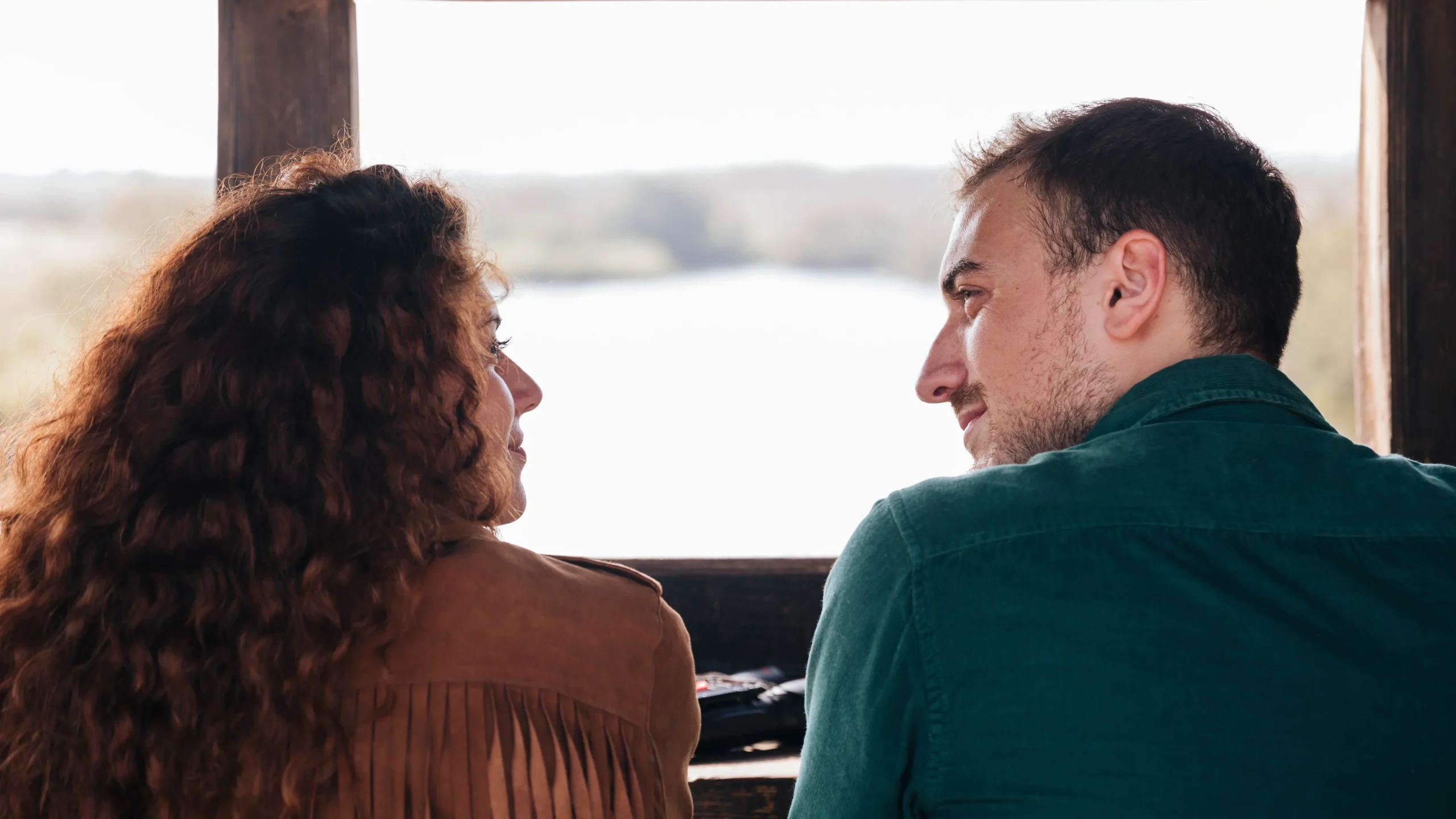
Helpful exercises:
- Active listening: One-sided conversations can encourage toxic dynamics. So practise consciously giving each other space: one of you speaks while the other listens attentively – without interrupting or reacting straight away. Then you swap. This creates mutual understanding and appreciation.
- Moments of gratitude: Constantly criticising and commenting on the other person’s weaknesses damages any relationship. Instead, consciously take time to name things you are grateful to each other for. This shifts your focus away from conflict and towards the positive experiences in your relationship.
- Breathing exercises together: Sit quietly for a few minutes and breathe in and out consciously – together. This simple exercise helps you reduce stress, calm down and approach conflicts with more clarity and composure.
Test: Am I toxic myself?
Frequent conflicts or difficulties in relationships can be a sign that you yourself are part of the problem. – Dirk Stemper
We often overlook our own toxic tendencies – precisely because toxic people are masters at turning the tables and casting themselves as the victim. Do you recognise yourself? Or has someone ever told you that you are toxic?
Then now is the right moment for a self-test:
Criticism
a) Do you give constructive criticism and support others?
b) Do you tend to criticise others all the time?
c) Do you often react defensively to criticism?
Control
a) Do you respect other people’s freedom?
b) Do you try to control other people’s behaviour?
c) Does your controlling behaviour lead to tension in relationships?
Dealing with conflict
a) Do you look for solutions to conflicts?
b) Do you ignore or avoid conflicts?
c) Do conflicts often escalate because of your reactions?
Empathy
a) Do you show compassion and understand other people’s perspectives?
b) Do you find it hard to put yourself in other people’s shoes emotionally?
c) Do you show little empathy and take hardly any interest in other people’s feelings?
Taking responsibility
a) Do you take responsibility for your actions?
b) Do you often shift the blame onto others or onto external circumstances?
c) Do you often refuse to take responsibility?
Boundaries
a) Do you respect other people’s personal boundaries?
b) Do you sometimes overstep other people’s boundaries?
c) Do you often ignore agreed boundaries?
Jealousy
a) Does jealousy play little role in your relationships?
b) Do you tend to be jealous without any concrete reason?
c) Are you excessively jealous and constantly checking up on the other person?
Give and take
a) Is there a balanced exchange in your relationships?
b) Do you often expect more than you give back?
c) Do you give only conditionally and always attach expectations to your giving?
Communication style
a) Do you communicate clearly and respectfully?
b) Can your communication style be aggressive or passive-aggressive?
c) Do you use communication to manipulate others?
Self-reflection
a) Are you open to self-reflection and change?
b) Do you find it hard to admit your own mistakes?
c) Do you refuse to acknowledge your negative behaviour patterns?
Results: If the questions you answered ‘yes’ to are
- mostly ‘a’: Your behaviour shows healthy self-reflection and respect for others.
- mostly ‘b’: There may be toxic patterns present. It is advisable to reflect on yourself more closely.
- mostly ‘c’: Your behaviour shows clear signs of toxicity.
Conclusion
I hope this article helps you to recognise toxic relationships more easily, to deal with them in a healthier way with the help of mindfulness – or perhaps to realise that you yourself may be showing toxic sides.
Finally, I would like to add: if the dynamic of a relationship develops into psychological abuse, bullying or blackmail, self-help is not enough. In such cases, you should not hesitate to seek professional support – whether through counselling services, coaching or emotion-focused therapy.
Stay mindful, protect your boundaries and your mental health. Feel free to share your thoughts on this topic in the comments or on Instagram.
Da-Yong K. (psychology student)
Deepen your meditation practice with Mindfulife
Meditation can be more than a short break in your everyday life. If you would like to understand more deeply how meditation works, how to build a steady practice of your own and how to guide others mindfully, our meditation teacher training is the next step. There you will not only get to know meditation in theory, but also develop more confidence, clarity and trust in your own practice.
Would you like to find out more about the training first? In our weekly webinar you will get an insight and learn more about what your path to becoming a meditation teacher could look like.
For regular support in your everyday life, you can also use our online meditation studio and join guided meditations flexibly via Eversports.
We look forward to accompanying you on your journey.
You can find more mindfulness inspiration on our channels too
References
Lembke, L. (2022). Toxische Beziehungen erkennen: Wie du von der emotionalen Abhängigkeit wegkommst und den Schmerz nach dem emotionalen Missbrauch lindern kannst (2. Aufl.). Selbstverlag.
Möbius, V. (2023). Detox your life! Welche Menschen du in deinem Umfeld haben willst – und welche nicht! GABAL Verlag. https://doi.org/10.15358/9783967402650
Voigt, D. (2024). Toxische Menschen und ihre Opfer. In Gesunder Umgang mit toxischen Menschen für Dummies (S. 25–44). Wiley-VCH. https://d-nb.info/1252661002/34
Wagner, E. (2024). Bin ich toxisch? Machen Sie hier den Test.
Hamburger Abendblatt. Zuletzt abgerufen am 9. September 2025 von https://www.abendblatt.de/ratgeber-wissen/article406809821/toxische-beziehung-test-bin-ich-toxisch.html
Wagner, E. (2025). Toxische Menschen erkennen? Experte nennt „Alarmsignale“. Berliner Morgenpost. Zuletzt abgerufen am 9. September 2025 von https://www.morgenpost.de/ratgeber-wissen/article405762715/toxische-menschen-verhalten-beziehung-erkennen-anzeichen-signale.html