Narcissists in My Life – How Can I Recognise Them?
These days, people are quickly labelled "narcissists", yet narcissism is a dimension of normal personality.

 · 8 min read

These days, people are quickly labelled “narcissistic”, yet narcissism is a dimension of normal personality. Only 0.4% of the world’s population – men more often than women – have a verified diagnosis of pathological narcissistic personality disorder. So how do you know whether your boss or your partner is simply self-centred and difficult, or actually a narcissist?
What characterises narcissists?
At first glance, narcissists come across as charming: they are extroverted, friendly and take good care of their appearance. They also seem self-confident and engaging. These are people who shine, who offer you a strong shoulder to lean on and who, at the beginning, give you a great deal of attention.
Most people have a certain degree of narcissistic personality traits. So what matters is not whether these traits are present, but how strongly they are expressed.
These personality traits are:
- a lack of empathy
- overestimation of oneself
- hypersensitivity to criticism
- arrogance
- mood swings – even to the point of aggression.
In her book “Eitle Liebe” (Vain Love), the psychologist Bärbel Wardetzki writes: “However, if a person’s self-love is badly damaged or undeveloped, the perfect outer façade of success, achievement, status, attractiveness and slimness serves as a substitute for a positive sense of self“.
Where does the term “narcissism” come from?

In Greek mythology, the figure of Narcissus grows up as an unloved child and is himself unable to love. At the same time, he is very handsome, vain and intoxicated by his own beauty. He rejects all his admirers. As punishment, Aphrodite condemns him to fall in love with his own reflection. As he admires himself in the water, a leaf falls in and distorts the reflection. Narcissus cannot bear his supposed ugliness – and dies.
What is narcissistic personality disorder?
Psychology distinguishes between narcissism as a healthy personality trait and pathological narcissism. When it is strongly pronounced and causes suffering for the person concerned and those around them, it becomes pathological (pathological narcissism). The transition from personality trait to disorder is fluid. Narcissism is widely discussed in society, yet the personality disorder itself has so far been little researched.
One of the world’s most famous psychotherapists and a leading expert in the field is Otto Kernberg. He regards the inability to love as a typical symptom of narcissistic personality disorder. People with the disorder need admiration, but not love. In an interview, he describes narcissism as follows: “A narcissistic disorder is a disorder of one’s appreciation of oneself and of the normal feeling of self-love and satisfaction with one’s own life. Narcissistic personalities suffer from terrible insecurity and have a deep feeling of not being recognised, of not being loved, which stems from the earliest years of life.“
The personality disorder therefore involves a pervasive pattern of grandiosity (in fantasy or behaviour), an exaggerated sense of self-worth (at least outwardly), a constant need for admiration and a lack of empathy for others.
The underlying lack of self-confidence (on the inside) is often compensated for by showing off “great” and successful deeds. People with pathological narcissism also belittle others in order to feel “bigger” themselves.
According to the Diagnostic and Statistical Manual of Mental Disorders (DSM-5), patients must meet at least five of these criteria to be diagnosed with narcissistic personality disorder:
- an exaggerated, unfounded sense of their own importance and talents (grandiosity)
- preoccupation with fantasies of unlimited success, influence, power, intelligence, beauty or ideal love
- the belief that they are special and unique and should only associate with people of the highest status
- the desire to be admired unconditionally
- exploiting others to achieve their own goals
- a lack of empathy towards others
- envy of others and the belief that others envy them, as well as arrogance
Severity is classified as mild, moderate or severe.
Otto Kernberg assumes that latently aggressive or emotionally cold parents encourage exaggerated self-presentation. Children who receive little recognition try to make up for this injury to their self-worth through special achievements (e.g. at school) in order to earn praise.
How can I recognise narcissists?
They constantly need recognition and admiration from other people. But how can psychologists find out whether someone meets the diagnostic criteria or has a narcissistic personality?
This is only possible by asking the person themselves, either in conversation (an “interview”) or through various questionnaires that have proven to be scientifically valid.
The most widely used is the NPI (Narcissistic Personality Inventory), which is also available in a German version. Here are a few sample excerpts:
| Dimension | Sample items |
| Authority | I see myself as a leader. I like giving other people instructions. |
| Arrogance and self-satisfaction | I am going to be an important person one day. I am more capable than other people. |
| Sense of superiority and uniqueness | I wish somebody would write my biography one day. I know that I am good because people keep telling me so. |
| Showing off | Modesty doesn’t suit me. I tend to show off whenever I get the chance. |
| Tendency to manipulate and exploit | I find it easy to manipulate others. I can usually talk my way out of any awkward situation. |
| Entitlement | I will never be satisfied until I get everything I deserve. If I ruled the world, it would be a much nicer place. |
| Items from the German version of the Narcissistic Personality Inventory (NPI) by Collani, 2012 | |
In its original form, this questionnaire contains 54 questions; it measures narcissism as a general personality trait and captures the personality disorder only to a lesser extent.
Typical things narcissists say
To help you spot narcissistic people in everyday life, here are some frequently used phrases:
- “Don’t be so sensitive!”
- “I never said that!”
- “You’ve only got yourself to blame!”
- “You’re just imagining it!”
- “Nothing works around here without me!”
- “I am who I am – you’ll just have to deal with it!”
- “You can never be relied on!”
Dealing with narcissists
Dealing with narcissistic people means, above all, stress. Working and living with such personalities is exhausting and marked by power struggles and manipulation. Open communication is hardly possible, because interactions are shaped not by trust, respect and appreciation, but by ruthlessness, selfishness, blame and hidden fear. In this atmosphere, lightness and creativity evaporate, and even the strongest, most self-assured personality reaches its limits.
Here are a few general tips for dealing with narcissists:
- Recognise the narcissism clearly: observe their behaviour attentively
- Withdraw from the narcissist’s presence: They create a very particular aura around themselves with their attractiveness and the way they present themselves. You should withdraw from this aura by making your own boundaries clear, standing up for your own needs and staying true to your own convictions. Always view what they say with the necessary distance and remain critical.
- Recognise the soft core: Narcissistic people lose their power when you see, behind their self-absorbed and selfish behaviour, the weak, sensitive child who longs for love and struggles inwardly with a sense of inferiority.
- Don’t try to be the narcissist’s therapist: This belongs in professional hands.
- Praise appropriately: If you don’t give narcissistic people enough praise and recognition, you will never get through to them. Withholding praise makes them irritable, nervous and angry. If you overdo the praise, they will stop taking you seriously. When dealing with narcissists, praise has to be genuine and authentic.
- Set boundaries: Make it clear and unmistakable, but not rude, that you are not prepared to go along with everything.
- You can never do right by a narcissist: Whatever you do – in their eyes you will never be better than them. So there’s no point in trying.
- Listen: Not listening to them means ignoring them – which can lead to aggression.
Relationships with narcissists
Thanks to their charm, narcissistic people seem like the perfect partner at first glance, but over time the relationship often turns into a nightmare: narcissistic people make their partners dependent on them and destroy their self-confidence by belittling them. Through their manipulative behaviour, they convince their partners that they are to blame for the problems in the relationship.
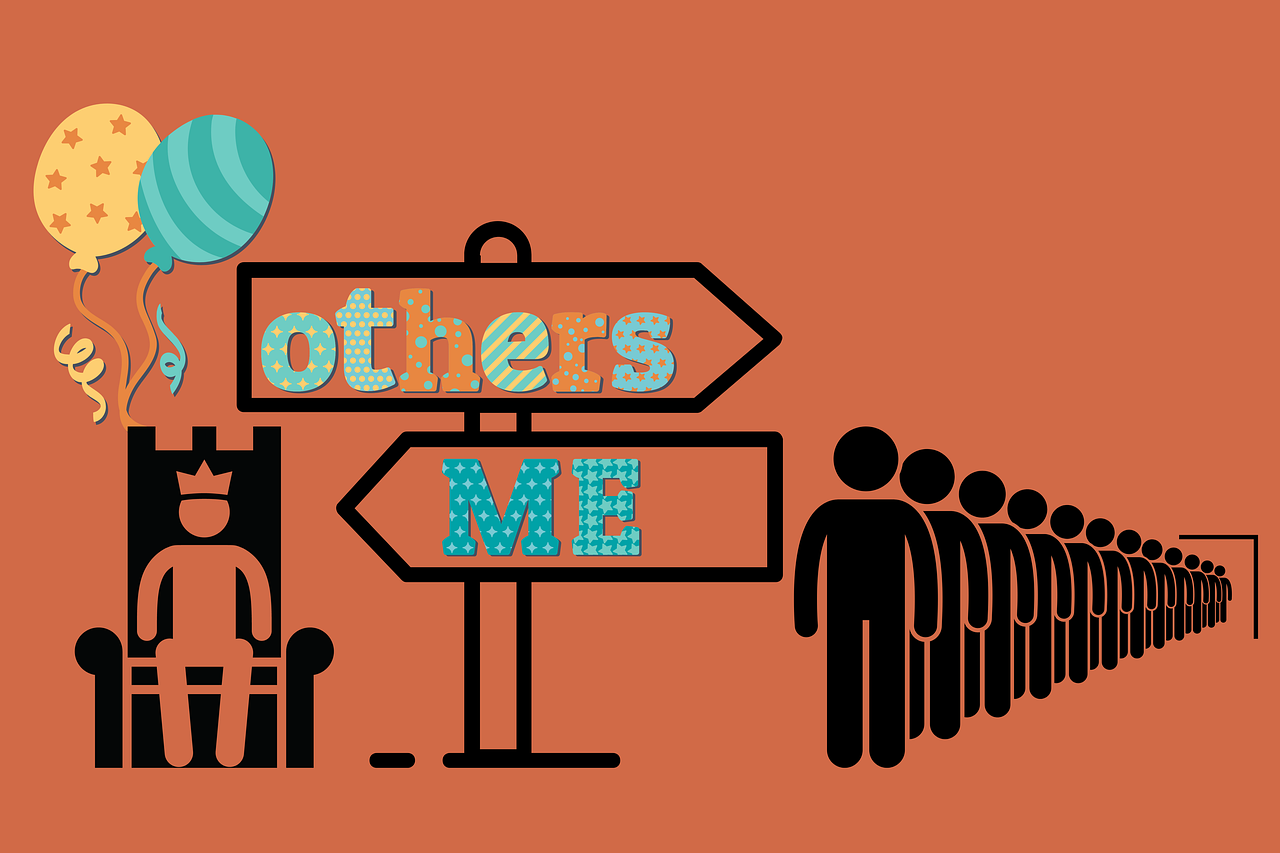
For narcissists, the world practically revolves around themselves alone. Putting themselves in other people’s shoes is not one of their strengths.
As a result, they expect their partners to fulfil their wishes and expectations. If this doesn’t happen, they feel unloved and punish their partners.
For a relationship to work, it is not only important for the narcissist to undergo therapy. Their partners should also seek professional help to learn more about how best to handle the situation.

Narcissism and break-ups
People with a narcissistic personality, let alone a personality disorder, are easily offended. Because they experience criticism as highly threatening, even small conflicts can lead to a major row. They find it very difficult to make sense of their feelings and process them appropriately. To stop their partners from seeing their vulnerability, they show anger instead of sadness or disappointment. When narcissistic people feel hurt, they respond with revenge. Their partner is then seen as an enemy whom they try to cause pain.
Separating from a narcissist is a difficult and painful process. Narcissistic people do not feel responsible for problems in the relationship. When the relationship ends, they blame their partner and do everything they can to come out of the break-up as the winner.
If you would like to read more about this particular topic, I recommend the following book:
Lara Carter, Gemeinsame Elternschaft mit einem narzisstischen Ex-Partner, Medimops, 2022.
Female narcissism
Female narcissists increasingly seek admiration and recognition in social contexts and relationships. They place great importance on being seen as attractive, desirable and successful. This craving for validation can lead them to fish for compliments more and more and to put themselves at the centre of attention.
Women lose themselves in the obsession with being thin or in the quest for the perfect selfie, so that every Insta like follows narcissistic logic.
Conclusion
Not everyone who is quickly labelled narcissistic these days is actually a narcissist or suffers from narcissistic personality disorder. However, knowing how to spot narcissists and how to deal with them is very important for your own wellbeing and lets you breathe easy again in everyday life!
If you need support in dealing with narcissists in your life, or if the strain becomes too much, it is a good idea to seek help yourself from a psychologist or psychotherapist. Your GP is usually the first port of call.
Self-help groups, crisis chats, helplines and counselling services can also offer support.
Written by Inga Gosch
Deepen your meditation practice with Mindfulife
Meditation can be more than a short break in your everyday life. If you would like to understand more deeply how meditation works, how to build a steady practice of your own and how to guide others mindfully, our meditation teacher training is the next step. There you will not only get to know meditation in theory, but also develop more confidence, clarity and trust in your own practice.
Would you like to find out more about the training first? In our weekly webinar you will get an insight and learn more about what your path to becoming a meditation teacher could look like.
For regular support in your everyday life, you can also use our online meditation studio and join guided meditations flexibly via Eversports.
We look forward to accompanying you on your journey.
You can find more mindfulness inspiration on our channels too
References
Babette Renneberg, Sabine C. Herpertz, Persönlichkeitsstörungen, Hogrefe,
Bärbel Wardetzki, Eitle Liebe- Wie narzisstische Beziehungen scheitern oder gelingen können, Kösel-Verlag, 2010
Franz J. Neyer, Jens B. Asendorpf, Psychologie der Persönlichkeit, Springer Verlag, 2024 https://doi.org/10.1007/978-3-662-67385-0
Kai Externbrink, Moritz Keil, Narzissmus, Machiavellismus und Psychopathie in Organisationen, Springer Verlag,2018
Lara Carter, Gemeinsame Elternschaft mit einem narzisstischen Ex-Partner, Amazon Fulfillment, 2021
https://www.netdoktor.de/krankheiten/narzisstische-persoenlichkeitsstoerung/
https://www.geo.de/wissen/gesundheit/der-narzisst--wie-man-ihn-erkennt-und-mit-ihm-umgeht-32963256.html