ADHD in Women: Why Is It So Often Overlooked?

 · 5 min read

ADHD in women is often recognised late – find out why the symptoms are so often overlooked, what challenges arise in everyday life and how mindfulness can help you to handle them more consciously and gain more clarity and quality of life.
What is ADHD in women – and why is it often overlooked?
ADHD (attention deficit hyperactivity disorder) is often associated with restless children. Perhaps a particular image springs to mind straight away: loud, impulsive, constantly on the move. But in many women, ADHD looks quite different – quieter, more subtle and often directed inwards. That is precisely why it frequently goes unrecognised for a long time.
Many women only receive their diagnosis in adulthood. This is often preceded by a long journey marked by self-doubt and the feeling of somehow being ‘different’. This article aims to help you understand ADHD in women better and, at the same time, to find a mindful way of relating to yourself.
How does ADHD show up in women’s everyday lives?
The symptoms of ADHD can vary greatly. In women, however, the classic hyperactive behaviours (e.g. an excessive urge to move) are often less prominent; inner processes tend to take centre stage instead. Perhaps you know the feeling of appearing calm on the outside while there is constant movement going on inside you.
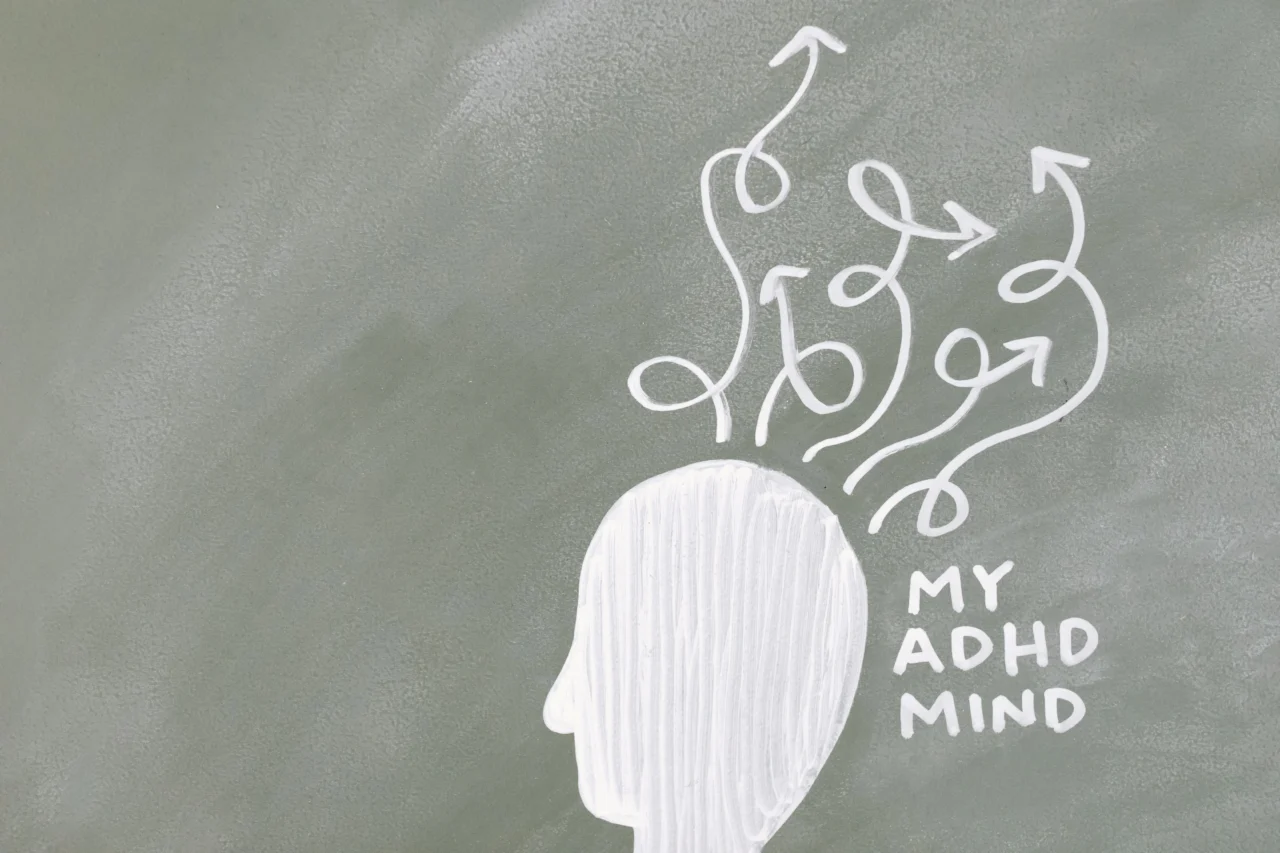
Many women report a persistent inner restlessness that is hard to pin down. Thoughts jump from one topic to the next, tasks are left undone or feel overwhelming. At the same time, there can be a strong emotional intensity – joy and enthusiasm, but also frustration or feeling overwhelmed, are often experienced especially intensely.
On top of this, there is often perfectionism and self-doubt. You go to great lengths to do everything ‘right’ and still feel that you are not good enough. Research shows that women more frequently have the inattentive form of ADHD, in which exactly these kinds of inner processes are at the forefront.

Why is ADHD in women so often recognised late?
A key reason lies in society’s expectations of women. From an early age, many girls learn to fit in, to be quiet and to meet expectations. As a result, they develop strategies to hide their difficulties.
Perhaps you have learned to come across as particularly organised, even though it costs you a great deal of energy. Or you make an above-average effort just to cope with everyday life. This so-called ‘masking’ means that ADHD can go undetected for a long time.
In addition, ADHD in women is often confused with other conditions, such as anxiety disorders or depression. Studies show that, on average, women are diagnosed considerably later than men. This can mean that many years go by in which you question yourself instead of recognising the actual cause.
What impact can ADHD have on your life?
ADHD affects many areas of your life – sometimes obviously, sometimes very subtly. In everyday life, it can feel as though you are constantly playing catch-up. Starting things is hard, and finishing them is often even harder.
ADHD can also play a role in relationships. Your emotional depth can be a great strength, but it can also lead to misunderstandings when feelings quickly become intense. Perhaps you know the feeling of quickly becoming overwhelmed or of not being able to regulate yourself well.
Your self-image is often especially affected. Over time, many women with ADHD come to believe that there is something ‘wrong’ with them. Yet it is important to understand this: ADHD is not a weakness. It is a different way of processing information and perceiving the world.

What happens in the brain with ADHD?
Among other things, ADHD is linked to an altered regulation of messenger substances in the brain, particularly dopamine. This substance plays an important role in motivation, attention and the sense of reward.
This can mean that things that genuinely interest you completely captivate you. At the same time, tasks that offer little stimulation feel extremely exhausting or even paralysing. Researchers therefore describe ADHD not simply as a deficit of attention, but rather as a difficulty in consciously directing attention.
How can mindfulness support you in dealing with ADHD?
Especially when your thoughts often wander or your feelings are intense, mindfulness can be a valuable anchor. Mindfulness means consciously perceiving the present moment without judging yourself.
That sounds simple, but it is a profound practice. Studies show that mindfulness can help to stabilise attention, regulate emotional reactions better and reduce stress.
The breath is particularly helpful here. It is always there and can bring you back to the here and now at any moment. You do not have to change anything or achieve anything – just notice. When your thoughts wander, you gently return. It is precisely in this returning that the real practice lies.

How can you bring more mindfulness into your everyday life?
Mindfulness does not have to be complicated. Especially with ADHD, it can be light and suited to everyday life. Perhaps you could start by consciously taking a moment each day to pause. You feel your breath, your body, or notice what is happening around you right now.
Small rituals can help too. The first sip of coffee in the morning, a short walk or breathing consciously before an appointment – all of these are ways to reconnect with yourself again and again.
What matters here: it is not about being perfect or calming your mind completely. It is about coming back again and again – to yourself.
Conclusion: How do you find your own way with ADHD?
ADHD in women is often invisible, but its effects are real. If you recognise yourself in this article, that can be a first step towards understanding yourself better – and perhaps also treating yourself a little more kindly.
Mindfulness offers you the opportunity to create a counterbalance to inner restlessness. Your breath can become a reliable anchor that brings you back to the here and now again and again.
You do not have to walk your path perfectly. It is enough to walk it consciously – step by step, breath by breath.
Thomas M. (Business Psychologist BSc/MBA)
If you would like to explore neurodivergent experiences in more depth, our article on neurodiversity and neurodivergence offers further information on how differently people think, feel and perceive the world. ADHD is one of many forms of neurodivergent perception.
Deepen your meditation practice with Mindfulife
Meditation can be more than a short break in your everyday life. If you would like to understand more deeply how meditation works, how to build a steady practice of your own and how to guide others mindfully, our meditation teacher training is the next step. There you will not only get to know meditation in theory, but also develop more confidence, clarity and trust in your own practice.
Would you like to find out more about the training first? In our weekly webinar you will get an insight and learn more about what your path to becoming a meditation teacher could look like.
For regular support in your everyday life, you can also use our online meditation studio and join guided meditations flexibly via Eversports.
We look forward to accompanying you on your journey.
You can find more mindfulness inspiration on our channels too
References
Barkley, R. A. (2015). Attention-deficit hyperactivity disorder: A handbook for diagnosis and treatment. Guilford Press.
Mowlem, F. D., Rosenqvist, M. A., Martin, J., Lichtenstein, P., Asherson, P., & Larsson, H. (2019). Sex differences in predicting ADHD clinical diagnosis and pharmacological treatment. European Child & Adolescent Psychiatry, 28(4), 481–489. https://doi.org/10.1007/s00787-018-1211-3
Quinn, P. O., & Madhoo, M. (2014). A review of attention-deficit/hyperactivity disorder in women and girls. Primary Care Companion for CNS Disorders, 16(3). https://doi.org/10.4088/PCC.13r01596
Zylowska, L., Smalley, S. L., & Schwartz, J. M. (2008). Mindfulness meditation training in adults and adolescents with ADHD. Journal of Attention Disorders, 11(6), 737–746. https://doi.org/10.1177/1087054707308502