How can you strengthen your resilience? 5 effective tips
How do you manage to master all of life's challenges emotionally? We give you 5 effective tips on how to strengthen your resilience in a targeted way.

 · 12 min read

Throughout your life, you will repeatedly encounter things that challenge you emotionally. A heavy workload, the loss of a loved one, or the typical everyday stress of work and family, as well as financial hardship, can push your wellbeing to its limits and even trigger crises. But how can you manage to master challenges time and again and even emerge from them stronger?
To find effective strategies for coping with challenges, it is worth taking a closer look at psychological resistance, known as resilience. In this article, you will learn what exactly resilience means and what it is based on. Finally, you will receive 5 tips including exercises to help you go through life with more inner strength and confidence.
What is resilience?
The term “resilience” comes from materials science. A material is described as resilient if it returns to its original shape after being deformed by extreme stress. A rubber band made of natural rubber, for example, is extremely resilient: up to a certain point, a rubber band can be stretched very far without snapping, and afterwards it returns to its original shape.
Similarly to this principle, psychology uses the term resilience to describe a person’s psychological resistance. Psychological resistance refers to a person’s ability to withstand stress and crises without developing lasting damage to body and mind. So if, from a psychological perspective, you have high resilience, you do not break down in the face of stressful events such as losing your job or the end of a relationship – instead, you manage to process such events well, learn from them and grow from them in the long term. Highly resilient people therefore have a good capacity for psychological recovery, which brings them back to a restored baseline after a period of strain.
What makes up resilience?
Adaptability plays a particularly important role in resilience: the American Psychological Association describes resilience as “the process and outcome of successfully adapting to difficult or challenging life experiences, especially through mental, emotional, and behavioral flexibility and adjustment to external and internal demands”. Resilience is therefore, above all, active and flexible action in a problematic situation with the aim of warding off dangers that could permanently impair one’s health.
Exactly how a person’s capacity for resilience develops cannot be described precisely. On the one hand, we know that a very complex interplay of biological, genetic and social factors (so-called resilience factors) plays a decisive role. On the other hand, the capacity for resilience is definitely not a fixed trait that is given from the outset – it also depends to a considerable extent on how you are feeling on a particular day. In addition, resilience is very difficult to measure and assess. Certain factors that promote resilience, such as a stable social environment, do not automatically protect a person from a deep crisis if that person has not learned good coping strategies.

How do highly resilient people differ from less resilient people?
If you have high resilience, you do not become defensive when faced with challenges. You actively confront your problems and have resources and strategies (so-called resilience mechanisms) to deal with them calmly and in a solution-focused way. For you, disappointments and failed efforts are primarily an opportunity to learn from experience and develop further. You do not let problems discourage you and you are confident that your situation will improve one day. Drive, a focus on solutions and optimism are therefore some of the key qualities you have as a highly resilient person, and they give you a great deal of inner strength.
If you have low resilience, on the other hand, you become overwhelmed much more quickly under pressure and can almost fall into a kind of ‘inner’ helplessness. You experience stressful events as crushing and find few ways of helping yourself. As a result, stress can become your constant companion, which in the long run can lead to further strain in the form of physical and mental illnesses, such as cardiovascular disease, depression or anxiety disorders.
The 7 pillars of resilience according to Ursula Nuber
Psychological research has developed numerous models to explain which factors strengthen or weaken resilience. Nevertheless, many resilience trainers prefer to work with a well-known model by the psychologist Ursula Nuber. According to Ursula Nuber, high resilience is a kind of foundation that rests on seven pillars.
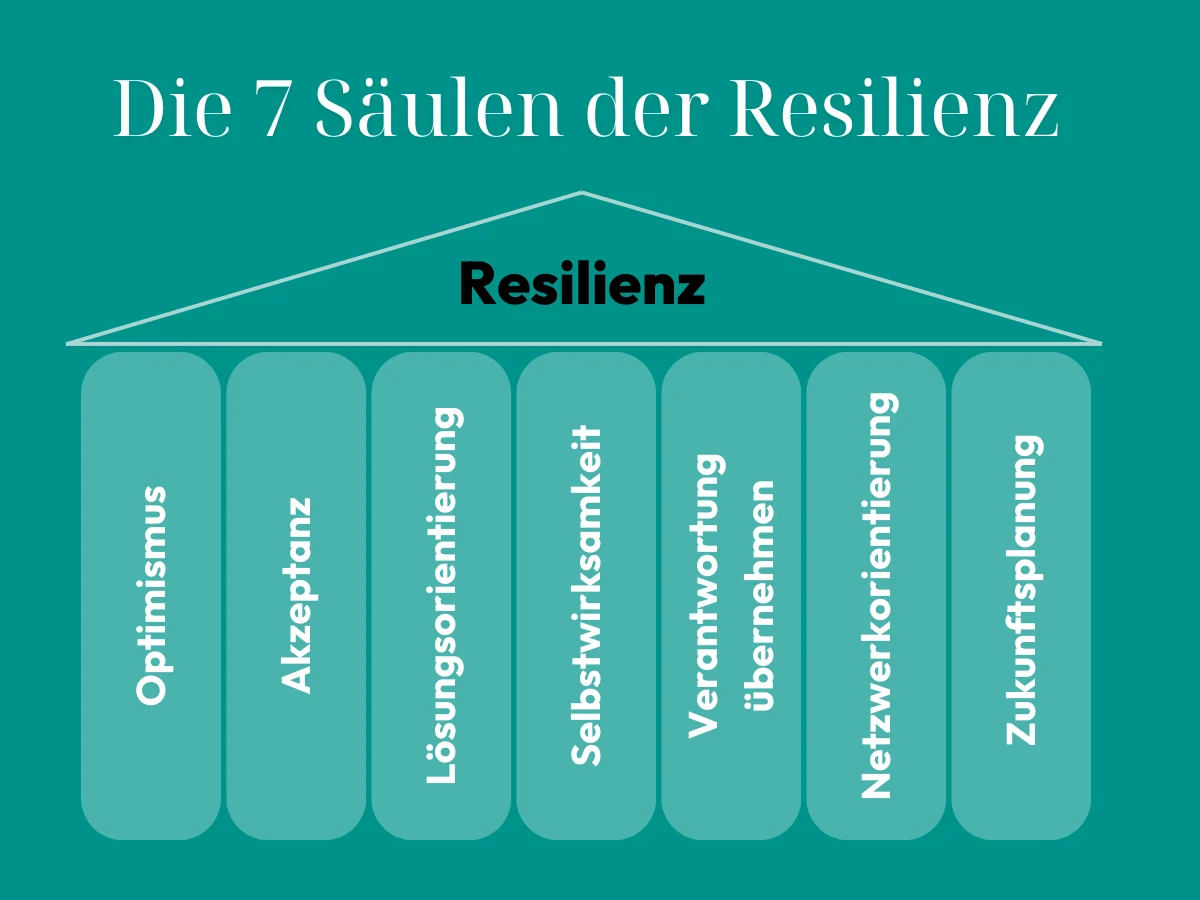
Pillar 1: Optimism
People who think optimistically are more resilient. This does not mean, however, that optimistic people dance through life wearing rose-tinted glasses and simply ignore all the difficulties in their lives. Rather, they live a realistic optimism that focuses more on opportunities and potential than on possible setbacks. Optimistic people are confident that they will solve their problems sooner or later. This also helps them approach problems with greater calm.
Pillar 2: Acceptance
Resilient people focus on things they can actively influence. When their workload is high, they try, where possible, to hand over part of the work to others and are also willing to say ‘no’ to things they no longer have the capacity for. They calmly accept facts that cannot be changed, such as a rejected job application, and find ways to keep applying for jobs with motivation.
Pillar 3: Solution focus
Resilient people have a strong focus on solutions when facing problems. They concentrate less on what exactly is going wrong and who is to blame for a problem. Instead, they actively look for possible solutions and put them into practice. True to the motto: “Problems are there to be solved”.
Pillar 4: Self-efficacy
A strong belief in oneself and one’s own abilities is an important aspect of resilient people. They are convinced that, by taking action, they can help to overcome all of life’s challenges. They do not cave in when faced with a problem and do not see themselves as passive victims of their circumstances.
Pillar 5: Taking responsibility
Resilient people have a strong sense of personal responsibility. They take care of themselves, for example by actively communicating personal boundaries and openly expressing their needs. If self-inflicted mistakes are part of a problem, they reflect on them and learn from them.
Pillar 6: Network orientation
A stable social network that catches and supports you in difficult times is important for maintaining resilience. Resilient people consciously cultivate good social contacts and therefore experience less loneliness. Thanks to the pleasant feeling of connectedness, they know that they can get help and support when they need it.
Pillar 7: Planning for the future
Resilient people focus less on past mistakes and look to the future with confidence. Despite setbacks, they do not let themselves be discouraged and set goals for their future, which they pursue with motivation.
5 tips and exercises to strengthen your resilience
The good news is: resilience is not a purely innate ability! Resilience can actually be trained. Even if you tend to react sensitively to stress and are quicker to feel discouraged by setbacks, there is a whole range of methods and strategies that can help you effectively strengthen your psychological resistance. The important thing is that you work on your resilience training regularly, as only continuous practice can bring about lasting positive change.
The following 5 tips contain reflection questions and practical exercises so that you can start your resilience training straight away.
1. Uncover negative thought patterns and change your perspective
It is often dysfunctional patterns of thinking and evaluating that make a problem seem so problematic in the first place. They can limit our ability to act and make it harder for us to deal with a problem successfully. In this exercise, you reflect on your current perspective on challenging events and develop a new attitude towards them.
Reflection questions: How do I generally deal with problems? What exactly makes certain problems so unpleasant and difficult for me? Which ways of thinking could help me cope better with problems?
- Go through the reflection questions and write down your thoughts on them. Be completely honest with yourself: do you perhaps recognise dysfunctional thought patterns in yourself, such as “I always get everything wrong”? Then find something that regularly reminds you to question and dissolve these dysfunctional thought patterns. For example, write “Everyone makes mistakes, not just me!” in large letters on a piece of paper and hang it up somewhere clearly visible.
- Consciously direct your attention towards the solution and a little less towards analysing the problem. Then work out possible solution strategies step by step. A mind map can be helpful for keeping an overview.
- Remind yourself that problems and challenges are always also a great opportunity for personal growth. After all, you can learn a lot from them and will be better prepared for similar situations in the future. From now on, stop calling a problem a “problem” and call it an “opportunity” instead.
- Remind yourself that problems are dynamic developments. They are not set in stone; they change constantly and may one day disappear altogether. Practise calmness by reminding yourself more often that problems will one day disappear or at least become smaller.

2. Develop more mindful stress management
Challenges and problems can create a lot of stress for body and mind. Anyone who struggles with stress over long periods greatly reduces their general wellbeing and increases their risk of illness. With this exercise, you reflect on how you deal with stress and look for ways to keep your stress levels as low as possible.
Reflection questions: What is stressing me at the moment? What can I do to experience less stress? Which techniques and strategies could help me with this?
- Identify all the stressful things in your everyday life that you could avoid entirely. Say ‘no’ more often to things you do not necessarily have to take care of.
- Set aside at least 30 minutes every day for relaxation techniques such as progressive muscle relaxation or breathing exercises.
- Spend more time on mindfulness and meditation. Mindful awareness of your body and your thoughts is very effective for focusing more on your personal wellbeing and relaxing. There are various ways in which you can even integrate meditation into everyday life.
- Make a conscious effort to treat yourself more often. Do you love cooking and really enjoy a good dinner? Or are you passionate about sport? Try to build activities that do you good into your everyday life as often as possible. You might also like to draw up a weekly plan so that you can set aside enough time for them.

3. Actively build your network
You do not have to get through problems entirely on your own. There are surely people in your life who would be glad to support you. Have the courage to actively ask for help. A social network fosters a reassuring sense of connectedness and can be your lifeline in crucial situations in life. In this exercise, you reflect on your current social network and consider how you can expand it further.
Reflection questions: Who can support me in difficult times, and how? Is there anyone who is not good for me at all? What professional support services are available?
- Think about which people in your life you trust the most. Spend time with them more regularly, as they can give you a lot of strength. Talk to them about what is going on inside you. Also seek out people who have particular resources that can help you with a specific problem.
- Identify people in your life who are less good for you. Try either to keep contact with such people to a minimum or even to end it.
- If necessary, seek professional help from psychotherapists or counselling services. Self-help groups and online communities can also provide good emotional support.

4. Boost your self-confidence
Over the course of our lives, we experience a lot of personal criticism. As a result, we often focus too much on our weaknesses and quickly become unsure of our abilities. From now on, your strengths should take centre stage. This boosts your self-confidence and your courage to face challenges again and again. In this exercise, you reflect on your self-perception and build a more positive self-image.
Reflection questions: What self-image do I have? How do others see me? What are my valuable resources? Which of these resources even help me to get through crises better?
- Look at yourself in the mirror and ask yourself how you generally see yourself. Think about which of your qualities you would like to develop so that you can become more of the person you want to be. But also make sure you are aware of your strengths, because they are important resources for you. What are you particularly good at?
- Use affirmations to gradually replace negative thought patterns with positive ones.
- Write down your greatest personal achievements. They show you that you are capable of great things.
- Ask the people closest to you to name positive qualities they see and value in you. Collect all these qualities. You might even be pleasantly surprised – perhaps your friends think you are braver than you would give yourself credit for.

5. Think about a future that motivates you
Personal wishes and goals provide orientation and meaning in life. In difficult times, they remind us why we get up every day and stand up for ourselves. In this way, they can become real fuel for our motivation. When we are determined to achieve our goals, we do not settle for setbacks and find a way to keep moving forward. Goals and wishes therefore strengthen your will to actively master challenges. In this final exercise, you look at your small and big goals and wishes in life.
Reflection questions: What would I like to achieve in the next 5-10 years? What are my deepest heartfelt wishes? Who can help me achieve these goals?
- Make lists of goals and wishes for different time frames (for example, goals and wishes for the current month, for the whole year, for the next 5 years, etc.). Which of these goals and wishes could you perhaps move a step closer to today? Picture a motivating future in your mind and draw up a master plan for fulfilling your wishes. Perhaps you even know someone who has a similar goal or who has already achieved one of your goals? Be sure to talk to them and gather valuable input.
- Think about which values drive you in life and could give you a certain amount of motivation even in difficult times. These values often also shape your individual wishes and goals. Are you perhaps someone with a strong sense of justice? Stand by your values and defend them at times when you are treated unfairly.
- Create a vision board that illustrates your exciting visions of the future. You will find plenty of templates and inspiration online. Feel free to let your creativity run wild – it can be a lot of fun!

Conclusion
Although the capacity for resilience is linked to personal predispositions to a certain extent, it can definitely be actively developed and strengthened. There are many different ways of achieving this. If, above all, you are open to a change of perspective, develop a more positive self-image and regulate your stress more mindfully, you will already have taken a few big steps towards greater resilience. The important thing is to keep practising and stick with it – then one day you, too, will be able to stand firm like a rock amid the crashing waves, even in the middle of a storm.
This article was written by Rebecka Endl
Deepen your meditation practice with Mindfulife
Meditation can be more than a short break in your everyday life. If you would like to understand more deeply how meditation works, how to build a steady practice of your own and how to guide others mindfully, our meditation teacher training is the next step. There you will not only get to know meditation in theory, but also develop more confidence, clarity and trust in your own practice.
Would you like to find out more about the training first? In our weekly webinar you will get an insight and learn more about what your path to becoming a meditation teacher could look like.
For regular support in your everyday life, you can also use our online meditation studio and join guided meditations flexibly via Eversports.
We look forward to accompanying you on your journey.
You can find more mindfulness inspiration on our channels too
References
APA Dictionary of Psychology (19.04.2018): Resilience. (https://dictionary.apa.org/resilience). Abgerufen am 17.08.2024.