Vipassana Meditation: The Powerful Path Through Stillness to Yourself
Vipassana meditation is one of the oldest meditation techniques, and its name means seeing things as they really are. If you would like to know exactly what lies behind it and how to bring the technique into your everyday meditation practice, read on!

 · 5 min read

Perhaps you know this feeling: your body is sitting still, but your mind is running thoughts on an endless loop. Memories. Worries. Plans.
Meditation is often described as a way of calming this inner noise. One of the oldest and at the same time most effective methods for doing so is Vipassana – a form of mindfulness meditation that has its origins in the teachings of the Buddha.
But Vipassana is far more than a spiritual practice. In recent years, science has also become increasingly interested in how this meditation can influence the body, the brain and our emotions.
In this article you will find out:
- what Vipassana meditation means
- which effects have been scientifically studied
- how it can reduce stress
- which changes in the brain have been observed
- and how you can integrate the practice into your everyday life.

What does Vipassana meditation mean?
The word Vipassana comes from Pali and roughly means ‘clear insight’ or ‘seeing things as they really are’.
At the heart of the practice is the mindful observation of your own experience. It is not about suppressing thoughts or feelings. Instead, you learn to perceive them consciously – without reacting to them straight away.
You observe:
- bodily sensations
- thoughts
- emotions
- inner impulses
and recognise that all of these experiences come and go again.
In the Buddhist tradition, Vipassana is based on three fundamental insights:
Anicca – impermanence
Everything is constantly changing.
Dukkha – dissatisfaction
Clinging to experiences creates inner stress.
Anatta – non-self
Thoughts and emotions are not a fixed identity.
These insights are not just philosophical concepts. In practice, they often show up in very concrete ways:
Anger dissolves when you observe it.
A thought loses its power when you stop feeding it.
What does science say about Vipassana?
Over the last two decades, research into mindfulness and Vipassana meditation has grown considerably.
Studies suggest that Vipassana meditation may be associated with improvements in emotional wellbeing, stress regulation and attention.
These include, among others:
- greater mindfulness
- lower perceived stress
- better emotional regulation
- enhanced cognitive functions such as attention and working memory
Several studies also report improvements in general wellbeing and self-kindness – as well as reductions in anxiety and negative affect.
Interestingly, the effects seem to be particularly strong when people meditate regularly or intensively, for example on retreats lasting several days.
How can Vipassana reduce stress?
Stress often arises because our mind reacts automatically to thoughts and emotions.
A thought pops up – and judgement, rumination or worry immediately follow.
Vipassana interrupts precisely this mechanism.
Through the practice, you learn:
- to observe thoughts instead of following them
- to notice emotions without judging them straight away
- to recognise physical stress reactions early on
Studies show that regular meditation is associated with reduced perceived stress and improved emotional regulation.
A study on meditation retreats also found moderate improvements in psychological wellbeing and in coping with stress.

What neuroscientific findings are there so far?
Vipassana is also increasingly being studied from a neuroscientific perspective.
Research shows, for example:
- Changes in brain activity:
Meditation can increase activity in the prefrontal cortex: an area associated with attention, self-regulation and decision-making. - Improved heart-brain regulation:
Studies have found links between Vipassana meditation and changes in heart rate variability (HRV), a marker of stress regulation and parasympathetic activity (the parasympathetic nervous system is responsible for rest and relaxation).
- Changes in brain networks: Some studies show increased hippocampal connectivity, which is linked to memory processes and emotional regulation.
In addition, studies report improvements in:
- attention
- cognitive flexibility
- interoception (the perception of internal bodily states)
These findings suggest that meditation is not merely a mental exercise but can also bring about measurable neurobiological changes.
What effects on emotions and wellbeing are possible?
Alongside cognitive effects, studies also show changes in emotional experience.
People who meditate often report:
- more self-compassion
- more positive affect
- less anxiety
- less rumination
How can you practise Vipassana in everyday life?
Vipassana doesn’t only have to take place on silent retreats. You can also integrate its basic principles into your everyday life.
A few simple ways to do this:
- Observing the breath
Sit down calmly and direct your attention to your breath.
Observe:
- breathing in
- breathing out
- the movement in your belly or chest
When thoughts arise, notice them and gently bring your attention back to your breath.
2. Observing bodily sensations
Direct your attention to physical sensations.
For example:
- warmth
- tingling
- tension
- pressure
You don’t have to change anything. Simply observe how sensations change and fade away again.
3. Noticing thoughts
When thoughts arise, don’t try to stop them.
Instead, you can say to yourself:
‘There is a thought.’ – Then let it drift on, like a cloud in the sky.
What challenges can arise in practice?
Meditation often sounds simple – but in practice it can be challenging.
Some typical experiences are completely normal.
Restlessness: Especially at the beginning, the mind can seem particularly busy.
This doesn’t mean that meditation isn’t working – you are simply becoming more aware of your mind.
Old emotions: Sometimes feelings that have long been suppressed come to the surface.
This, too, is part of the process.
Resistance: The mind often looks for distraction. That’s part of it.
Meditation doesn’t mean that everything becomes calm straight away – it means that you learn to deal consciously with whatever comes up.
Vipassana retreats – an intensive meditation experience
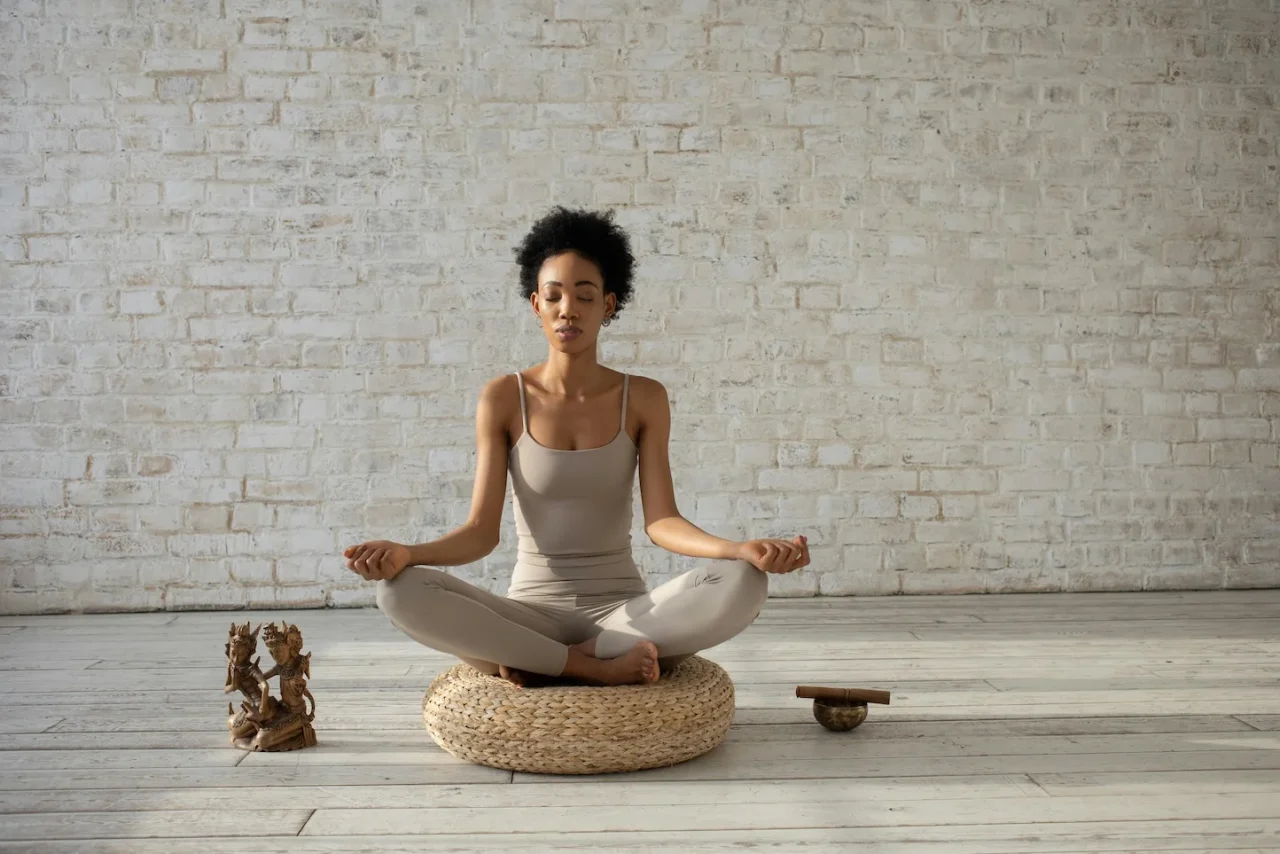
Many people learn Vipassana on meditation retreats.
A classic Vipassana retreat often lasts 10 days and includes:
- several hours of meditation a day
- a structured daily routine
- guidance from experienced teachers
After such retreats, many participants report profound insights, emotional clarity and lasting changes in the way they deal with stress.
Conclusion: The way back to yourself
Vipassana is not a technique designed to turn you into a different person.
Rather, it invites you to perceive yourself more clearly.
Thoughts.
Emotions.
Sensations.
When you learn to observe them without reacting straight away, something surprising often emerges:
more calm, more clarity and more freedom in your own mind.
Meditation won’t necessarily change the world around you. But it can change how you meet it.
Would you like to try Vipassana for yourself?
If you would like to delve deeper into the topic, why not try one of our guided meditations?
Enjoy trying it out!
revised by Miriam Sara Senf (psychology student)
on 16 March 2026
Deepen your meditation practice with Mindfulife
Meditation can be more than a short break in your everyday life. If you would like to understand more deeply how meditation works, how to build a steady practice of your own and how to guide others mindfully, our meditation teacher training is the next step. There you will not only get to know meditation in theory, but also develop more confidence, clarity and trust in your own practice.
Would you like to find out more about the training first? In our weekly webinar you will get an insight and learn more about what your path to becoming a meditation teacher could look like.
For regular support in your everyday life, you can also use our online meditation studio and join guided meditations flexibly via Eversports.
We look forward to accompanying you on your journey.
You can find more mindfulness inspiration on our channels too
References
Cahn, B. R., & Polich, J. (2008). Meditation (Vipassana) and the P3a event-related brain potential. International Journal of Psychophysiology, 72(1), 51–60. https://pmc.ncbi.nlm.nih.gov/articles/PMC2715145/
Chiesa, A., & Serretti, A. (2010). Mindfulness (Vipassana) meditation: Effects on P3b event-related potential and heart rate variability. International Journal of Psychophysiology, 76(1), 20–27. https://doi.org/10.1016/j.ijpsycho.2013.07.006
Giridharan, S. (2025). The impact of Vipassana meditation on health and well-being: A systematic review of current evidence. Cureus. https://pmc.ncbi.nlm.nih.gov/articles/PMC12558566/
Goyal, M., Singh, S., Sibinga, E. M. S., Gould, N. F., Rowland-Seymour, A., Sharma, R., Berger, Z., Sleicher, D., Maron, D. D., Shihab, H. M., Ranasinghe, P. D., Linn, S., Saha, S., Bass, E. B., & Haythornthwaite, J. A. (2014). Meditation programs for psychological stress and well-being: A systematic review and meta-analysis. JAMA Internal Medicine, 174(3), 357–368. https://jamanetwork.com/journals/jamainternalmedicine/fullarticle/1809754
Joshi, R. (2025). Vipassana meditation in educational settings for enhancing attention and academic performance: Neurological mechanisms and implementation strategies. Cogent Psychology. https://doi.org/10.1080/2331186X.2025.2563703
Kumar, R., et al. (2025). The impact of Vipassana meditation on health and well-being: A systematic review of current evidence. Cureus. https://doi.org/10.7759/cureus.93355
Montero-Marin, J., Puebla-Guedea, M., Herrera-Mercadal, P., & Cebolla, A. (2016). Psychological effects of a 1-month meditation retreat on experienced meditators: The role of non-attachment. Frontiers in Psychology, 7, 1935. https://pmc.ncbi.nlm.nih.gov/articles/PMC5149565/
Wankhade, T. (2025). Observational study on Vipassana meditation and mindfulness. https://pmc.ncbi.nlm.nih.gov/articles/PMC12424088/