Mindfulness through Shamatha Meditation: “Calm Abiding”

 · 12 min read
The beautiful term Shamatha comes from Sanskrit and translates roughly as “calm abiding”. In the Pali tradition, you will also find the spelling Samatha. Both terms refer to a meditation practice in which the mind is allowed to settle and develop stability.
At first, this may sound very simple. Yet that is exactly where the depth of this practice lies: not constantly thinking ahead, analysing or already being mentally on to the next item on your to-do list, but gently guiding the mind back to a single point.
Shamatha meditation invites you to become calmer, clearer and more present. Not through pressure. Not through self-optimisation. But through a kind and gentle training of your attention.
What is the “Shamatha Project”?
Shamatha meditation is a form of concentration meditation. At its heart is the ability to gather your attention again and again and to rest with the chosen object of meditation.
This object might be, for example, the breath, an inner image, an external object or – in more advanced practice – the mind itself. The aim is not to forcibly switch off your thoughts. Rather, it is about noticing when the mind wanders and calmly bringing it back, time and again.
This is precisely why Shamatha is often described as training the mind. You practise not getting swept away by every thought, every impulse or every distraction. Instead, over time, greater inner stability develops.
In everyday life, we are often used to constantly jumping back and forth between different tasks, roles and thoughts. One moment you are thinking about the washing machine, the next about a message, then about a conversation you still need to have. The mind is in motion, often without a break.
This is exactly where Shamatha meditation comes in. It helps you step out of this mental multitasking and anchor yourself in the present moment once again.

The pillars of meditation – Shamatha as the foundation for Vipassana
Many Buddhist traditions distinguish between Shamatha and Vipassana . The two practices are closely linked but have different areas of focus.
Shamatha means calm abiding. The practice strengthens concentration, calm and mental stability.
Vipassana means insight. Here, the emphasis is more on consciously exploring the nature of thoughts, feelings, bodily sensations and inner processes.
Put simply: Shamatha calms and stabilises the mind. Vipassana uses this stability to see more deeply.
This does not mean you first have to master Shamatha perfectly before you are allowed to explore other forms of meditation. But calmer, more stable attention can be a valuable foundation for many other mindfulness practices.
Why is “calm abiding” so challenging?
Perhaps you have tried meditating yourself and quickly noticed: the mind does not automatically become calm just because you sit down.
Thoughts arise. Sounds distract you. The body makes itself felt. Perhaps you get bored, become restless or wonder whether you are meditating “properly”.
All of this is normal.
Shamatha meditation does not mean being completely still and relaxed straight away. It means getting to know your own mind again and again. You notice how quickly it jumps around, which thoughts come up and how often you are somewhere else entirely in your head.
That is the practice. Not reaching a perfect state, but consciously returning.
Every time you notice that your mind has wandered, a moment of mindfulness arises. And every time you kindly return, you strengthen your attention.
The Shamatha Project: what was researched?
Shamatha meditation is not only a traditional practice; it has also been studied scientifically. Particularly well known is the Shamatha Project, one of the most comprehensive longitudinal research projects on intensive meditation practice. The project examined the effects of a three-month retreat at the Shambhala Mountain Center in Colorado, during which participants meditated for several hours every day.
The project was led by, among others, neuroscientist Dr. Clifford Saron and Buddhist scholar and meditation teacher Dr. B. Alan Wallace. The central question was how intensive meditation practice might affect attention, wellbeing, emotional processes and biological markers.
During the retreat, participants were assessed using a variety of methods. These included questionnaires, interviews, attention tests, physiological measurements and biological samples. Among other things, the studies looked at mindfulness, stress markers, attention, compassion and markers of cellular health.
Importantly: the findings of the Shamatha Project are exciting, but they should be interpreted with caution. They show associations and possible effects of intensive meditation practice, but they do not prove that meditation automatically triggers specific physical or psychological changes.
What did the Shamatha Project find?
Several publications from the Shamatha Project suggest that intensive meditation practice may be associated with positive changes in attention, wellbeing and mindfulness. A later follow-up study found indications that improvements in sustained attention could, in part, still be present years after the retreat.
Biological factors were also examined. One study showed, for example, that telomerase activity was higher among retreat participants than in the control group. Telomerase is an enzyme studied in connection with cell health and telomeres. However, the researchers explicitly stressed that this does not allow the conclusion that meditation directly extends life or automatically slows ageing. Rather, the findings pointed to a possible link between psychological wellbeing and biological markers.
Another study looked at mindfulness and cortisol, a hormone often considered in connection with stress processes. Here, too, the focus was not on simple promises such as “meditation always reduces stress“, but on nuanced associations between self-reported mindfulness and physiological stress markers.
Above all, then, the Shamatha Project shows one thing: intensive meditation practice can influence body, mind and perception in many different ways. At the same time, it calls for careful, scientifically rigorous interpretation.
For your personal practice, this means: you do not have to meditate in order to improve certain measurable values. You are welcome to meditate to meet yourself more consciously, to get to know your mind better and to invite more calm into your everyday life.
The nine stages of Shamatha meditation
In Buddhist meditation teachings, the path to calm abiding is often described in a series of developmental stages. A well-known illustration shows a monk, an elephant and a monkey on a winding path. The elephant represents the mind, the monkey represents distraction and restlessness. The monk symbolises the practitioner, who guides the mind step by step with attention and mindfulness.
This illustration is not meant to suggest that meditation follows a strictly linear course. Rather, it shows that inner calm is a process. Some days feel easy, others restless. Sometimes concentration comes more easily, sometimes the mind wanders constantly. That, too, is part of the practice.
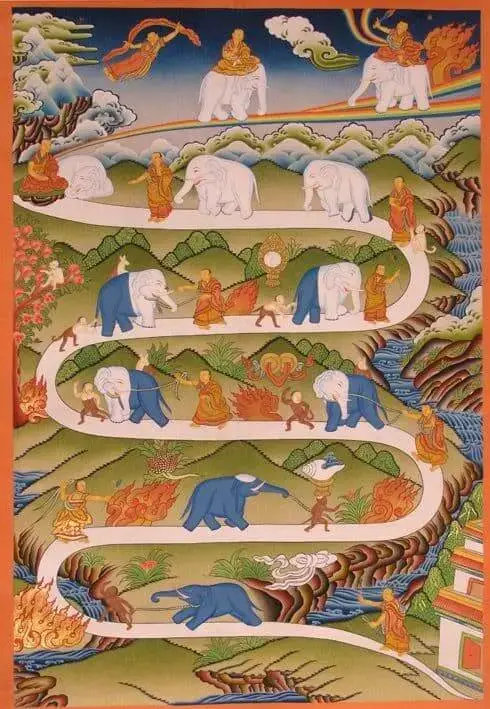
The nine stages can help you understand this path better:
1. Establishing a practice
At the beginning, it is simply about meditating regularly. You develop a routine and get your mind used to staying with the practice for a certain amount of time.
2. Gathering attention
You notice that your mind often wanders. At the same time, you are increasingly able to return to the object of meditation.
3. Recognising distractions more quickly
Thoughts, sounds or inner images no longer carry you away for quite so long. You recognise sooner when your mind has wandered.
4. Stabilising attention
Your focus becomes clearer. You can stay with the chosen object for longer, even if distractions still arise.
5. Taming dullness and restlessness
You learn to perceive subtle forms of tiredness, dullness or inner restlessness. The practice becomes more alert and more conscious.
6. Developing single-pointed attention
The mind remains increasingly collected. Distractions lose their power, and concentration becomes more stable.
7. Deepening mental calm
The practice feels calmer and more natural. You need to work less actively against distractions.
8. Experiencing physical and sensory calm
Physical restlessness may also decrease. The body may feel stiller, lighter or more relaxed.
9. Calm abiding
The mind can rest on the object of meditation with clarity and stability. Attention and calm no longer feel forced, but increasingly natural.
These stages are not performance levels that you have to reach as quickly as possible. Rather, they can serve as orientation. Meditation is not a competition. It is not about becoming “better” than others, but about getting to know your own mind more lovingly and more clearly.
How to get started with Shamatha meditation
You do not need much for your first Shamatha meditation. No special equipment, no perfect sitting posture, no incense sticks and no complicated rituals.
Above all, you need: yourself, a little time and a willingness to practise with kindness towards yourself.
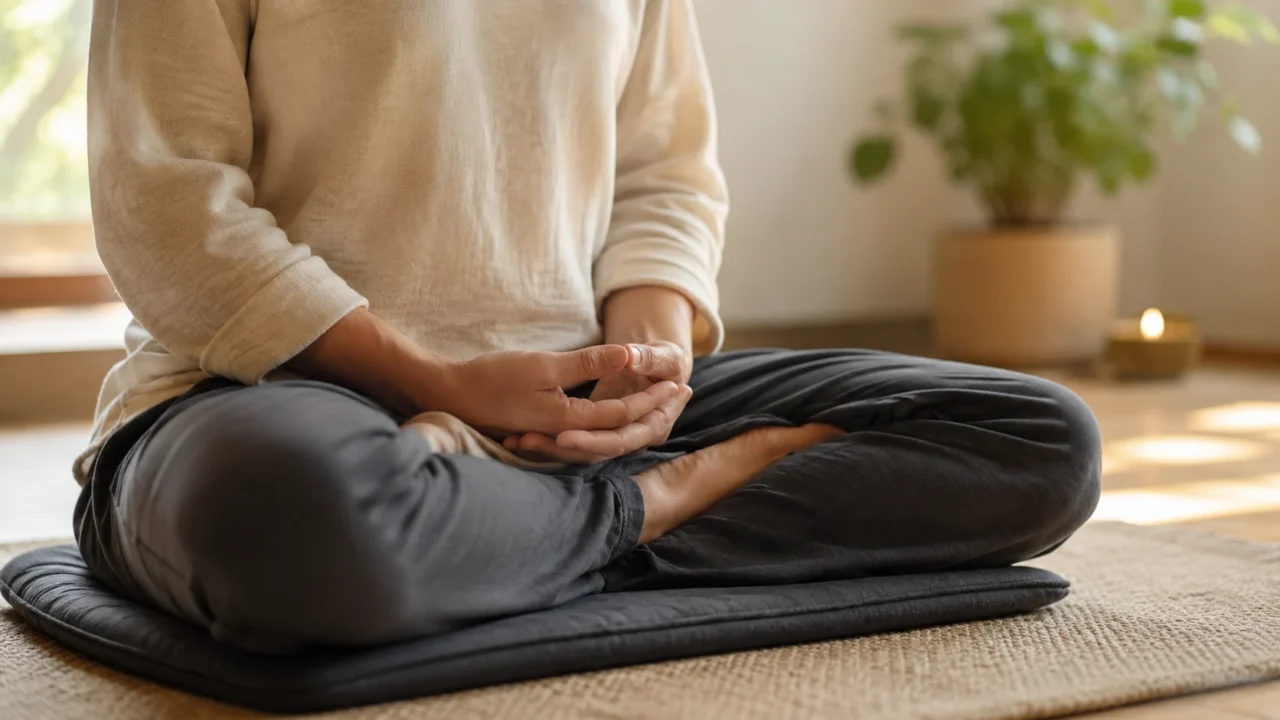
Find a quiet place where you will not be disturbed for a few minutes. Sit on a cushion, a chair or your meditation mat. What matters is not that your posture looks perfect, but that you can sit upright and, at the same time, as relaxed as possible.
Let your spine be gently upright. Your hands can rest on your knees, in your lap or wherever feels comfortable for you. If you like, close your eyes or let your gaze soften and drop downwards.
Take a few conscious breaths. Feel that you are here.
Then choose an object of meditation. The breath is particularly well suited for beginners. For example, you can observe the air flowing in and out at your nose, or how your belly gently rises and falls.
Your task is simple: keep your attention on the breath.
And if your mind wanders? Then you have not done anything wrong.
As soon as you notice that you have been lost in thought, kindly return. Not strictly. Not irritably. Not with the feeling of having failed. But as if you were gently calling back a little puppy that had briefly run off.
This very act of returning is the practice.
A simple Shamatha exercise for everyday life
You can start with this short exercise:
Sit down comfortably and upright.
Gently close your eyes or lower your gaze.
Breathe in and out deeply a few times.
Bring your attention to your breath.
Notice where you feel the breath most clearly.
Stay right there for a few breaths.
When thoughts arise, acknowledge them.
Let them drift by.
Return to the breath.
Remain seated for a moment longer before ending the exercise.
Even just a few minutes can be a good start. Especially at the beginning, it is often more helpful to practise briefly and regularly than to set yourself overly long sessions and quickly become frustrated.
You might start with three to five minutes a day. If that feels good, you can gradually extend the time.
What Shamatha meditation is not
Shamatha meditation is sometimes misunderstood. So it helps to clarify a few things.
Shamatha does not mean you are no longer allowed to have thoughts. Thoughts will continue to arise. The difference lies in how you meet them.
Nor does Shamatha mean you have to force yourself to be calm. Forced calm is often just another form of tension.
And Shamatha is not a quick fix for stress, sleep problems or inner restlessness. Meditation can support you, but it is no substitute for medical or psychotherapeutic help if you are under severe strain.
Rather, Shamatha is a practice that is allowed to take effect over time. It invites you to get to know your mind better and to relate to your inner experience with more kindness.
Mindfulness through Shamatha meditation
Shamatha meditation can strengthen your mindfulness because you repeatedly practise consciously perceiving what is happening right now.
You notice when your mind wanders.
You notice which thoughts keep coming up.
You notice how your body responds to stillness.
You notice when you become impatient.
You notice how you talk to yourself.
These observations can be valuable. After all, in everyday life we often run on autopilot. We react, plan, judge and function without ever really pausing.
Shamatha meditation creates a small space between stimulus and response. In this space, you can perceive yourself more consciously. Perhaps you notice sooner when you are overwhelmed. Perhaps you recognise when you need a break. Perhaps you realise how often you are hard on yourself inwardly.
This is exactly where Shamatha touches the core of mindfulness: you learn to be present. Not perfectly. Not always calmly. But present.
Calm abiding in everyday life
The lovely thing about Shamatha meditation is that it does not have to end on the meditation cushion.
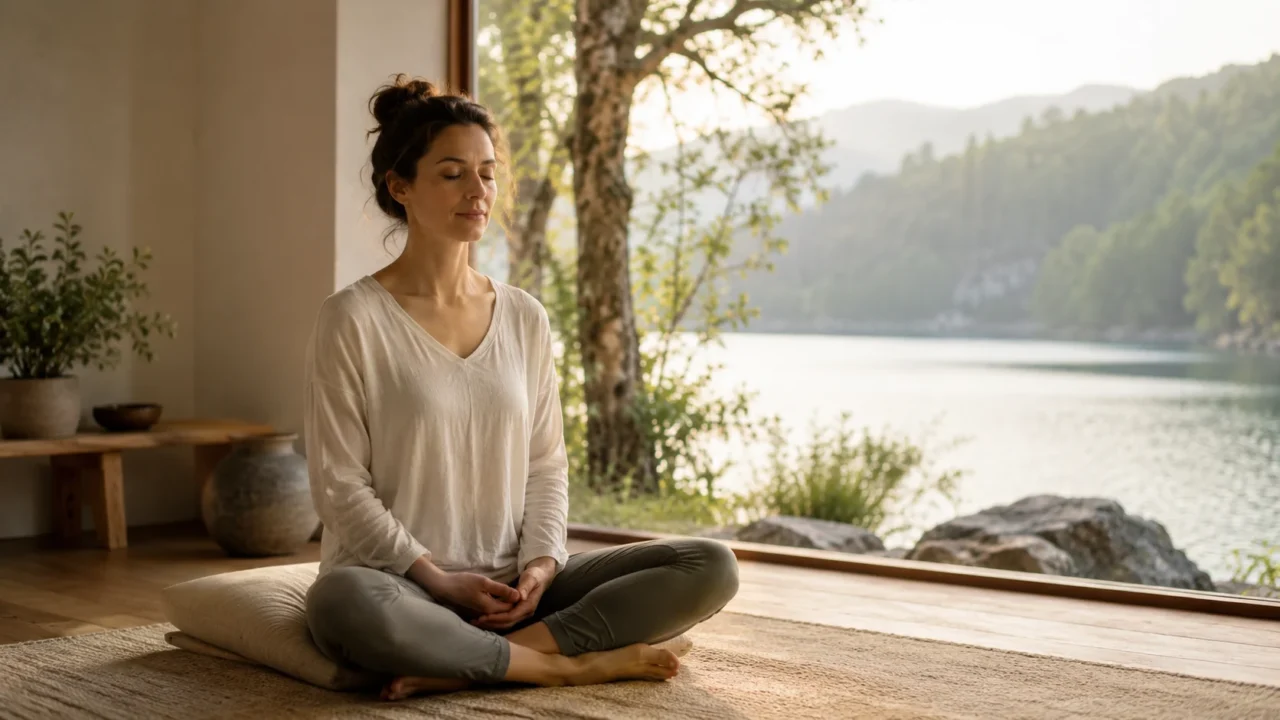
You can also practise calm abiding in small moments of your everyday life. While waiting. While drinking tea. While going for a walk. While breathing consciously before a conversation.
Perhaps you pause briefly before unlocking your phone. Perhaps you take a breath before replying to a message. Perhaps you feel your feet on the ground for a moment before heading into your next appointment.
Small moments like these will not change your whole life overnight. But they can remind you that you do not have to follow every inner impulse straight away.
You are allowed to linger.
You are allowed to breathe.
You are allowed to arrive, just for a moment.
Tips for your Shamatha practice
Start small. Three minutes a day is better than one long session you only do once.
Choose a fixed time. Many people like to meditate in the morning or evening, but what matters more is that it fits into your daily life.
Do not expect every meditation to be calm. Some sessions are restless, tired or chaotic. They are part of it too.
Be kind to yourself. If you become strict with yourself, notice that as well. Then return.
Use your breath as an anchor. It is always there and is particularly well suited for getting started.
Stay open about progress. You might notice changes quickly, or only after a longer time. Both are fine.
Learning calm abiding with Mindfulife
If you would like to delve deeper into the practice, structured guidance can be helpful. In the Mindfulife meditation teacher training, you learn through your own practice how to bring your mind to rest and how to guide meditation mindfully.
It is not about meditating perfectly straight away. Rather, you are invited to experience, step by step, how inner calm, mindfulness and self-awareness can develop.
You learn to perceive your thoughts more consciously, to be less carried away by them and to cultivate a kinder relationship with yourself.
If this interests you, you can find all the latest information right here on our meditation teacher training course page.
Conclusion: Shamatha meditation as an invitation to inner calm
Shamatha meditation means “calm abiding”. This practice invites you to gather your mind, stabilise your attention and return to the present moment again and again.
It is not about fighting your thoughts or reaching a perfect state. Rather, you learn to notice distractions, let them go and kindly return.
The Shamatha Project shows that intensive meditation practice can also display scientifically interesting associations with attention, wellbeing and biological processes. At the same time, meditation should not be seen as a miracle cure. It is a practice that can help you connect with yourself more consciously, more calmly and more clearly.
Perhaps your path to calm abiding does not begin with a long meditation, but with a single breath.
And perhaps that is already enough for today.
revised on 16 June 2026
by Katharina R. (psychology student)
Deepen your meditation practice with Mindfulife
Meditation can be more than a short break in your everyday life. If you would like to understand more deeply how meditation works, how to build a steady practice of your own and how to guide others mindfully, our meditation teacher training is the next step. There you will not only get to know meditation in theory, but also develop more confidence, clarity and trust in your own practice.
Would you like to find out more about the training first? In our weekly webinar you will get an insight and learn more about what your path to becoming a meditation teacher could look like.
For regular support in your everyday life, you can also use our online meditation studio and join guided meditations flexibly via Eversports.
We look forward to accompanying you on your journey.
You can find more mindfulness inspiration on our channels too
References
Quellen und weiterführende Links
Center for Contemplative Research. (o. D.). The Shamatha Project. Abgerufen am 16. Juni 2026, von https://centerforcontemplativeresearch.org/journal-article/the-shamatha-project-2/
Jacobs, T. L., Epel, E. S., Lin, J., Blackburn, E. H., Wolkowitz, O. M., Bridwell, D. A., Zanesco, A. P., Aichele, S. R., Sahdra, B. K., MacLean, K. A., King, B. G., Shaver, P. R., Rosenberg, E. L., Ferrer, E., Wallace, B. A., & Saron, C. D. (2011). Intensive meditation training, immune cell telomerase activity, and psychological mediators. Psychoneuroendocrinology, 36(5), 664–681. https://doi.org/10.1016/j.psyneuen.2010.09.010
Jacobs, T. L., Shaver, P. R., Epel, E. S., Zanesco, A. P., Aichele, S. R., Bridwell, D. A., Rosenberg, E. L., King, B. G., MacLean, K. A., Sahdra, B. K., Kemeny, M. E., Ferrer, E., Wallace, B. A., & Saron, C. D. (2013). Self-reported mindfulness and cortisol during a Shamatha meditation retreat. Health Psychology, 32(10), 1104–1109. https://doi.org/10.1037/a0031362
Saron Lab. (o. D.). Shamatha Project. University of California, Davis. Abgerufen am 16. Juni 2026, von https://saronlab.ucdavis.edu/shamatha-project.html
Shamatha Project. (o. D.). Publications. Abgerufen am 16. Juni 2026, von https://shamathaproject.org/publications
UC Davis. (2018, 5. April). 7-year follow-up shows lasting cognitive gains from meditation. https://www.ucdavis.edu/news/7-year-follow-shows-lasting-cognitive-gains-meditation
Yates, J., Immergut, M., & Graves, J. (2017). The mind illuminated: A complete meditation guide integrating Buddhist wisdom and brain science for greater mindfulness. Atria Books.
Zanesco, A. P., King, B. G., MacLean, K. A., & Saron, C. D. (2018). Cognitive aging and long-term maintenance of attentional improvements following meditation training. Journal of Cognitive Enhancement, 2, 259–275. https://doi.org/10.1007/s41465-018-0068-1