Self-Determination Theory: The Key to Mental Health?
Self-determination theory is a complex psychological theory about wellbeing and personal growth. Since it was formulated in the 1970s and 1980s, a great deal of research has been carried out on self-determination theory, so that today it is regarded as an evidence-based framework for understanding and changing human motivation. Read this article to find out what self-determination theory involves, where it can be applied and how it can improve your mental health too.

 · 7 min read

Self-determination theory is a complex psychological theory about wellbeing and personal growth. Since it was formulated in the 1970s and 1980s, a great deal of research has been carried out on self-determination theory, so that today it is regarded as an evidence-based framework for understanding and changing human motivation. Read this article to find out what self-determination theory involves, where it can be applied and how it can improve your mental health too.
What does self-determination theory say?
Background
Edward Deci and Richard Ryan, two professors at the University of Rochester in New York, began studying human motivation in the 1970s. Together they developed self-determination theory, which is now considered one of the most influential theories explaining human motivation and wellbeing. It is what is known as a macro-theory, one that looks at broad, overarching relationships.
Universal basic needs
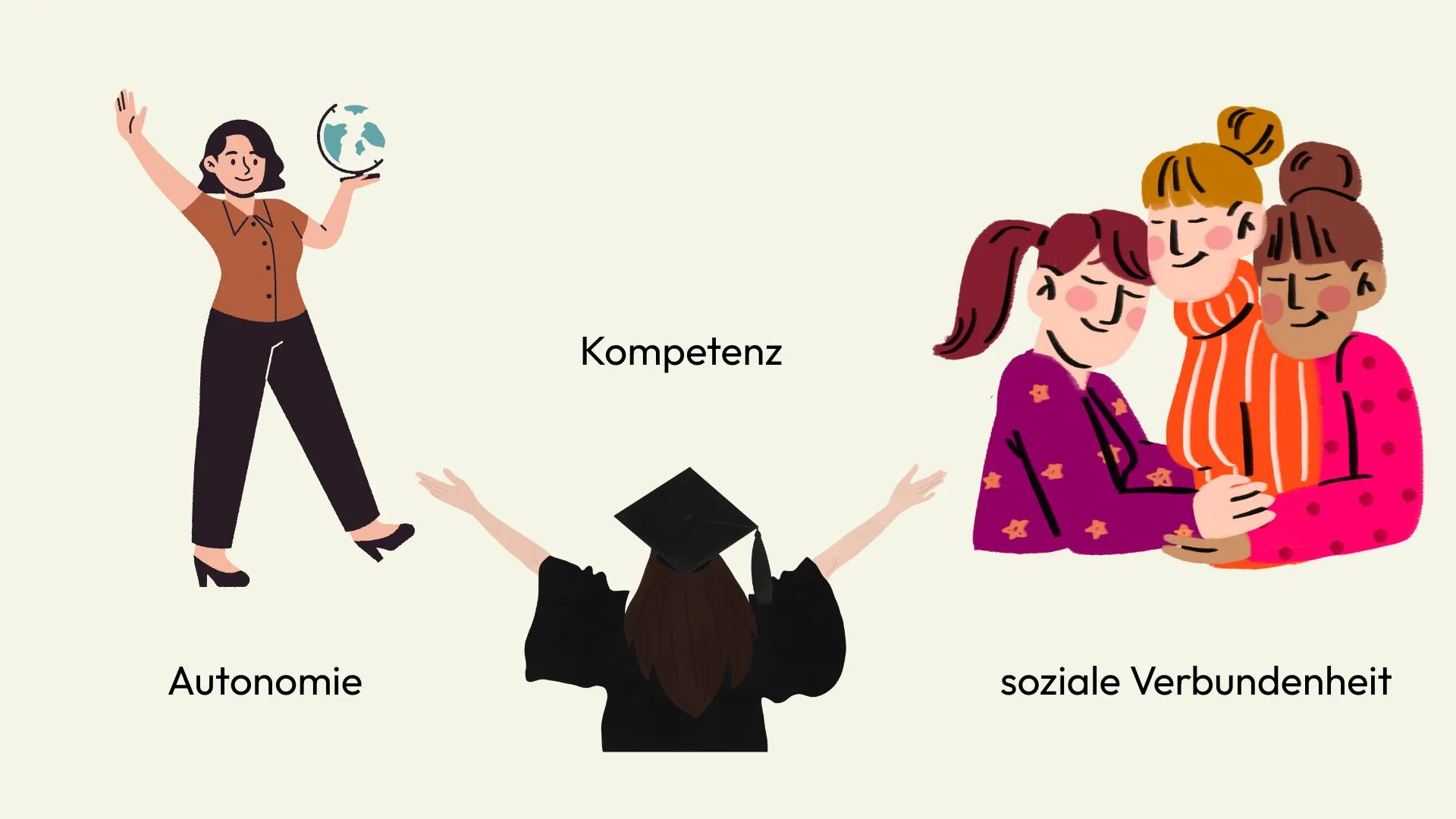
According to self-determination theory, every person has three universal basic needs. When these basic needs are met, we feel good, are more likely to reach a state of mental health and are motivated to carry out our tasks. If, on the other hand, these basic needs are frustrated, this leads to negative emotions and a loss of motivation.
Autonomy: People want to feel that they are in control of their own behaviour, that they can make decisions independently and so bring about change.
Competence: People have a need to learn new tasks and to engage effectively with their environment. This gives rise to the feeling of having the skills needed to succeed.
Relatedness: People want to feel that they belong with other people.
Forms of motivation
Self-determination theory also distinguishes between two different forms of motivation: we can be extrinsically motivated to do something. This may be for financial reasons, for example, or we may act to gain recognition or out of fear of negative consequences. If, on the other hand, we are intrinsically motivated, we pursue an activity because we enjoy it, because we consider it important or because it is interesting. In other words, we act simply because we genuinely want to.
According to self-determination theory, this is a continuum: actions are not either intrinsically or extrinsically motivated, but sit somewhere between these two poles. So almost everything we do involves a mixture: if you exercise, for example, you might do so to stay fit and healthy (to avoid negative consequences), because you want to look good (recognition from others) and also because it makes you feel good and you enjoy it (intrinsic motivation). The more your three basic needs of autonomy, competence and relatedness are met when you exercise, the more likely you are to move along the continuum towards intrinsic motivation.
Core assumptions of self-determination theory
Building on the definitions above, self-determination theory makes two fundamental assumptions:
- People have an innate tendency towards growth: we are naturally motivated to improve and develop (rather than simply survive).
- Self-determination matters: motivation that arises intrinsically through the fulfilment of basic needs is more sustainable and leads to greater wellbeing than extrinsic motivation.
Do people differ in how self-determined they are?

As already described, the three basic needs are present in every one of us. According to Ryan and Deci, however, there are individual differences that mean our basic needs are met to different degrees, for example because we perceive and interpret situations in different ways. Ryan and Deci define three different orientations:
- Autonomy orientation
People have a strong autonomy orientation if they enjoy activities that offer them plenty of choice. Controlled activities feel unpleasant to them.
- Controlled orientation
People with a strong controlled orientation feel controlled and constrained in what they do. They work because they feel they have to fulfil a task, and they are often under pressure.
- Impersonal orientation
People with a strong impersonal orientation feel incompetent and unable to cope with their tasks. They are anxious about new situations and feel they have little control over their behaviour. To them, the outcome of a task seems largely beyond their influence.
According to self-determination theory, all three orientations are also present in each of us to a certain extent, but each is more or less pronounced.
Does self-determination theory stand up to scientific scrutiny?
Because of the great influence self-determination theory has had on the psychological understanding of human motivation, a large body of research has examined and tested individual aspects of the theory. This research has looked at a range of areas, from parenting and education to the workplace.

In 2015, researchers at the University of Texas reviewed the existing research on parenting in a meta-analysis. Across 36 studies, the scientists found that children raised with an autonomy-supportive parenting style showed better academic results and psychosocial functioning, such as autonomous motivation, psychological health, perceived competence, engagement and a positive attitude towards school. The strongest effects were found for psychological health.
Another meta-analysis from 2024 reaches a similar conclusion for the school context: here too, across 90 different studies, meeting the basic need for autonomy led to improved wellbeing and fewer mental illnesses. Similar effects are also found in the world of work: intrinsically motivated employees not only enjoy greater wellbeing, but also perform better.
Overall, the core tenets of self-determination theory can be considered scientifically confirmed. When the three basic needs for autonomy, competence and relatedness are met, people are more satisfied, learn better, perform better and are more likely to stay mentally healthy.
So what does self-determination theory have to do with you?
Now that you have read all the scientific findings on self-determination theory, you can perhaps easily imagine that Ryan and Deci were not far off the mark with their theory of human motivation. But perhaps you are not quite sure what all this has to do with your life, or what you can take from this theory into your everyday life?
As explained above, whether the three basic needs are met and how self-determined we feel in a situation depends on our individual orientation. The same situation may feel self-determined to one person, while someone else experiences the opposite. Take a setback at work, for example: you can acknowledge your mistake, convinced that you can learn from it, improve and take action. You experience the situation as self-determined and within your control, and so you are motivated to do something.

But you can also perceive the situation quite differently: instead of looking for your own mistake and seeing it as an opportunity, you focus on external factors that are to blame for the setback. You do not feel motivated to take action and you experience the situation as beyond your control.
Of course, this example cannot be applied to every situation. Not every situation can be influenced by you taking action, and sometimes the three basic needs simply cannot be met, whatever perspective you adopt. Think, for example, of a highly regulated workplace with no room for your own decisions or personal development, where you also do not feel socially included. Over time, this is likely to lead to dissatisfaction and strain, because the environment simply does not allow the basic needs to be met.
Can self-determination be learned?
In many situations, however, you do have some influence over whether or not you experience self-determination, as in our example of the setback at work. How we perceive such situations has a lot to do with our upbringing and our personality. The good news, though, is that we can practise seeing ourselves as self-determined.
Improve your self-awareness. Studies have found that our self-awareness goes hand in hand with experienced self-determination. Good self-awareness can help you make purposeful decisions. You can improve your self-awareness through meditation, mindfulness exercises, asking for (honest) feedback and journaling, for example.
Practise mindfulness. Being aware of what is happening right now, in this moment, helps you pursue intrinsic goals. Mindfulness also improves your ability to self-regulate, which further supports you in acting in a self-determined way.
Find social connection. Social relationships are not only a crucial factor in mental health, they also have a major impact on motivation. Stay in touch with people you feel connected to and who make you feel good. When we feel socially connected, it is easier for us to experience our lives as self-determined.
Conclusion
Self-determination theory is one of the most influential motivational theories in psychology, and its basic principles are considered scientifically proven. Self-determination is an essential factor in people being mentally healthy and content. If we make sure that the three basic needs are met, it is easier for us to stay motivated and perform well. Although our personality and upbringing shape how self-determined we become, you can still practise and strengthen self-determination in adulthood.
Sarah B. (BSc Psychology)
Deepen your meditation practice with Mindfulife
Meditation can be more than a short break in your everyday life. If you would like to understand more deeply how meditation works, how to build a steady practice of your own and how to guide others mindfully, our meditation teacher training is the next step. There you will not only get to know meditation in theory, but also develop more confidence, clarity and trust in your own practice.
Would you like to find out more about the training first? In our weekly webinar you will get an insight and learn more about what your path to becoming a meditation teacher could look like.
For regular support in your everyday life, you can also use our online meditation studio and join guided meditations flexibly via Eversports.
We look forward to accompanying you on your journey.
You can find more mindfulness inspiration on our channels too
References
Morris, L.S., Grehl, M.M., Rutter, S.B., Mehta M., Westwater M.L. (2022). On what motivates us: a detailed review of intrinsic v. extrinsic motivation. Psychol Med. 52(10).
Ryan, R.M., & Deci, E.L. (2020). Intrinsic and extrinsic motivation from a self-determination theory perspective: Definitions, theory, practices, and future directions. Contemp Educ Psychol., 61.
Ryan, R. M., & Deci, E. L. (2000). Self-determination theory and the facilitation of intrinsic motivation, social development, and well-being. American Psychologist, 55(1), 68–78
Schultz PP, Ryan RM. The 'why,' 'what,' and 'how' of healthy self-regulation: Mindfulness and well-being from a self-determination theory perspective. In: Ostafin B, Robinson M, Meier B (eds) Handbook of Mindfulness and Self-Regulation.
Van den Broeck, A., Howard, J. L., Van Vaerenbergh, Y., Leroy, H., & Gagné, M. (2021). Beyond intrinsic and extrinsic motivation: A meta-analysis on self-determination theory’s multidimensional conceptualization of work motivation: A meta-analysis on self-determination theory’s multidimensional conceptualization of work motivation. Organizational Psychology Review, 11, 240–273.
Vasquez, A. C.; Patall, E. A.; Fong, Carlton J.; Corrigan, A. S.; Pine, L. (2015): Parent Autonomy Support, Academic Achievement, and Psychosocial Functioning. A Meta-analysis of Research. Educational Psychology Review 28 (3), S. 605–644.
Vite, A., Patall, E. A., & Chen, M. (2024). Relationships between Experiences of Autonomy and Well(Ill)-Being for K-12 Youth: A Meta-Analysis. Educational Psychology Review, 36(4), 32.