Meditation for Parents: How Your Mindfulness Affects Your Child

 · 5 min read

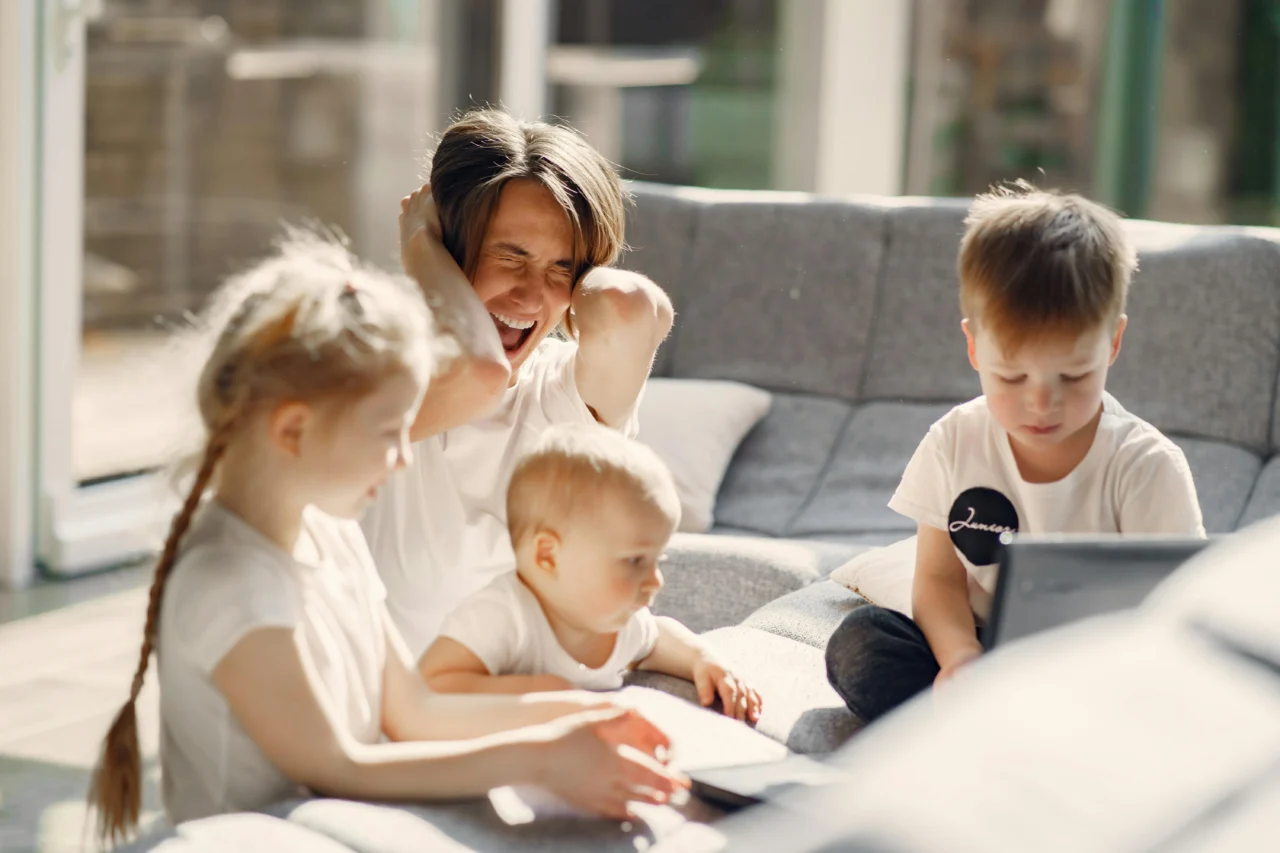
Do you know those moments when your child simply won’t cooperate? The shoes stay off even though you should have left ages ago. Something gets broken. Your requests are met with no response. And although you really want to stay calm and patient, you get irritated or even raise your voice. You are far from alone in this. Being a parent often pushes us to our limits – and at the same time, there are ways to handle these situations more calmly. Meditation for parents can be one way of dealing with such situations more calmly.
Why do we often react more impulsively as parents than we would like to?
Most parents have an idea of how they want to be: loving, patient, understanding. But in everyday life, time pressure, exhaustion and constant demands all collide. Our nervous system is frequently under strain, and then sometimes even a small thing is enough to make us react impulsively.
This doesn’t mean you’re not doing a good job as a parent. It simply means that you’re human.
In stressful moments we often react on autopilot. That is exactly why it’s so valuable not to wait until a conflict arises to use skills such as patience, mindfulness and self-regulation, but to practise them beforehand.
Meditation for parents doesn’t have to take long
Many parents believe that meditation only works if it’s practised for a long time every day. But in family life especially, the steps can be small. A conscious breath, a short pause before your next reaction or a few minutes of silence in the morning can already help you reconnect with yourself. Meditation for parents can fit into everyday life – not perfect, but doable.
How can meditation help in everyday family life?
Meditation is often misunderstood. Many people think it means having to sit as still as possible or not being allowed to have any thoughts. In fact, meditation is much more about deliberately practising certain skills: attention, kindness, patience and awareness of your own state.
In a formal meditation practice, you don’t have to actively keep yourself in check as you would in a stressful situation. Instead, you train these skills in a calm moment – a bit like a workout for your nervous system.
The more often you practise, the more easily you can draw on them in everyday life. In a sense, you build up a higher baseline of calm. Challenging situations won’t suddenly disappear, but you can often meet them more consciously instead of reacting impulsively straight away.
This connection is also being studied scientifically: researchers describe “mindful parenting” as an approach in which parents interact with their children more consciously, with greater emotional regulation and less reactivity (Duncan et al., 2009). Studies also show that mindful parenting is linked to better emotional self-regulation in children (Evans et al., 2020).
Perhaps you’ll then notice sooner that your impatience is rising. Perhaps you’ll take a deep breath before you answer. Perhaps, in the middle of the chaos, you’ll be able to step back for a brief moment.
And it is precisely this brief moment that can make a big difference in everyday family life.

Why do your children benefit too?
Mindfulness doesn’t only affect you. Children watch very closely how adults deal with feelings and stress. They learn less from explanations than from what they experience regularly.
If you pause in a difficult situation and say, for example, “I can tell this is stressing me out right now. I’m going to take a deep breath”, you are teaching your child something very valuable: feelings are allowed to be there – and we can learn how to deal with them.
In this way, you not only give yourself more calm but also model self-regulation for your child. Over time, children often adopt such strategies quite naturally.
This isn’t about always showing your child perfect calm. Parents are allowed to be stressed, overwhelmed or irritated too. What matters far more is how you deal with these moments. When you show your child that feelings can be noticed, named and regulated, you become a realistic and loving role model. This is exactly what can make mindfulness so valuable in everyday family life.
Meditation then becomes not only a support for you but also a gift for your relationship.
How can you start with a short meditation?
– A meditation for parents:
You don’t need much time or perfect conditions. Just a few minutes can help you reconnect with yourself more consciously.
First, settle into a relaxed sitting position. You might like to close your eyes or let your gaze soften.
Bring your attention to your body. How does it feel right now? Is there anything you would like to change? Perhaps you’d like to sit a little differently or loosen your shoulders. If there is something, allow yourself to make that adjustment.
Now turn your attention to your breathing.
Take a really deep breath.
And then let your breath flow quite naturally again.
Feel the breath coming and going.
A single conscious breath can ground us. It can create a little distance between us and a challenging situation.
Perhaps you know those moments with your child when everything happens at once. That’s exactly where taking a conscious breath can help. And you’re allowed to show this openly: “This is difficult right now, I need to take a deep breath.”
Now keep your attention on your breath.
Thoughts may come up. You may get distracted. That’s completely normal. As soon as you notice that your thoughts have wandered, simply come back to your breath.
Feel the contact with the floor. The contact with your seat.
Take one more deep breath.
And then slowly bring the meditation to a close.

Does meditation have to be perfect to work?
No. Meditation doesn’t mean always being calm or never reacting with irritation again. It isn’t about perfection. It’s about becoming more aware of yourself and inviting small moments of calm into your everyday life, again and again.
As a parent in particular, these small moments can be incredibly valuable – for you and for your child.
Anastasia Prut (psychology student)
Would you like to try the exercise with guidance straight away? Here you’ll find a guided meditation for exactly this practice. On the channel you’ll also find many more mindfulness exercises and meditations that can help you bring more calm, patience and awareness into your everyday family life.
Deepen your meditation practice with Mindfulife
Meditation can be more than a short break in your everyday life. If you would like to understand more deeply how meditation works, how to build a steady practice of your own and how to guide others mindfully, our meditation teacher training is the next step. There you will not only get to know meditation in theory, but also develop more confidence, clarity and trust in your own practice.
Would you like to find out more about the training first? In our weekly webinar you will get an insight and learn more about what your path to becoming a meditation teacher could look like.
For regular support in your everyday life, you can also use our online meditation studio and join guided meditations flexibly via Eversports.
We look forward to accompanying you on your journey.
You can find more mindfulness inspiration on our channels too
References
Duncan, L. G., Coatsworth, J. D., & Greenberg, M. T. (2009). A model of mindful parenting: Implications for parent–child relationships and prevention research. Clinical Child and Family Psychology Review, 12, 255–270. https://doi.org/10.1007/s10567-009-0046-3
Evans, S., Bhide, S., Quek, J., Nicholson, J. M., Anderson, V., Hazell, P., Mulraney, M., & Sciberras, E. (2020). Mindful parenting behaviors and emotional self-regulation in children with ADHD and controls. Journal of Pediatric Psychology, 45(9), 1074–1083. https://doi.org/10.1093/jpepsy/jsaa073