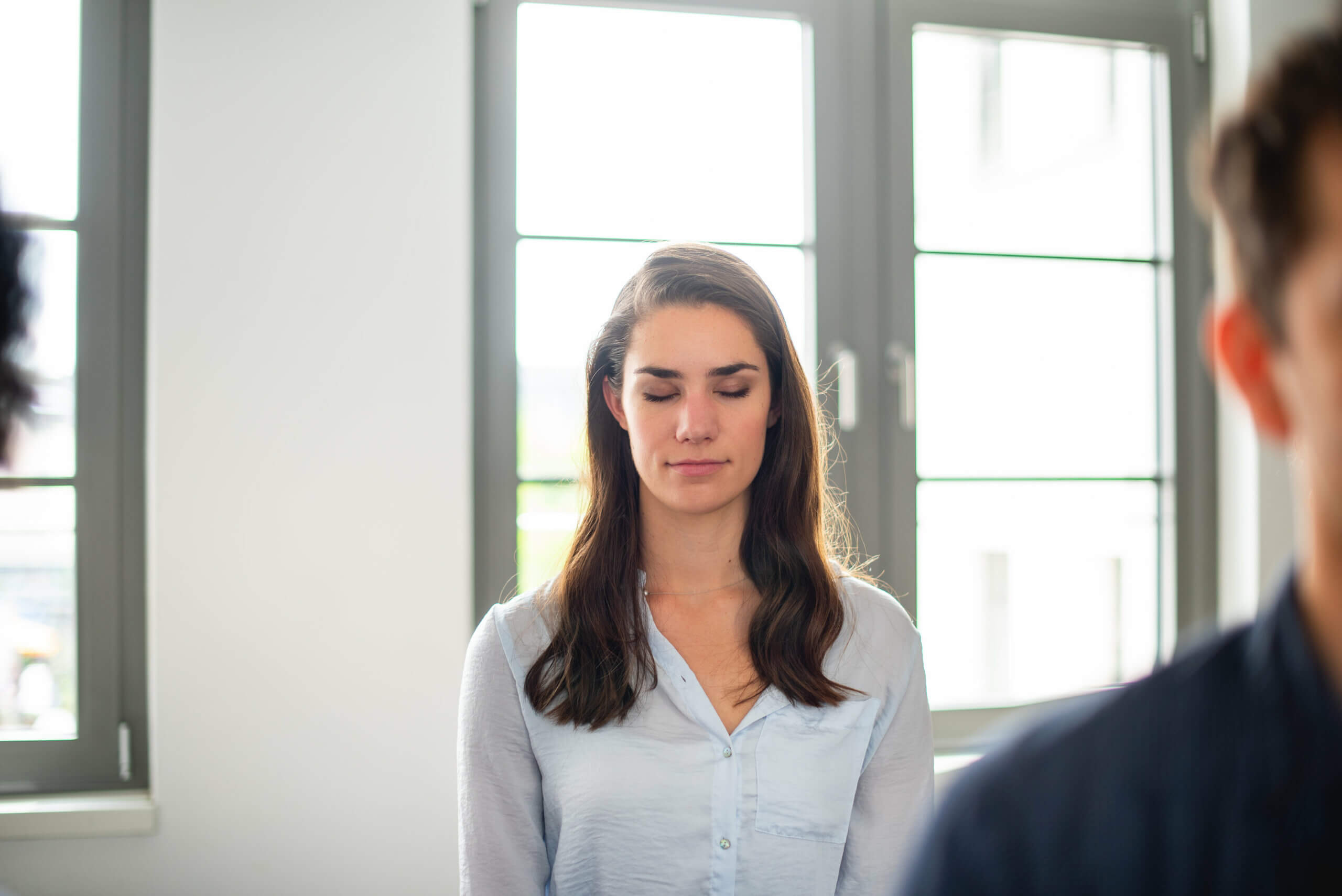
Breathwork for Conscious Relaxation: The 4-7-8 Method

 · 3 min read
What exactly is the 4-7-8 method?
Perhaps you know this moment in the evening: your body is tired – but your mind keeps running. Thoughts. To-dos. Scenarios.
And the more you ‘want to fall asleep’, the more awake you become.
This is exactly where breathwork can help.
If you would like to try breathwork straight away, you will find a practical follow-along exercise in this YouTube video. If you are interested in the theory behind breathwork, do read on, because this article explains why the 4-7-8 method works – and what happens in your nervous system as you practise it.
What does breathwork actually mean?
Breathwork literally means working with your breath.
Unlike classic meditation, you don’t just observe your breath –
you consciously change it.
Depending on the technique, you can:
- create activation (e.g. when you lack energy)
- increase focus
- or deliberately bring about relaxation
Today we are focusing on the latter. This technique is particularly suitable:
- before falling asleep
- as part of your evening routine
- when you wake up during the night
- when you feel inner restlessness
Phil himself uses it regularly for exactly this.
The 4-7-8 technique – step by step
Before the breathing technique begins, you start with a short introduction:
1 Arriving
- Sit upright or lie down comfortably.
- Feel your body.
- Let your shoulders, jaw and forehead soften.
At first, simply observe your natural breath – without changing it.
Only once you have truly arrived does the technique begin.
2 The breathing technique
- Breathe in through your nose for 4 seconds
- Hold your breath for 7 seconds
- Breathe out slowly through your mouth for 8 seconds
Important:
The out-breath is especially slow.
Imagine you want to make a candle flame dance – not blow it out, just let it flicker gently. Your mouth is only slightly open. Repeat 4-6 breathing cycles. While you do so, keep checking:
Are you tensing up anywhere?
Can you become just a little bit ‘softer’?
Why is it so effective?
The key lies in the autonomic nervous system. Slow breathing – especially with a prolonged out-breath – activates the parasympathetic nervous system, the part of your nervous system responsible for regeneration, safety and relaxation. Several studies show:
- Slow breathing increases heart rate variability (HRV)
- It reduces stress markers (e.g. cortisol)
- It improves emotional regulation
- It lowers subjectively experienced stress
What exactly does the research say?
The effects of conscious breathing techniques are now well researched.
One controlled intervention study was able to show that regular diaphragmatic breathing (a deep belly breath in which the abdominal wall rises on the in-breath, not just the chest) practised over several weeks significantly reduced subjectively experienced stress. At the same time, negative emotions decreased, attention improved – and even physiological stress markers such as cortisol fell measurably.
Other studies also conclude that slow, consciously controlled breathing has a direct effect on the autonomic nervous system. A slower breathing rate in particular appears to be associated with stronger activation of the parasympathetic system.
This means:
When we consciously slow down our breathing and lengthen the out-breath, we directly influence our stress physiology.
The calming effect is not imagined.
It can be explained neurobiologically.
Or to put it another way:
It isn’t magic.
It’s biology.
Why is the long out-breath so crucial?
The prolonged out-breath sends a safety signal to your brain.
In evolutionary terms, this means:
Long out-breath = no immediate danger.
Your body can wind down. The longer you breathe out, the stronger this signal becomes. That is why the eight seconds are the most important part of the exercise.
An important note
This technique is no substitute for therapy.
It does not resolve deep trauma.
But it is a tool.
And this tool works – if we use it regularly.
Breathwork is not self-optimisation.
It is self-regulation.
Conclusion
Relaxation doesn’t begin out there.
It begins within you.
And perhaps the most powerful technique is the one you always carry with you.
Your breath.
If you would like to experience the exercise rather than just read about it, you will find the guided breathing session with Phil in the accompanying YouTube video.
Take a few minutes for yourself – and simply breathe along.
Miriam Sara Senf (psychology student)
Deepen your meditation practice with Mindfulife
Meditation can be more than a short break in your everyday life. If you would like to understand more deeply how meditation works, how to build a steady practice of your own and how to guide others mindfully, our meditation teacher training is the next step. There you will not only get to know meditation in theory, but also develop more confidence, clarity and trust in your own practice.
Would you like to find out more about the training first? In our weekly webinar you will get an insight and learn more about what your path to becoming a meditation teacher could look like.
For regular support in your everyday life, you can also use our online meditation studio and join guided meditations flexibly via Eversports.
We look forward to accompanying you on your journey.
You can find more mindfulness inspiration on our channels too
References
Ma, X., Yue, Z. Q., Gong, Z. Q., Zhang, H., Duan, N. Y., Shi, Y. T., Wei, G. X., & Li, Y. F. (2017). The effect of diaphragmatic breathing on attention, negative affect and stress in healthy adults. Frontiers in Psychology, 8, 874. https://doi.org/10.3389/fpsyg.2017.00874
Zaccaro, A., Piarulli, A., Laurino, M., Garbella, E., Menicucci, D., Neri, B., & Gemignani, A. (2018). How breath-control can change your life: A systematic review on psycho-physiological correlates of slow breathing. Frontiers in Human Neuroscience, 12, 353. https://doi.org/10.3389/fnhum.2018.00353