Relationships at Christmas: 8 Effective Ways to Greater Emotional Wellbeing
The season of love is just around the corner. We organise get-togethers, lose ourselves in Christmas shopping and our to-do list is filled with all kinds of preparations. All for the sake of our relationships? Stressful, isn't it?

 · 9 min read

The season of love is just around the corner. We organise get-togethers with colleagues, friends or acquaintances, throw ourselves into Christmas shopping and tick off all sorts of things on our to-do list: baking biscuits with the children, planning the Christmas dinner and rushing through crowded shops. All for love? Yes, the love for the relationships we want to nurture. But sometimes it simply feels like too much.
Perhaps you are asking yourself: do I really need all these relationships? Wouldn’t I get through the run-up to Christmas far more relaxed on my own, without constant social obligations?
The clear answer: no. Quite the opposite – social relationships are crucial for your emotional wellbeing and your health (RND, 2023; Stahl, 2023). Read on to find out why, how you can nurture them and why this is especially relevant right now.
Life as a hermit is more relaxed, isn’t it?
We all know those phases when we would rather crawl under a rock. This urge grows especially when things get stressful. And the run-up to Christmas is a particularly nerve-racking time! But withdrawing is not an option.
One of the largest studies on relationships shows this especially clearly: the Harvard Grant Study. It was originally about the factors behind a fulfilled and successful life. From this study, which has run for more than 80 years with 724 participants, one clear insight emerged:
“Loneliness kills. It’s as powerful as smoking or alcoholism.” (Waldinger, study director, 2015)
along with the following memorable quotes:
“When the study began, nobody cared about empathy or attachment. But the key to healthy aging is relationships, relationships, relationships.” (George Vaillant, member of the research team, 2012).
“The key to healthy aging is relationships, relationships, relationships.” (Vaillant, 2012)
One thing is certain: relationships are the be-all and end-all of our lives. Not something to put off until later. Close relationships have been shown to make us happier than wealth and fame. They protect us from dissatisfaction and slow down mental and physical decline – regardless of social status, IQ or genetics. They are quite simply the key to your health.

“Loneliness kills”
Not least because of the shock you feel when reading such a quote, the study director’s statement serves as a warning. Relationships need to be nurtured! A life as a nomad is out of the question, even if, thanks to technology, we are probably never truly alone these days. What we need are real relationships with people!
Now imagine one of these days: you come home from shopping at Christmas time and your partner is waiting for you with a hot cup of tea. You are not alone. This form of self-care is just as important as looking after your physical health in general. Healthy relationships have even been shown to keep you healthy. The study shows that the people who were most satisfied in their relationships at the age of 50 were the healthiest at the age of 80.
So off to the Christmas market with your friends!
At Christmas in particular, loneliness can be felt especially strongly – if you would like to find out more, you will find helpful tips and ideas here – Loneliness at Christmas – How can mindfulness help?
Child, teenager and suddenly old and grey
But when does our human connection actually begin? The answer: babies sense their environment while still in the womb. And from the moment we are born, our journey of discovery begins – and it moves at breakneck speed. After birth we are a baby for a short while, then a toddler, a teenager, eventually an adult and at some point old. That’s it. And amid all this breakneck pace, we are also supposed to build relationships and, ideally, nurture them for a lifetime? Yes – it’s worth it! And I’ll tell you why!
If you have built a network you can rely on, you are quite literally holding the best source of eternal youth in your hands. When you feel strong social support, your mental decline in old age slows down. If you don’t care because you think that in old age you just want some peace and quiet, take a closer look now.
Good interpersonal relationships – whether with siblings, family or your mother – have a considerable influence on later life and even on financial success. As the study initially focused mainly on men, the following emerged for them: those who had positive relationships with their siblings in their youth and a warm childhood earned more money per year on average than those with poor or no sibling relationships. In addition, men from stable families were more financially successful than those from unstable backgrounds. Men who had a close relationship with their mother also earned more.
Those who scored highly on interpersonal relationships not only had higher incomes but were also more successful overall and were more frequently included in publications such as Who’s Who. And if you’re now thinking, “Pah, a long life and good health are in my genes!”, I’m afraid I have to disappoint you. The study showed that genetics and long-lived ancestors matter less for lifespan than satisfaction with relationships in midlife – which is now recognised as a good indicator of healthy ageing.
Well, if that doesn’t motivate you to get up off your comfy sofa and arrange a biscuit-baking session – you’ll be combining business with pleasure, by the way 😉

A recipe for friendship
But enough scaremongering. We need a recipe, a cookbook or simply a guide on how to actually get this relationship thing right.
First of all, you should know that it is completely normal not to have all your friends by your side for a lifetime. Our relationships can be divided quite simply into two categories: close-to-the-heart friendships and everyday friendships. Close, heartfelt friendships develop slowly – on average, you have to meet 30 new people before one of them becomes a close friend. At the same time, we lose around 50% of our friends within seven years.
Some phases of life are also shaped by particular events, such as starting a family. Or a friendship drifts apart – because of unresolved conflicts, a lack of common ground and shared interests, or certain character traits. That is why it is challenging to establish new relationships during these phases, and we rely more heavily on long-standing friendships. But don’t worry: such big projects are usually followed by a phase in which we can – and indeed should – invest fully in the people around us.
At around the age of 45, a kind of “state of health” sets in: people who stay curious and get out to meet new people remain healthier and build more connections. For many, however, this is not the case. Still, we should never forget that we always have the opportunity to work on our existing relationships – even when they are full of conflict.

The 8 ways
- 1. Make time for real encounters
Whether it’s your partner, friends or family: time spent together matters more than expensive presents (Stahl, 2023). Make conscious use of Christmas parties, walks or cooking together to create closeness.
- 2. Manage withdrawal consciously rather than avoiding people
It is normal to go through phases when you want less contact. Still, a conscious approach to social activities helps to avoid overload (RND, 2023).
- 3. Nurture communication
Phone calls, messages or conversations help to keep relationships stable, even if you don’t see each other every day (Kubacka & Röcke, 2024).
- 4. Plan activities together
Walks, cooking, Christmas markets or hobbies strengthen your bond and create lovely memories (FAU, 2024; Envivas, 2023).
- 5. Actively support your mental health
Mindfulness, meditation or short breaks reduce stress, promote calm and improve your capacity for relationships (Deutsche Heilpraktikerschule, 2023; Lefrank & Gräf, 2021).
- 6. Prioritise close friendships
Quality over quantity: long-standing close friendships are especially valuable for emotional wellbeing (Vaillant, 2012).
- 7. Include everyday friendships
Casual, everyday contacts also have a positive effect, providing stability and social support (Seeman et al., 2001).
- 8. Don’t forget self-care
Only by looking after yourself can you nurture relationships in a healthy, stable way – for example through breaks, small rituals or loving attention to yourself (Stahl, 2023; Deutsche Heilpraktikerschule, 2023).
These eight ways fit wonderfully into everyday life, even when Christmas stress is running high. They not only help to strengthen your relationships but also act as a booster for your emotional wellbeing.
How to do relationships?
Especially now, at Christmas time, you have plenty of opportunities to work on your relationships. And the recipe we are all looking for to have happy relationships lies within ourselves.
We simply have to nurture our relationships – whether through a phone call, a walk, a holiday together or shared hobbies. But this only works through ongoing communication! We need to use the special gift that sets us apart from most animals: we can speak and share our feelings and emotions. This brings us to an important point: only when our own body is doing well and we look after our own health can we experience the health-promoting aspects of a relationship and pass them on to our friends.
Mental health in particular makes an important contribution here. Stress, which in turn triggers conflict and makes us narrow-minded, closes the doors to curious, lifelong learning – the kind of learning that protects us from general dissatisfaction with life. What is meant here above all is the classic work-life balance.
Especially now, at Christmas time, there are sometimes extra shifts at work, the social pressure to find the perfect present, and even the weather doesn’t exactly seem to be on our side. Now is the time to pay attention and consciously decide against that lazy inner voice that wants to hide away and neglect our relationships.
How can meditation help?
And this is where meditation comes in. Many of the processes you have probably just read about, and where you may have thought here and there, “Yes, I know that feeling!”, unfortunately happen unconsciously far too often.
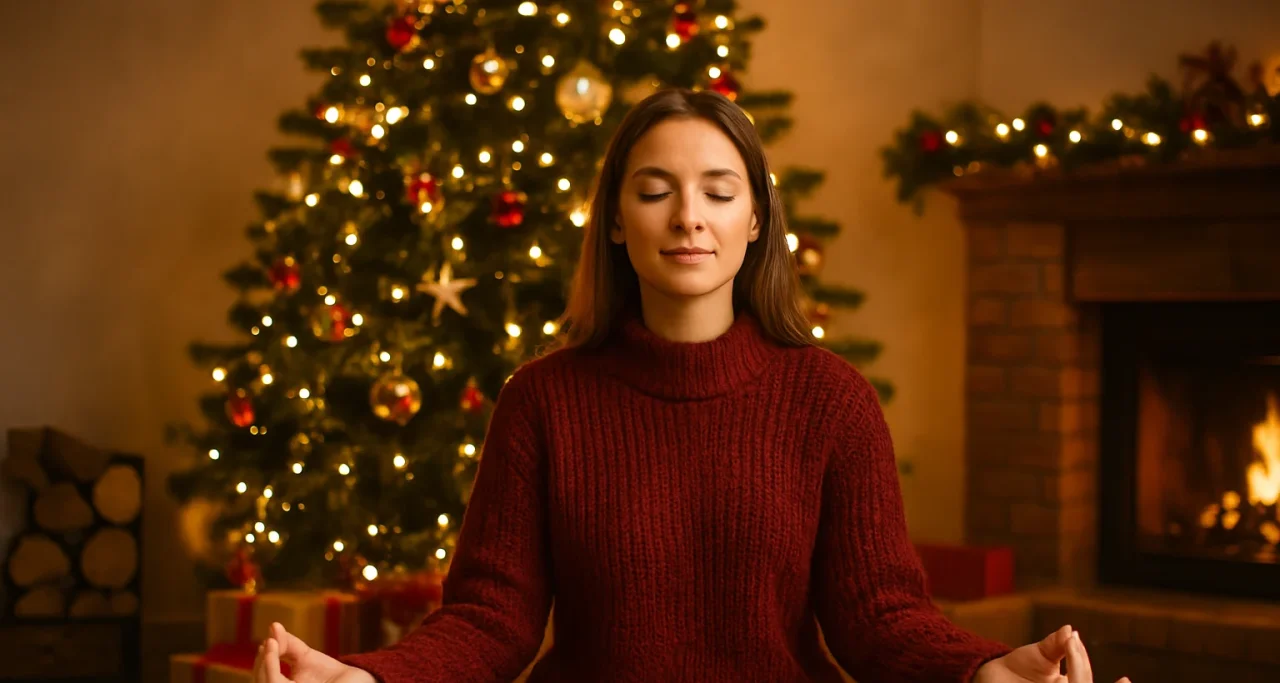
Meditation can not only help you deal better with your general sense of stress but also give you mindfulness – the conscious, non-judgemental awareness of the present moment. This can help you to be more mindful and attentive in relationships, which in turn improves communication and mutual understanding.
How about meditating together with your loved ones to your favourite Christmas songs this year?
Conclusion
The run-up to Christmas can be stressful and overwhelming, but it also offers a unique opportunity to consciously nurture our relationships and thereby boost our emotional wellbeing. The Harvard Grant Study and numerous other studies show that real, close relationships are not just a happiness booster – they have a direct impact on our health, satisfaction and even our later success (Vaillant, 2012; Waldinger, 2015; Holt-Lunstad, Smith, & Layton, 2010).
With the 8 ways – from consciously making time, active communication, shared activities, mental health, close friendships and everyday friendships through to self-care – you have a practical recipe at hand to strengthen your relationships, reduce stress and consciously enjoy the Christmas season.
Remember: it’s not about perfection or being constantly available, but about small, conscious steps that create closeness, joy and connection. Every encounter, every conversation and every shared activity counts. Use this time to celebrate and deepen your relationships and, in doing so, to strengthen your own emotional wellbeing for the long term.
Revised on 22/11/2025
by Katharina R. (psychology student)
Deepen your meditation practice with Mindfulife
Meditation can be more than a short break in your everyday life. If you would like to understand more deeply how meditation works, how to build a steady practice of your own and how to guide others mindfully, our meditation teacher training is the next step. There you will not only get to know meditation in theory, but also develop more confidence, clarity and trust in your own practice.
Would you like to find out more about the training first? In our weekly webinar you will get an insight and learn more about what your path to becoming a meditation teacher could look like.
For regular support in your everyday life, you can also use our online meditation studio and join guided meditations flexibly via Eversports.
We look forward to accompanying you on your journey.
You can find more mindfulness inspiration on our channels too
References
Deutsche Heilpraktikerschule. (2023, 15. Dezember). Weihnachtsamkeit – Achtsam bleiben im Weihnachtsstress. Deutsche Heilpraktikerschule. https://deutsche-heilpraktikerschule.de/weihnachtsamkeit-achtsam-bleiben-im-weihnachtsstress/
Envivas. (2023, 5. Dezember). Entspannte Weihnachten – wie wir besser „runterkommen“ können. Envivas Gesundheitsmagazin. https://www.envivas.de/magazin/gesundheitswissen/entspannte-weihnachten
FOM Hochschule für Oekonomie & Management (Lefrank, V., & Gräf, M.). (2021). Eine quantitative Studie zum Einfluss von Achtsamkeit auf Stress, Burnout und Depression (Arbeitspapiere der FOM Nr. 82). FOM Hochschule. https://forschung.fom.de/fileadmin/fom/forschung/arbeitspapiere/Arbeitspapiere-der-FOM/FOM-Forschung-Arbeitspapier-82-Lefrank-Graef-Einfluss-von-Achtsamkeit-2021-eBook.pdf
Friedrich-Alexander-Universität Erlangen-Nürnberg (FAU). (2024, 2. Dezember). Resilient durch den Advent – Tipps für eine achtsame Weihnachtszeit. FAU News. https://www.fau.de/2024/12/news/resilient-durch-den-advent/
RedaktionsNetzwerk Deutschland (RND). (2023, 15. Dezember). Weihnachten: 40 Prozent der Deutschen sind vor Weihnachten gestresster als sonst. https://www.rnd.de/panorama/weihnachten-40-prozent-der-deutschen-gestresster-als-sonst-IG347VOT2BFO5JEVFTQIZW3EGU.html
Stahl, S. (2023, 10. Dezember). Selbstfürsorge zur Weihnachtszeit: Stressfrei und achtsam durch die Festtage. Psychoblog von Stefanie Stahl. https://www.stefaniestahl.de/psychoblog/selbstfuersorge-zur-weihnachtszeit-stressfrei-und-achtsam-durch-die-festtage/
Universität Rostock & Hochschule Bonn-Rhein-Sieg (Kubacka, K., & Röcke, C.). (2024, 5. Dezember). Wohlbefinden der Menschen in der Weihnachtszeit und danach – Ergebnisse einer Tagebuchstudie. Universität Rostock. https://www.uni-rostock.de/universitaet/kommunikation-und-aktuelles/medieninformationen/detailansicht/n/forscher-legen-studie-zum-wohlbefinden-der-menschen-in-der-weihnachtszeit-und-danach-vor-40421/
Vaillant, G. E. (2012). Triumphs of experience: The men of the Harvard Grant Study. Harvard University Press.
Waldinger, R. (2015). Harvard Study of Adult Development. Harvard University.
Holt-Lunstad, J., Smith, T. B., & Layton, J. B. (2010). Social relationships and mortality risk: A meta-analytic review. PLoS Medicine, 7(7), e1000316. https://doi.org/10.1371/journal.pmed.1000316
Seeman, T. E., Lusignolo, T. M., Albert, M., & Berkman, L. (2001). Social relationships, social support, and patterns of cognitive aging in healthy, high-functioning older adults: MacArthur Studies of Successful Aging. Health Psychology, 20(4), 243–255. https://doi.org/10.1037/0278-6133.20.4.243