Raunächte: How to Welcome the New Year Mindfully

 · 6 min read
For many people, the time “between the years” instinctively feels like a moment to pause: we look back on the past year, reflect on what we have experienced and achieved, and perhaps also think about what was difficult for us. At the same time, our gaze turns towards the future. We are already thinking about the new year and how we would like to shape it. In recent years, more and more people have been using an old ritual to spend this special time of year mindfully: the Raunächte. In this article, you will find out what the Raunächte are, what the ritual involves and how we can use them today for a mindful transition into the new year.
What are the Raunächte?
The Raunächte (also spelt Rauhnächte – both spellings are correct) are a number of nights around the turn of the year that are said to hold a special significance. The term usually refers to the twelve nights from 25 December to 6 January, although in some regions slightly different periods may fall under the name.

The term Raunächte probably originates from Celtic and Germanic customs. Its exact etymology has still not been fully established. The name may go back to the Middle High German “ruch”, which roughly means “hairy”. This could be linked to the old folk belief that the boundary between the visible and the invisible world is particularly thin during the Raunächte. The Germanic peoples believed that many strange beings appeared in our world on these nights, for example demons, which were imagined as hairy creatures.
To protect the farm and its inhabitants from the evil spirits of the invisible world, all the family’s rooms were smudged with smoke. This points to another possible origin of the word: the term “Rauchnächte” (“smoke nights”) may have turned into “Raunächte” over time.
What do the Raunächte mean today?
In recent years, the old ritual of the Raunächte has been regaining importance. Bookshops offer numerous titles on how you can spend the Raunächte, whether on your own, as a couple or as a family. This trend may be explained by a growing need for orientation and for pausing, while the world around us becomes ever faster and more complex.
Very few people today probably believe that spirits from other worlds actually haunt ours during this time. What may remain relevant today, however, is the Raunächte as a time of stillness. Even in the old days, everything was often done by Christmas: the work in the fields was finished and the house and farm were in order. So there was not much to do, which was rarely the case. People could therefore use these days to settle down and pause. And perhaps we find something of this in our own lives too, when we have few obligations between Christmas and the new year and can turn our attention inwards.
In modern interpretations, the Raunächte are meant to offer an opportunity to reflect and to cleanse ourselves (with or without smoke): what would we like to let go of because it is not (or no longer) good for us? What really matters to us? Exactly how the nights, or rather the days, around New Year’s Eve are spent as part of the ritual varies depending on the interpretation. However, some elements appear in many versions.
The ritual of the 13 wishes
This part of the Raunächte involves taking time before they begin (for example on 25 December) to think about the coming year. What do you wish for over the next 12 months, what small or big things? What should happen, what would you like to achieve – and what might you want to change? Phrase your wishes in full sentences and as specifically as possible. Write each wish on a small slip of paper and then fold it up. Place all the folded slips in a container.
Once the Raunächte begin, you take out one slip each day and destroy it without reading it. Many guides suggest burning the slip, but this is not a must. By the evening of the twelfth night, a single wish remains. You are now responsible for this thirteenth wish and can spend the year doing everything you can to make it come true.
The Raunächte diary
Many modern interpretations include keeping a kind of diary over the twelve days of the ritual. Exactly how you design such a journal is up to you. Many authors recommend noting down in the morning, as soon as you get up, whether you dreamt anything and, if so, what. As you spend a lot of time with yourself during the Raunächte and some of your thought patterns may loosen up, you may well dream more intensely during this period. And simply writing down your dreams can help you remember your dreams better and in more detail.

In the evening, you can write down what happened to you during the day, what thoughts you had or whether you noticed anything special. Having the task of paying attention to these things throughout the day will make you much more attentive: you will perceive your surroundings more mindfully.
Thought walking
Another ritual during the Raunächte is thought walking, essentially a daily walking meditation that you should do whatever the weather. The aim is to get moving without any further distractions, such as your phone or music in your ears. This is meant to get your thoughts flowing and help them rearrange themselves. Scientific studies also show that this works. Exercise improves blood flow not only to our muscles but also to our brain, and has been shown to improve cognitive performance.
Smudging
As described above, people in earlier times used smoke to protect their homes from evil spirits and demons. For many, this practice is still part of the Raunächte ritual today. Certain scents can help us get into a particular mood, and various herbs are also said to have different effects, such as calming the mind or bringing mental clarity.
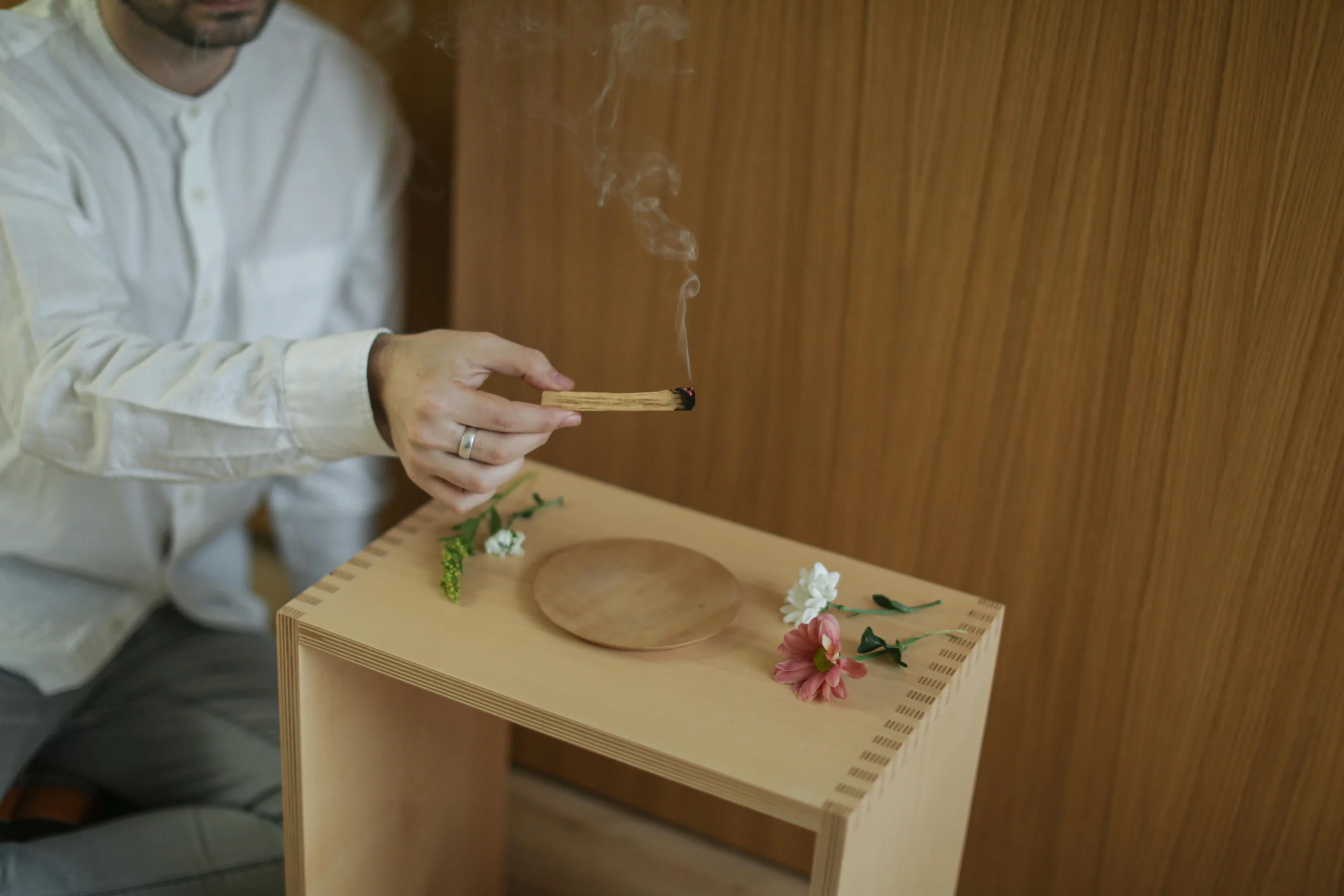
There are no scientific studies confirming these effects. On the contrary, some studies point to harmful effects of smudging on health. For example, links have been found with asthma and cardiovascular diseases.
From a health perspective, then, smudging is not necessarily advisable. You can safely leave it out when carrying out the Raunächte ritual. If you would like to use a particular scent to get into the mood for the ritual, you can find special Raunächte candles in shops that come without any health risk.
What might a mindful Raunächte ritual look like?
Many guides to the Raunächte recommend a specific sequence in which each day is dedicated to a particular theme. In some interpretations, each night symbolically represents one month of the year and its theme is based on that calendar month.
If you would rather not stick to such a rigid sequence, you can create your own little ritual according to your wishes. Throughout the day, try to have small mindful moments again and again – noticing what is there right now, in the here and now. This time of year might also be a good opportunity to start meditating, if you have been meaning to for a while. Meditation is also a great way to create islands of calm in hectic, overstimulating everyday life. Whatever you choose: if you would like to practise the Raunächte this year, you are free to shape your ritual entirely according to your wishes and needs and to include whatever is good for you.
Sarah B. (BSc Psychology)
Deepen your meditation practice with Mindfulife
Meditation can be more than a short break in your everyday life. If you would like to understand more deeply how meditation works, how to build a steady practice of your own and how to guide others mindfully, our meditation teacher training is the next step. There you will not only get to know meditation in theory, but also develop more confidence, clarity and trust in your own practice.
Would you like to find out more about the training first? In our weekly webinar you will get an insight and learn more about what your path to becoming a meditation teacher could look like.
For regular support in your everyday life, you can also use our online meditation studio and join guided meditations flexibly via Eversports.
We look forward to accompanying you on your journey.
You can find more mindfulness inspiration on our channels too
References
Atqah Abdul, W., & Mostafa, O. (2007). Arabian incense exposure among Qatari asthmatic children. A possible risk factor. Saudi medical journal, 28(3), 476–478.
Hansmeier, T. (2014): Beeinflusst Sport unser Gehirn? Die Effekte körperlicher Aktivität auf die kognitive Evaluierung visueller Reize. Hamburg: Diplomica Verlag.
Köhler, T., Pfeiffer, N., & von dem Knesebeck GmbH & Co. Verlag KG. (2024). Rauhnächte für Paare - 12 Tage nur für euch.
Pan, A., Ang, L.-W., Clark, M. L., Yu, M. C., Yuan, J.-M., & Koh, W.-P. (2014). Incense Use and Cardiovascular Mortality among Chinese in Singapore: The Singapore Chinese Health Study. Environmental Health Perspectives, 122, 1279–1284. https://doi.org/10.1289/ehp.1307662
Pontes, U. (2015): Was Sport im Gehirn bewirkt. In: Spektrum der Wissenschaft kompakt. Sport -von Motivation bis Muskelkater, S. 24-25.
Sigrid Früh: Rauhnächte. Märchen, Brauchtum, Aberglaube. 5. Auflage. Verlag Stendel, Waiblingen 1999
Yeatts, K. Β., El-Sadig, M., Leith, D., Kalsbeek, W., Al-Maskari, F., Couper, D., Funk, W. Ε., Zoubeidi, T., Chan, R. L., Trent, C. B., Davidson, C. A., Boundy, M. G., Kassab, M. M., Hasan, M. Y., Rusyn, I., Gibson, J. M., Donald, & Olshan, A. F. (2012). Indoor Air Pollutants and Health in the United Arab Emirates. Environmental Health Perspectives, 120(5), 687–694.