Morning routine: meditation to start your day?

 · 3 min read
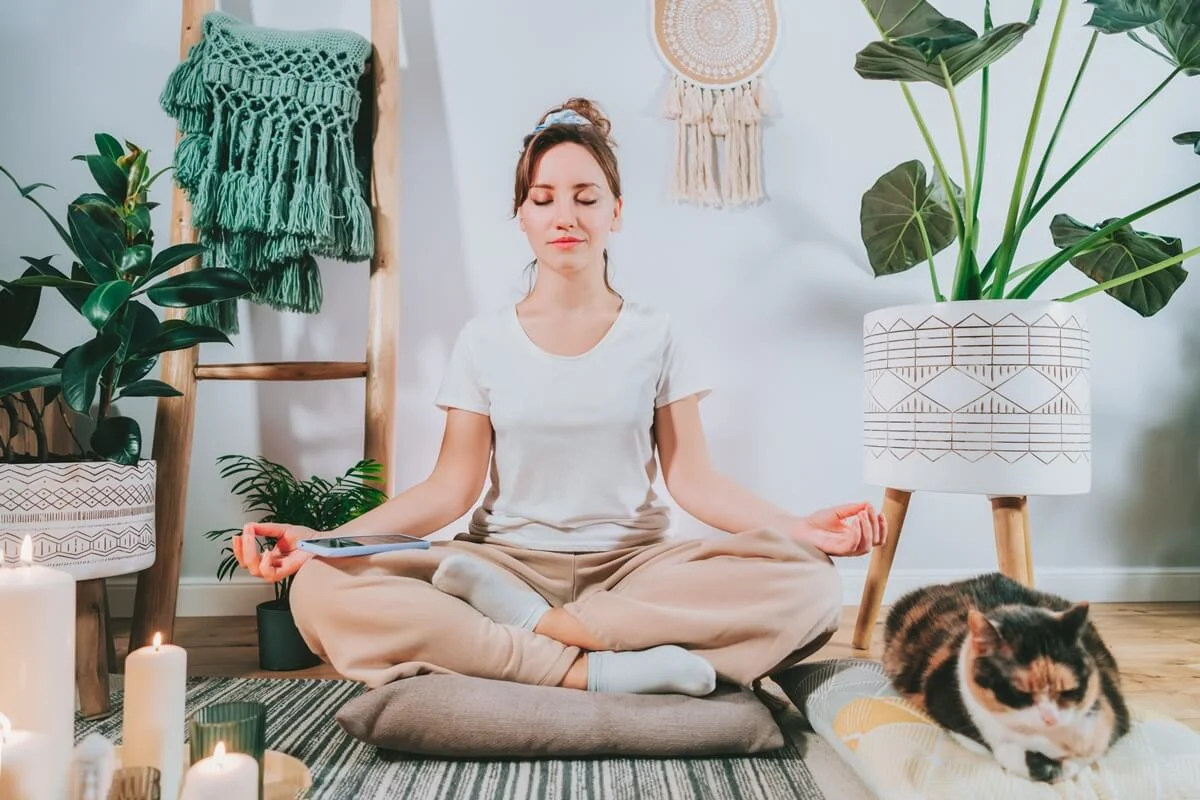
The morning lays the foundation for the rest of the day. A mindful morning routine can help you start your day feeling more focused, relaxed and positive – and, as you will read in this article, it often takes only small changes to make a big difference.
What is a morning routine?
A morning routine is a series of habits or rituals carried out regularly after waking up in order to begin the day in a structured, focused and positive way. It can be tailored to the individual and include a variety of activities. The aim of a morning routine is to reduce stress, increase productivity and promote general wellbeing.
Why is a morning routine important?
Your alarm goes off. You hit the snooze button – once, twice, maybe even three times. Eventually you reach for your phone, check new messages on WhatsApp and start scrolling through Facebook or Instagram – all before your first coffee. After a while you drag yourself out of bed to finally make that first coffee. But instead of concentrating on making it and noticing the smell and taste of the coffee, you carry on scrolling. Before the day has properly begun, you already feel stressed and overwhelmed. Sound familiar?

What if your morning could begin differently – calmly, with focus and a clear head? A mindful morning routine can help. And even a small change, such as five minutes of meditation, can make all the difference.
The psychology of the morning routine: what habits do to our brain
Habits affect your brain in many ways. Current scientific findings show that habits form through repeated behaviour, which leads to changes in the brain. Actions are then carried out automatically and require less effort from you. This means more of your energy is freed up for other tasks. Sounds good already, doesn’t it?
Morning meditation: the key to a good start to the day
But why should your morning include meditation? Meditation and mindfulness in particular can be a powerful part of your morning routine. They offer numerous scientifically proven benefits for body and mind. Some of these include:
- Improved wellbeing and a lifted mood
- Emotional stability and better handling of feelings
- Stress reduction
- Increased attention and concentration
- Pain relief

Even short meditation exercises practised regularly show these positive effects and are easy to fit into your everyday life.
Practical tips for your morning routine
Building a new routine can be challenging – especially when your inner couch potato is stronger than your alarm clock in the morning. A common mistake is to start straight away with a routine that is too ambitious. Start small instead: set yourself realistic goals, such as five minutes of meditation or a glass of water right after getting up. Link new habits to existing rituals, such as brushing your teeth or making coffee, to make getting started easier. A short walk with a walking meditation also fits in perfectly, as it not only gets your circulation going and wakes you up, but also trains your mind and prepares you for the day ahead. And most importantly: be patient with yourself. Routines take time to become ingrained – setbacks are normal, and sticking with it pays off!

Conclusion: start your day mindfully – today!
As you can see, building mindful habits is worthwhile, as it brings many long-term benefits. Why not visit our website today and find out more about meditation and mindfulness in our other blog posts? Take a look at our class schedule too. We offer guided morning meditations every day, perfect for your morning routine! What are you waiting for? Start your morning routine today with our free 5-minute guided meditation!
Laura B.
Deepen your meditation practice with Mindfulife
Meditation can be more than a short break in your everyday life. If you would like to understand more deeply how meditation works, how to build a steady practice of your own and how to guide others mindfully, our meditation teacher training is the next step. There you will not only get to know meditation in theory, but also develop more confidence, clarity and trust in your own practice.
Would you like to find out more about the training first? In our weekly webinar you will get an insight and learn more about what your path to becoming a meditation teacher could look like.
For regular support in your everyday life, you can also use our online meditation studio and join guided meditations flexibly via Eversports.
We look forward to accompanying you on your journey.
You can find more mindfulness inspiration on our channels too
References
Bergische Universität Wuppertal, & Trinity College Dublin. (2024). Voll im Flow: Wie Beschäftigte von einer Morgenroutine profitieren. Abgerufen von https://www.uni-wuppertal.de/de/news/detail/voll-im-flow-wie-beschaeftigte-von-einer-morgenroutine-profitieren
Spektrum der Wissenschaft. (2023). Meditation: Wie Achtsamkeit wirkt. Abgerufen von https://www.spektrum.de/news/meditation-wie-achtsamkeit-wirkt/1940368
American Psychological Association. (2023). Mindfulness meditation: A research-proven way to reduce stress. Abgerufen von https://www.apa.org/topics/mindfulness/meditation
Universität Hildesheim. (2023). Studie: Achtsamkeit & Ziele. Abgerufen von https://www.uni-hildesheim.de/media/fb1/psychologie/Arbeitsgruppen/Entwicklungspsychologie/Studieninformation_Homepage_Achtsamkeit.pdf
Sedlmeier, P. (2016). Achtsamkeit: Meditation und Wissenschaft. Forschung & Lehre, 23(9), 754–756.
Graybiel, A. M. (2008). Habits, rituals, and the evaluative brain. Annual Review of Neuroscience, 31, 359–387. https://doi.org/10.1146/annurev.neuro.29.051605.112851
Khoury, B., Sharma, M., Rush, S. E., & Fournier, C. (2015). Mindfulness-based stress reduction for healthy individuals: A meta-analysis. Journal of Psychosomatic Research, 78(6), 519–528. https://doi.org/10.1016/j.jpsychores.2015.03.009
Goyal, M., Singh, S., Sibinga, E. M. S., Gould, N. F., Rowland-Seymour, A., Sharma, R., ... & Haythornthwaite, J. A. (2014). Meditation programs for psychological stress and well-being: A systematic review and meta-analysis. JAMA Internal Medicine, 174(3), 357–368. https://doi.org/10.1001/jamainternmed.2013.13018
Zeidan, F., Johnson, S. K., Diamond, B. J., David, Z., & Goolkasian, P. (2010). Mindfulness meditation improves cognition: Evidence of brief mental training. Consciousness and Cognition, 19(2), 597–605. https://doi.org/10.1016/j.concog.2010.03.014
Reiner, K., Tibi, L., & Lipsitz, J. D. (2013). Do mindfulness-based interventions reduce pain intensity? A critical review of the literature. Pain Medicine, 14(2), 230–242. https://doi.org/10.1111/pme.12006