Inner autumn in your cycle: what helps during the luteal phase?

 · 4 min read

Introduction – The inner autumn in your cycle
The “inner autumn” describes the luteal phase of the menstrual cycle, a time when thoughts, mood and body awareness become especially sensitive. Perhaps this sounds familiar: you feel more irritable, more exhausted or you withdraw into yourself. Little things affect you more strongly, and the days before your period can be emotionally challenging.
Yet this phase also holds a special strength: it invites you to pause, listen inwards and consciously notice what you really need. Mindfulness can help you not just to get through this time, but to shape it with more self-compassion and stability.
The female cycle is often compared to the seasons: spring (follicular phase), summer (ovulation), autumn (luteal phase) and winter (menstruation). Biologically, during the luteal phase the body prepares for a possible pregnancy: progesterone rises, body temperature increases slightly, and breast tenderness or tiredness may occur. Psychologically, this phase often shows itself through heightened sensitivity, mood swings and a need to withdraw. Like autumn in nature, this phase invites you to pause, reflect and consciously recharge.

What happens during the luteal phase – physically and psychologically?
The luteal phase begins immediately after ovulation and lasts until menstruation – usually between day 15 and day 28 of the cycle. Progesterone, which is produced by the corpus luteum, dominates this phase. It prepares the body for a possible pregnancy, has a calming and sleep-promoting effect and at the same time influences mood.
Physical changes
Many women notice that their body changes: basal temperature rises slightly, breasts may feel tender, water retention occurs, the skin may show more blemishes, and energy levels change noticeably. Tiredness, food cravings or slower digestion are not uncommon. When progesterone levels drop towards the end of the phase, menstruation is on its way.
Psychological changes
Hormonal fluctuations also affect the mind. Mood swings, irritability and heightened sensitivity are typical companions. Many women feel a stronger need to withdraw, while others experience creative impulses or moments of self-observation. Lower self-esteem or greater susceptibility to stress can also occur.
Biologically, this is explained by progesterone and its metabolites, which act on GABA receptors in the brain – much like natural sedatives. If oestrogen falls at the same time, the balance can be thrown off, which can encourage inner restlessness, anxiety or low mood. The serotonergic system, which is responsible for “happiness hormones”, is also less active during this phase.
Why am I so sensitive during my inner autumn?
The luteal phase is a time of inner transition. Just as autumn in nature marks the shift from summer to winter, this phase signals a shift from “outside” to “inside”. Sensitivity to stress, conflict or everyday stimuli is especially high now.
This sensitivity is not a flaw. The interplay of progesterone, oestrogen and neurotransmitters such as serotonin means that the amygdala reacts more strongly and feelings seem more intense. Typical companions are irritability, heightened emotions or low mood. For some women, the effects can be so strong that they are classed as premenstrual dysphoric disorder (PMDD) – the more severe form of PMS.
From a psychological point of view, this sensitivity also serves a purpose: it makes you aware of boundaries and issues that might otherwise easily be overlooked. If you experience this phase consciously, you can use it as an opportunity to pause, gain clarity and take your own needs seriously.
What does the research say?
Neuroscientific studies suggest that the perception of internal bodily signals – known as interoceptive sensitivity (the ability to consciously perceive internal signals such as heartbeat, hunger, tiredness or muscle tension) – is heightened during the luteal phase. Stimuli such as tiredness, hunger, emotional disharmony or unresolved issues are perceived more intensely. Stress processing changes too: during this phase, women react more strongly to social rejection, which explains why critical comments or conflicts can suddenly hit hard.
How can mindfulness help me during my inner autumn?
The luteal phase invites you to treat yourself mindfully rather than fighting against your cycle. If you experience this phase consciously, you can recognise more intense feelings, notice your needs and set clear boundaries.
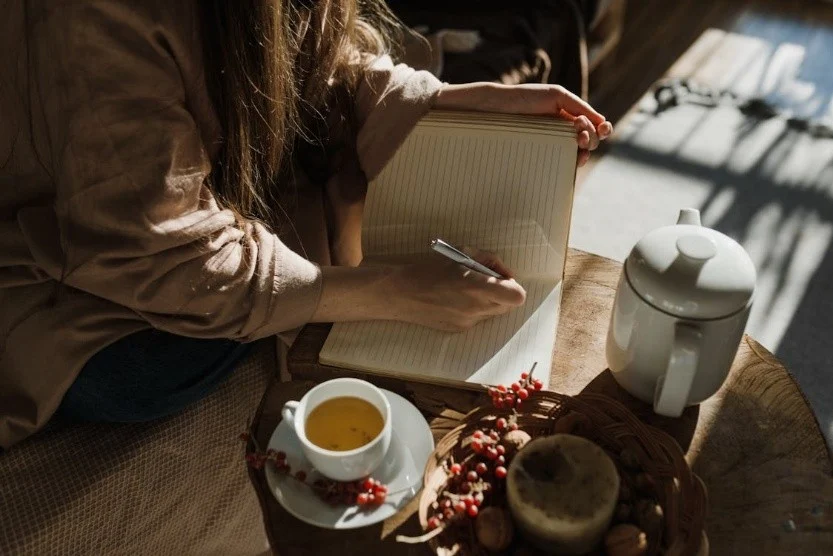
Practical exercises such as the body scan, conscious breathing or writing down your feelings every day can strengthen your emotional balance. Withdrawal, reflection, journaling, meditation or small rituals such as drinking tea or lighting candles encourage self-acceptance and emotional balance. Creative outlets and deliberately planning decisions around your cycle can also help you navigate the luteal phase mindfully and constructively.
Self-care during your inner autumn – what do I need right now?
A balanced diet with complex carbohydrates and magnesium-rich foods, enough sleep, plenty of fluids and gentle movement such as yoga or walks can help ease typical symptoms such as mood swings, irritability or exhaustion. You can cut back on intense workouts and plan in time to withdraw and take conscious breaks.
Scientific studies
A study by Lustyk et al. (2009) shows that mindfulness training can considerably reduce PMS symptoms: mindfulness-based interventions significantly lower both PMS symptoms and stress. German research groups, for example at the University of Freiburg, also emphasise that mindfulness strengthens emotional regulation – a crucial factor during hormonally sensitive phases. Programmes such as Mindfulness-Based Stress Reduction (MBSR) have also proven particularly effective for cycle-related mood swings.

Conclusion: your inner autumn as an opportunity
The inner autumn is not a tiresome phase but a valuable part of the cycle. It invites self-reflection, emotional depth and mindful self-care. If you recognise your body’s signals, respect your boundaries and consciously meet your needs, you can turn sensitive days into powerful moments of introspection and renewal. With mindfulness, loving self-care and targeted strategies, the inner autumn becomes an opportunity: to pause, gather strength and start the next part of your cycle feeling stronger.
Katharina R. (psychology student)
Deepen your meditation practice with Mindfulife
Meditation can be more than a short break in your everyday life. If you would like to understand more deeply how meditation works, how to build a steady practice of your own and how to guide others mindfully, our meditation teacher training is the next step. There you will not only get to know meditation in theory, but also develop more confidence, clarity and trust in your own practice.
Would you like to find out more about the training first? In our weekly webinar you will get an insight and learn more about what your path to becoming a meditation teacher could look like.
For regular support in your everyday life, you can also use our online meditation studio and join guided meditations flexibly via Eversports.
We look forward to accompanying you on your journey.
You can find more mindfulness inspiration on our channels too
References
Apotheken Umschau. (2025). PMDS erkennen und behandeln: Was Betroffene wissen sollten. https://www.apotheken-umschau.de/gesund-bleiben/psyche/pmds-psychische-belastung-vor-der-periode-850047.html
Bluth, K., Gaylord, S., Nguyen, K., & Girdler, S. (2015). Mindfulness-based stress reduction as a promising intervention for amelioration of premenstrual dysphoric disorder symptoms. Mindfulness, 6(6), 1292–1302.
Dorn, M., et al. (2022). PMDS als Herausforderung: Die Prämenstruelle Dysphorische Störung als schwerste Form des PMS. https://doi.org/10.17433/978-3-17-040260-7
Ergec, H. (Hrsg.). (2022). Cycle of Life: Den weiblichen Zyklus verstehen und optimal begleiten (1. Aufl.). Neue Erde.
Föhr, R. (2023). Know Your Flow: Unseren Zyklus verstehen für ein gutes Körpergefühl und besseren Sex. Piper ebooks.
Gingnell, M., Bannbers, E., Wikström, J., Fredrikson, M., & Sundström-Poromaa, I. (2013). Premenstrual dysphoric disorder and prefrontal reactivity during anticipation of emotional stimuli. European Neuropsychopharmacology, 23(11), 1474–1483. https://doi.org/10.1016/j.euroneuro.2013.08.002
Goerke, K. (2024). Menstrueller Zyklus. In Gynäkologie und Geburtshilfe für die Physiotherapie (Kap. 5). Elsevier GmbH. https://doi.org/10.1016/B978-3-437-45014-3.00005-0
Grundner, S. (2023). Menstruationszyklus: Bewusste Wahrnehmung und Kommunikation (Masterarbeit, Karl-Franzens-Universität Graz und UNI for LIFE).
Heinemann, K. A. J., Do Minh, T., Filonenko, A., & Uhl-Hochgräber, K. (2010). Explorative Evaluation der Auswirkungen schwerer prämenstrueller Störungen auf Arbeitsabsentismus und Produktivität. Women's Health Issues, 20(1), 58–65. https://doi.org/10.1016/j.whi.2009.09.005
Hochhauser, K. (2024). Untersuchung der Auswirkungen von Stress auf das physiologische und psychologische Stresserleben von Frauen mit natürlichem Zyklus und Frauen, die orale Kontrazeptiva verwenden (Masterarbeit, Paris-Lodron-Universität Salzburg, Fachbereich Psychologie). Salzburg, Österreich.
Kühner, C., & Nayman, S. (2025). Prämenstruelle dysphorische Störung [Premenstrual dysphoric disorder]. Die Psychotherapie, 70(2), 117–134.
Lustyk, M. K. B., Gerrish, W. G., Shaver, S., & Keys, S. L. (2009). Systematische Übersichtsarbeit: Kognitive Verhaltenstherapie bei prämenstruellem Syndrom und prämenstrueller dysphorischer Störung. Archives of Women's Mental Health, 12(2), 85–96. https://doi.org/10.1007/s00737-009-0052-y
New Systems Handelsgesellschaft m.b.H. (o. J.). Den Zyklus verstehen und achtsam leben. Selenacare. https://selenacare.com/ratgeber/den-zyklus-verstehen-und-achtsam-leben
Paulus, W., Agyemang, A., & Nowotny-Behrens, U. (2024). Psychische Störungen während Schwangerschaft, Geburt oder Wochenbett, Menstruation und Perimenopause (Kap. 27, S. 873–885). In Psychiatrie und Psychotherapie (7. Aufl.). Elsevier GmbH. https://doi.org/10.1016/B978-3-437-22487-4.00027-7
Rapkin, A. J., & Winer, S. A. (2009). Premenstrual syndrome and premenstrual dysphoric disorder: Quality of life and burden of illness. Expert Review of Pharmacoeconomics & Outcomes Research, 9(2), 157–170. https://doi.org/10.1586/erp.09.14