The AI Revolution: Will Machines Replace Humans? Leonard Schmedding on Opportunities and Risks
Leonard Schmedding on machines and artificial intelligence

 · 6 min read
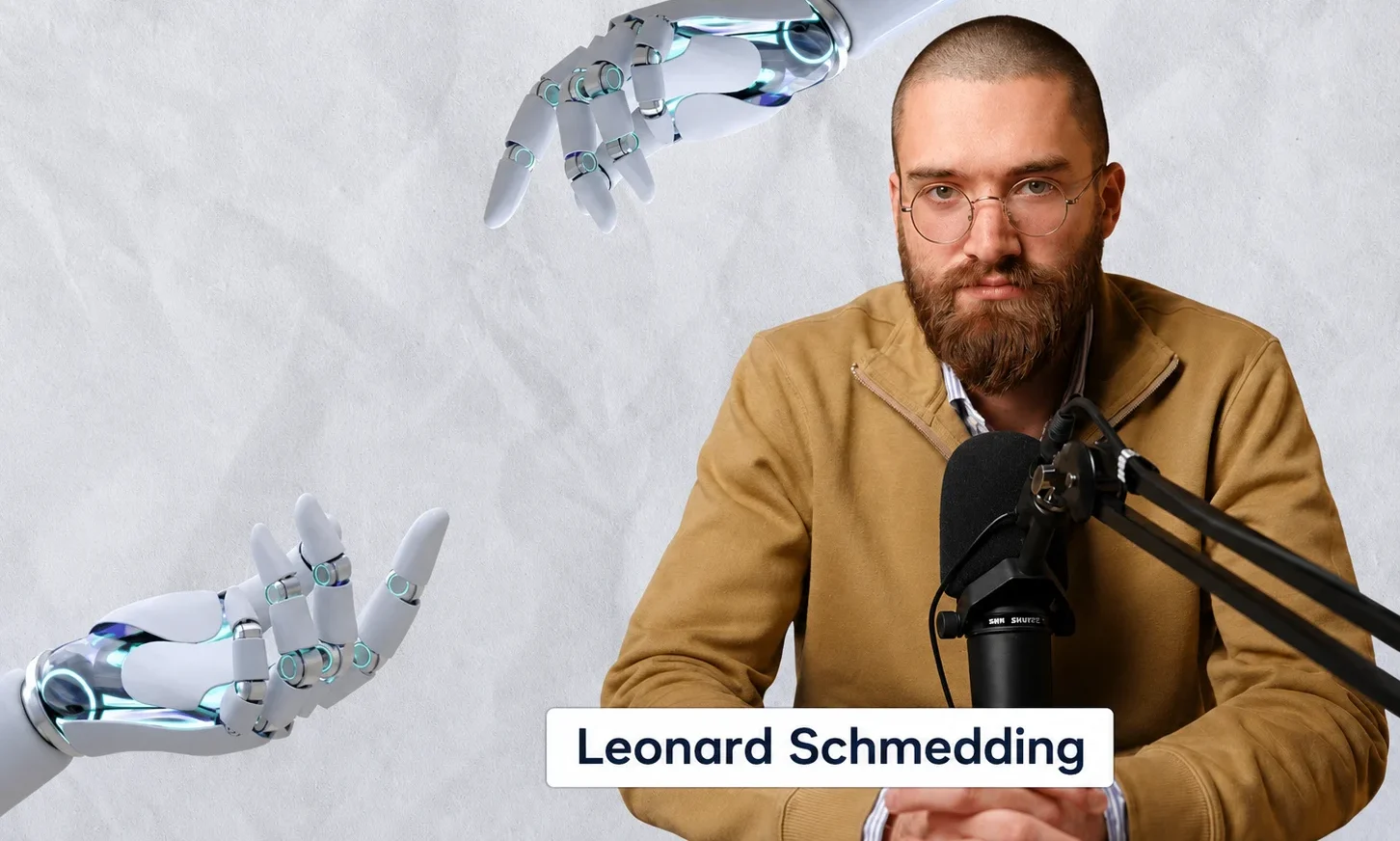
Artificial intelligence (AI) is currently transforming entire business models and putting machines centre stage, but Leonard Schmedding, co-founder and Chief AI Officer of Everlast Consulting GmbH, is not intimidated by this. In fact, he has made it his company’s vision. With his digital consultancy Everlast AI, he advises others on AI and automation to help them increase their efficiency.
Leonard knows the field of AI very well himself and regularly talks with experts, futurologists and professors, including Jürgen Schmidthuber and Markus Hutter, to deepen his expertise and perspective. In the latest podcast episode, he talks about the rapid development of artificial intelligence, possible upheavals in society and why, in his view, Germany needs more tech optimism. It is not just about ChatGPT or new tools, but about a development that, according to him, will change almost every industry.
Why does Leonard Schmedding see artificial intelligence as a historic opportunity?
Overall, he is optimistic about the development of AI, but he also stresses that the technology is perceived in completely different ways depending on one’s perspective. While entrepreneurs see enormous efficiency gains and new business models, many employees feel uncertain in the face of rapid technological change. This is precisely why the debate around AI is becoming increasingly important: somewhere between doomsday scenarios and blind hype, we need a realistic view of the changes that actually lie ahead.
A decisive turning point came at the end of 2022 with the breakthrough of large language models such as ChatGPT. This was made possible by technical developments such as the transformer architecture, which suddenly allowed AI models to understand and process language, context and complex tasks far better than earlier systems. The key innovation lies in the “attention” mechanism, which enables the model to consider and weight the relationships within a sentence. As a result, language can be understood and generated much more naturally (Vaswani et al., 2017).
In Leonard’s expert opinion, the next major step in development lies in the area of code and programming. The rule here is: “The better an AI becomes at mathematics and programming, the more capable it becomes in other areas too.” This could lead to enormous scientific breakthroughs, such as solving mathematical problems, accelerating scientific research and developing medicines. Systems such as AlphaFold are already showing that AI can solve highly complex biological problems, for example predicting protein structures (Jumper et al., 2021). AI is also increasingly being used in pharmaceutical research to identify new active substances more quickly and speed up development processes (Zhavoronkov et al., 2019).

How close are we really to AGI and autonomous AI systems?
According to Leonard, we are currently only at the beginning of AI development. As a guide, he presents a roadmap from OpenAI, which is divided into several stages of development.
- Classic chatbots – systems that mainly generate text or answer questions
- “Reasoners” or “thinking models” – models that can solve more complex problems logically and understand connections better
- AI agents – the stage we are currently in, which goes beyond generating content to independently carrying out economically relevant tasks and running automated processes
- “Innovative AI” – AI systems that can achieve scientific breakthroughs on their own
- Organisational AI – entire companies can be run largely autonomously by AI systems acting as economically and legally relevant entities in their own right
Google DeepMind also anticipates a similar development, but places particular emphasis on scientific research. In this context, Leonard also talks about AGI (artificial general intelligence) – a system capable of handling all the cognitive tasks a human can. Unlike today’s AI, AGI would therefore no longer be specialised in individual tasks but could be used universally. We are not nearly as far from this stage as many people still believe. Experts describe the period between 2030 and 2035 as a possible turning point at which AGI, and subsequently even superintelligence, could become reality. From that point on, AI could become cognitively more capable than any individual human.
What does artificial intelligence mean for the world of work?
The impact of machines will be felt in many different areas, but the world of work will be particularly affected. In the long term, it is a realistic estimate that 60 to 80 per cent of today’s jobs could disappear or change fundamentally. According to Goldman Sachs (2026), the risks are greatest where human work can be directly replaced, such as in office, administrative or assistant roles. At the same time, however, artificial intelligence can also boost productivity and thereby create new demand as well as new jobs.
How far this development has already progressed can be seen, among other things, in the discussion surrounding the so-called “remote Turing test”. While the classic Turing test describes a situation in which people in a conversation can no longer tell whether they are communicating with an artificial intelligence or a human, the remote Turing test goes one step further: here it is no longer possible to tell whether a specific piece of work was done by a human or by an AI. The original Turing test goes back to the mathematician Alan Turing, who back in 1980 asked whether machines can “think”.
At the same time, however, Leonard sees this as one of the most significant economic opportunities. Anyone who can integrate AI meaningfully into companies will be in extremely high demand in the coming years, which is why the roles of “AI manager” or “AI integrator” in particular are considered highly relevant. Especially important here is the introduction of “corporate LLMs”, central AI systems within a company that serve as a shared knowledge base and automate repetitive tasks.

What role will humans still play in the future?
Despite the rapid development of artificial intelligence, technological progress does not automatically mean that humans will become superfluous. Rather, the human role will change: instead of carrying out tasks themselves, it will become more important for people to define goals, steer processes and evaluate results. This shift is particularly evident in creative professions, such as graphic design.
At the same time, it is becoming clear that in many areas humans can hardly compete directly with artificial intelligence. AI already often works faster, more cheaply and more efficiently, which opens up a number of new opportunities for freelancers and small teams. Tasks that once required entire departments can now sometimes be carried out by just a few people with the support of AI.
Are we heading towards superintelligence in the long term?
The discussion around AI now goes far beyond chatbots. More and more often, the question arises as to whether it could develop in the long term into a superintelligence that far exceeds human abilities. Because AI is based on mathematical and physical principles, many experts currently see no clear limit that would fundamentally stop its further development.
At the same time, this idea raises enormous philosophical questions. One particularly well-known example is the “paperclip maximiser” thought experiment by the philosopher Nick Bostrom. He describes an AI that has been optimised solely to produce as many paperclips as possible and that would, in theory, use up all available resources to do so. The example is meant to illustrate that highly advanced AI systems would not necessarily have to act “maliciously” in order to become dangerous. Even goals that are wrongly or too narrowly defined could have problematic consequences (Bostrom, 2014). The key question is whether these goals will remain aligned with human interests in the long run.
This relationship is often compared to the difference between humans and animals: it is not physical strength that determines dominance but cognitive ability, which gives rise to the image of a “cognitive zoo” – a scenario in which humans would no longer be the most intelligent species.
Whether AI will ultimately prove to be more of a risk or an opportunity remains an open question. What is clear, however, is that the development is progressing faster than many would have expected and will fundamentally change the economy, the world of work and society in the long term.
Friederike Schuh (media communication student)
If you would like to delve even deeper into Leonard Schmedding’s thoughts, you can listen to the full conversation with Phil here. The podcast episode covers AI, the future of the world of work and the question of what role superintelligence might play in the future. Enjoy listening!
Deepen your meditation practice with Mindfulife
Meditation can be more than a short break in your everyday life. If you would like to understand more deeply how meditation works, how to build a steady practice of your own and how to guide others mindfully, our meditation teacher training is the next step. There you will not only get to know meditation in theory, but also develop more confidence, clarity and trust in your own practice.
Would you like to find out more about the training first? In our weekly webinar you will get an insight and learn more about what your path to becoming a meditation teacher could look like.
For regular support in your everyday life, you can also use our online meditation studio and join guided meditations flexibly via Eversports.
We look forward to accompanying you on your journey.
You can also find more mindfulness inspiration on our channels:
References
Bostrom, N. (2014). Superintelligence: Paths, Dangers, Strategies. Oxford University Press.
Goldman Sachs (2026). The Jobs AI Is Likely to Boost-and Those It May Disrupt.
https://www.goldmansachs.com/insights/articles/the-jobs-ai-is-likely-to-boost-and-those-it-may-disrupt
Jumper, J., Evans, R., Pritzel, A. et al. Highly accurate protein structure prediction with AlphaFold. Nature 596, 583–589 (2021). https://doi.org/10.1038/s41586-021-03819-2
Turing, A. M. (1980). Computing machinery and intelligence. Creative Computing, 6(1), 44-53.
Vaswani, A., Shazeer, N., Parmar, N., Uszkoreit, J., Jones, L., Gomez, A. N., ... & Polosukhin, I. (2017). Attention is all you need. Advances in neural information processing systems, 30. https://doi.org/10.48550/arXiv.1706.03762
Zhavoronkov, A., Ivanenkov, Y.A., Aliper, A. et al. Deep learning enables rapid identification of potent DDR1 kinase inhibitors. Nat Biotechnol 37, 1038–1040 (2019). https://doi.org/10.1038/s41587-019-0224-x