Introvert vs. Extrovert: How Do You Find the Balance?
Discover how introverts and extroverts can make the most of their strengths in everyday life. Tips for better communication, self-acceptance and harmonious relationships

 · 5 min read
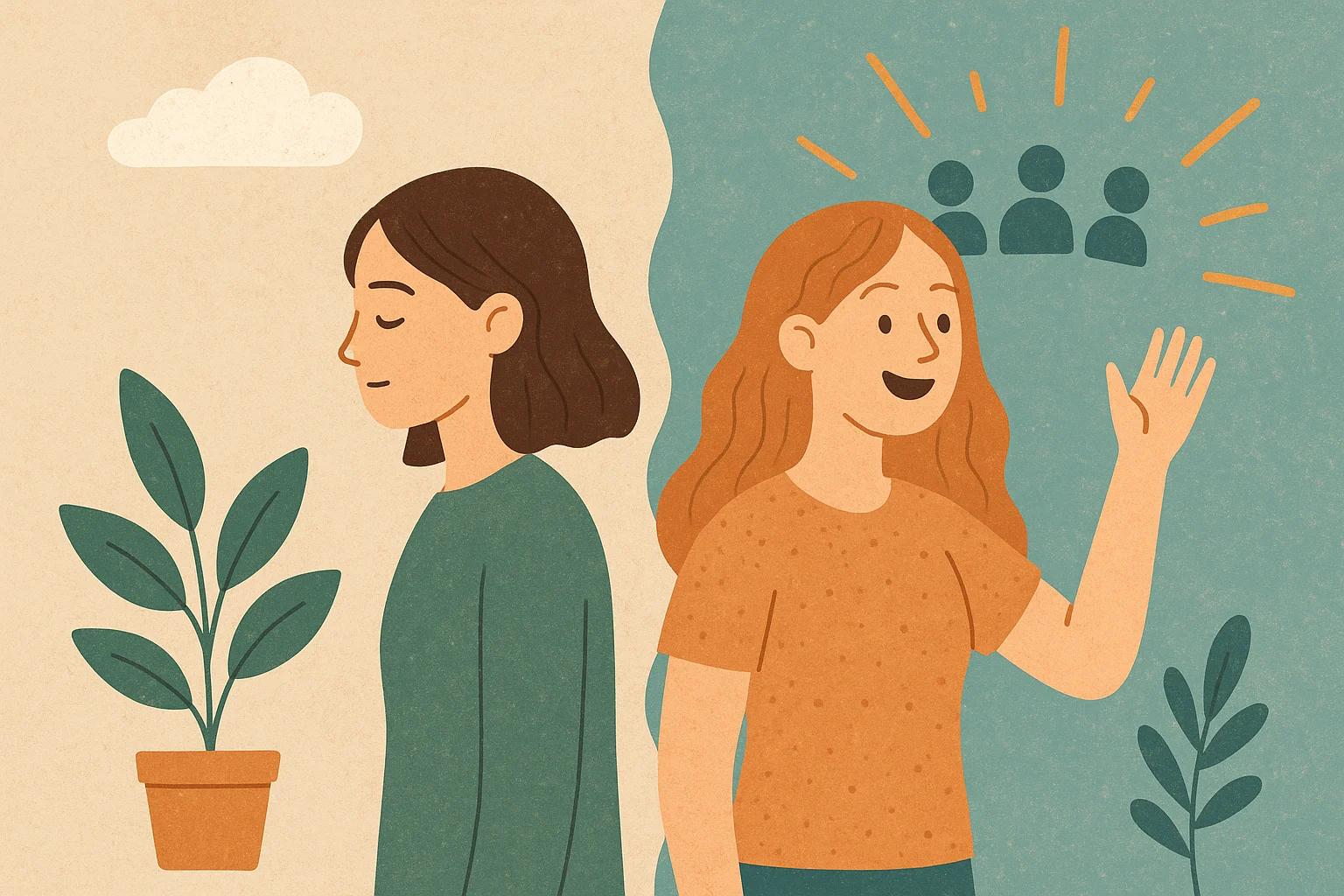
In a world often shaped by loud voices and hectic activity, two fundamental personality types shape our behaviour: introverted and extroverted. These terms describe deeply rooted traits that influence our daily lives. But how can we recognise their differences, and how can we use the strengths of both sides to find a harmonious balance in everyday life?
What does it mean to be introverted?
Introverted people draw their energy from their inner world. They enjoy time alone or in small groups and often think deeply about things. Large crowds or hectic surroundings can overwhelm them. Studies show that introverts process information more carefully and solve complex problems analytically (Nikol, 1996; Springer, 2024).
How does this personality structure play out in everyday life? Introverts often think things through thoroughly, show a high level of empathy and come up with creative solutions. At the same time, they may find it difficult to make themselves heard in large groups or to express themselves spontaneously.
Strengths of introverts
- Deep thinking: They are often able to analyse complex problems thoroughly. They take the time to consider every aspect of an issue.
- Empathy: They have a strong sense of other people’s feelings and are good listeners. This makes them valuable friends and colleagues.
- Creativity: Many of them are creative minds who find innovative solutions. Their capacity for self-reflection often fosters original ideas.

Challenges for introverts
Despite their many strengths, they also face challenges:
- Social interactions: Many of them feel uncomfortable or drained in social situations. This can lead them to miss opportunities or withdraw.
- Self-confidence: They often find it hard to make themselves heard in large groups or to voice their opinions out loud.
- Misunderstandings: Their quiet manner can sometimes be misread as disinterest or unfriendliness.
Tips for introverts
- Build your self-confidence: Acknowledge your strengths and abilities. Remind yourself that your quiet nature is often a strength.
- Prepare for networking: Get ready for networking events by thinking of conversation topics in advance or writing down questions you would like to ask.
- Favour small groups: Look for opportunities to interact in smaller groups, where you feel more comfortable and can have deeper conversations.
- Schedule breaks: Plan regular breaks to withdraw and recharge, especially after long social interactions.
- Practise active listening: Make active use of your listening skills to build relationships. Ask questions and show interest in other people’s opinions.
- Use written communication: If you feel uncomfortable in face-to-face conversations, use emails or messages to express your thoughts.
- Set goals: Set yourself small goals for social interactions – e.g. one conversation per event – to gradually gain more self-confidence.
- Pursue hobbies and interests: Get involved in activities or groups that match your interests. This makes it easier to connect with like-minded people.
What does it mean to be extroverted?
Extroverts draw energy from social interactions and feel at ease in large groups. They speak their minds openly, often act spontaneously and motivate others.
What opportunities and challenges does this bring? Extroverts can easily build networks and inspire teams, but they are sometimes impulsive and overlook details. They, too, need periods of calm to recharge and reflect clearly.
Strengths of extroverts
- Social skills: They are often excellent networkers and can easily make new connections. Their openness draws others in.
- Energy: Their enthusiasm can be infectious and motivate others. They create a positive atmosphere in groups.
- Quick decision-making: They often act on impulse and can respond quickly to change – an ability that is an advantage in dynamic environments.

Challenges for extroverts
- Superficial relationships: Because of their sociable nature, they may find it harder to build deeper emotional bonds.
- Impulsiveness: Their spontaneous nature can sometimes lead them to make rash decisions.
- Sensory overload: In very busy or noisy environments, they too can become overwhelmed.
Tips for extroverts
- Practise active listening: Try to listen consciously and ask questions rather than just expressing your own thoughts. This encourages deeper conversations.
- Schedule quiet time: Plan times when you are alone or doing calm activities – this helps you recharge your energy.
- Develop empathy: Try to understand the perspective of introverted people. This fosters understanding and cooperation.
- Seek out diversity: Actively look for opportunities to interact with introverted people. This way you can broaden your understanding and improve your social skills.
- Give and receive feedback: Be open to feedback from others about your communication style and work on responding more sensitively to other people’s needs.
- Observe group dynamics: Pay attention to how others respond in group situations. Sometimes it helps to make space for others.
- Set goals for quiet moments: Set yourself goals for quiet moments during the day – e.g. 10 minutes of meditation or simply time to think without distractions.
- Take responsibility: Use your leadership qualities to encourage and include others. Create an environment in which everyone can feel comfortable.
How do misunderstandings arise between introverts and extroverts?
Different communication styles often lead to misunderstandings. While introverts need more time to think, extroverts respond quickly. Studies show that extroverts perceive social stimuli more intensely and respond to them faster, whereas introverts act more selectively and reflectively (Fishman, Ng & Bellugi, 2011).
How can we communicate better? It helps to respect the other person’s style, to find common interests and to make room for different voices in conversations.

What role do introversion and extraversion play in working life?
In the world of work, the traits of introversion and extraversion play a decisive role in team dynamics as well as in individual career development.
Both types bring valuable perspectives to teams. Introverts provide analytical depth, while extroverts encourage exchange and motivation.
How can teams benefit from this? A mix of both types allows for both strategic planning and dynamic collaboration. Both types also show their strengths in leadership: introverts build trust, while extroverts inspire and motivate the team.
How important is self-acceptance for balance?
Self-acceptance is essential for a mindful life. Introverts should acknowledge their strengths and not try to conform to extroverted norms. Extroverts, in turn, can learn to consciously plan periods of rest and to withdraw.
How can self-acceptance contribute to a better balance? Those who understand and value their own traits can live more authentically and build more harmonious relationships.

Conclusion: How can we be strong together?
The world needs both introverted and extroverted people. By recognising and appreciating the strengths of both types, we can build harmonious relationships at work and in our private lives. When we learn from one another and look out for each other, we create an environment in which everyone can find their voice.
This article was written by Michelle Brühl
revised on 6 October 2025
by Katharina R. (psychology student)
Deepen your meditation practice with Mindfulife
Meditation can be more than a short break in your everyday life. If you would like to understand more deeply how meditation works, how to build a steady practice of your own and how to guide others mindfully, our meditation teacher training is the next step. There you will not only get to know meditation in theory, but also develop more confidence, clarity and trust in your own practice.
Would you like to find out more about the training first? In our weekly webinar you will get an insight and learn more about what your path to becoming a meditation teacher could look like.
For regular support in your everyday life, you can also use our online meditation studio and join guided meditations flexibly via Eversports.
We look forward to accompanying you on your journey.
You can find more mindfulness inspiration on our channels too
References
Mindset Movers. (n.d.). Typsache: Introvertierte & Extrovertierte im Beruf. https://www.mindsetmovers.de/blog/typsache-introvertierte-und-extravertierte-im-beruf/
Müllner, M., & Müllner, C. (2021). Individuell führen. Springer Fachmedien Wiesbaden. https://doi.org/10.1007/978-3-658-33219-8_6
Nikol, M. (1996). Introvertiert oder extrovertiert? Kommunikationsfähigkeiten. Springer Berlin Heidelberg. https://doi.org/10.1007/978-3-642-48901-3_3
Onaran, T. (2019). Introvertiert ist der neue Türöffner. Springer Fachmedien Wiesbaden. https://doi.org/10.1007/978-3-658-23735-6_12
Pong, C. (2024, Dezember 8). Why introverted leaders outperform extroverts by 28%, study reveals. Forbes. https://www.forbes.com/sites/cynthiapong/2024/12/08/why-introverted-leaders-outperform-extroverts-by-28-study-reveals/
Rechel, S. (2017). Introvertiert und involviert. Praxis: Introvertierte Personaler müssen im Job laufend ihre Komfortzone verlassen. So setzen Sie ihre Stärken besser ein und agieren in beruflichen Situationen souverän. PERSONALmagazin, 9, 84–85.
Springer. (2024). Persönlichkeitstypen – den Kunden verstehen lernen (S. 155–184). Springer Books.
Springer. (2024). Was bedeutet eigentlich Introversion? (S. 1–14). Springer Books. https://doi.org/10.1007/978-3-658-43483-0
Studyflix. (n.d.). Introvertiert und extrovertiert einfach erklärt. https://studyflix.de/biologie/introvertiert-und-extrovertiert-6843