Digital mindfulness: how can I quickly regain my balance?

 · 6 min read

Digital mindfulness – if you are wondering how it works and how you too can manage to meditate digitally, then you have come to the right place! We hope you enjoy reading!
Digitalisation has arrived
For some years now, digitalisation has been making its way into our private lives as well as the workplace. Many professions have changed fundamentally, new sectors have been created and some have disappeared from the market altogether. To keep up in the modern world of work, staying up to date with computer technology and enabling connectivity has become a central task for many companies. That is why, in this article, we look at the topic of digital mindfulness.
What challenges do employers and employees face?
However, it is not only employers who face new challenges in times of Industry 4.0, as digitalisation is often described, but employees too. Key challenges that arise include greater demands on one’s own education and training, changes to entire production chains, the fear of being constantly reachable (Klammer et al., 2017) and a generally faster pace of development within the labour market (Chobanova & Kocarev, 2019).
Lifelong learning for working with new technology
Although many employees fear losing their jobs to new technologies, this is rarely the case – jobs are mostly not replaced by automation processes but changed (Arnold et al., 2016). Because of this change, it is very important that employers and employees are able to adapt jobs and continue their training. Digitalisation gives the concept of lifelong learning a new meaning – it is important to be able to work alongside new technologies.
What does digitalisation mean for employees?
Industry 4.0 has also changed the way we work – towards greater flexibility in terms of location. While this offers obvious advantages, such as being able to work from anywhere and saving on commuting, it can also place a strain on employees. In particular, the fear of being constantly reachable and more difficult collaboration with colleagues are frequently raised as points of criticism by staff (Klammer et al., 2017).
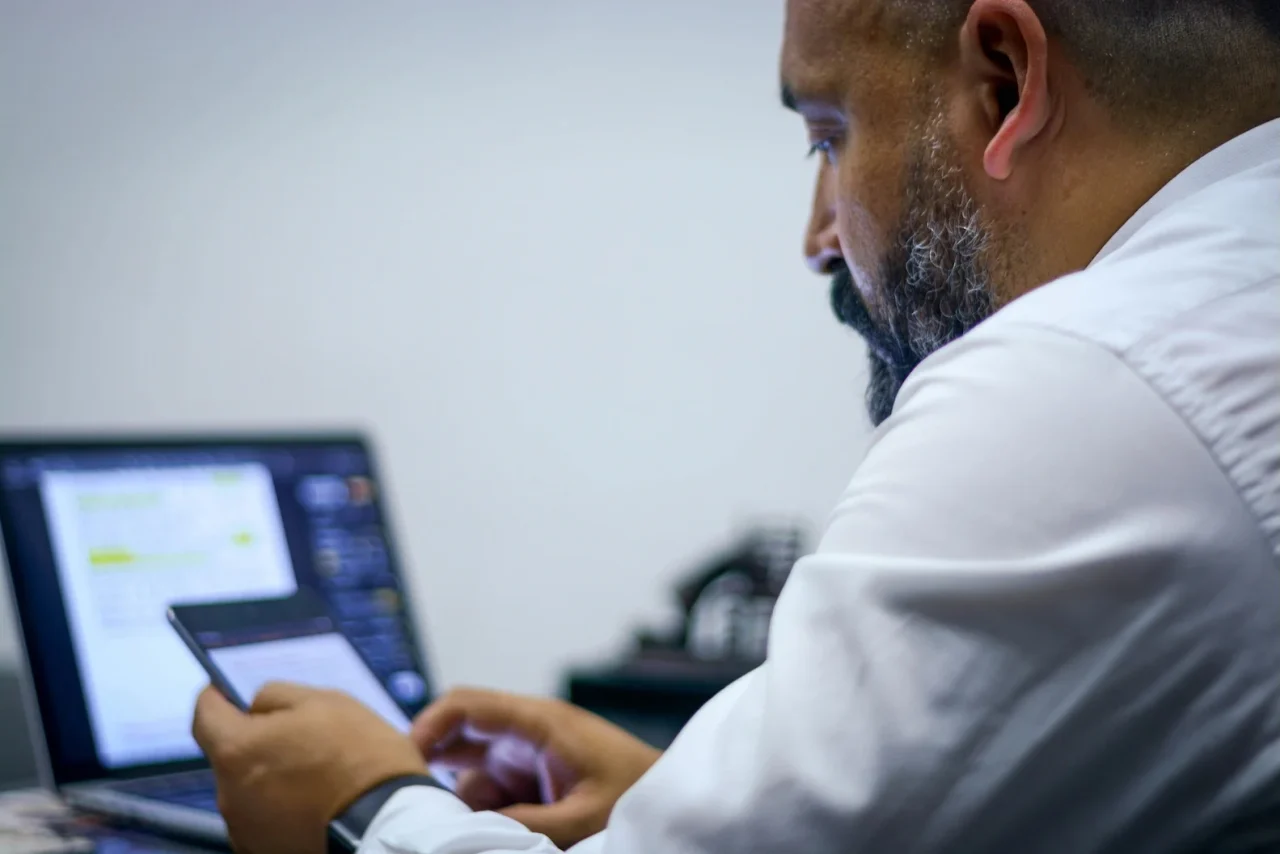
But it is not only when working from home – constant reachability through work and personal devices also plays a major role in the workplace and in our private lives. We are continually exposed to new stimuli, check work emails even during breaks and divide our attention between several tasks at once. As a result, employees quickly become overloaded with information and find it harder to switch off.
What are the disadvantages of digitalisation?
In one of his studies, psychologist Adrian F. Ward found that the mere presence of a smartphone leads to considerable losses in cognitive performance. Ward was also able to show that participants rated the tasks they had to complete as easier when their smartphone was as far away as possible (Ward et al., 2017). Van Velthoven and colleagues (2018) specified these losses in cognitive performance further and found that smartphone use can above all lead to a reduced attention span and problems with concentration.
How can we deal with these new challenges?
What matters is how you deal with these new challenges and counteract the possible negative effects of new technologies. One approach that has received increasing attention in recent years is mindfulness practice. The fact that meditation, for example, has positive effects on both mental and physical processes has now been scientifically demonstrated many times. Mindfulness is also a promising approach when it comes to work-related stress.
What does mindfulness mean? Well, there are many definitions of mindfulness (in German, Achtsamkeit). While the concept originally comes from Buddhism and roughly means “reflective awareness” (Buddhadasa, 2017), it has since arrived in the Western world too. Jon Kabat-Zinn, one of the pioneers of mindfulness practice, defines mindfulness as “paying attention in a particular way: on purpose, in the present moment, and non-judgementally” (Kabat-Zinn et al., 2019).
Can acceptance increase resilience?
A central element of mindfulness is acceptance. In their study, Kropp and Sedlmeier (2019) were able to show that mindfulness practice (in this case in the form of a body scan) increased participants’ acceptance. A greater capacity for acceptance helps us to stay resilient and ready for new challenges in an increasingly overwhelming digital world. In addition to increased acceptance, Kropp and Sedlmeier (2019) also found that practising the body scan improved the ability to concentrate.
Better emotion regulation through mindfulness
Compared with two other relaxation methods, the authors of the study were also able to show that the mindfulness exercise was most strongly associated with improved emotion regulation. When it comes to dealing with the frustration that can arise in a world of work transformed by digitalisation, this can be a key element. The study concluded that the body scan helped participants to cope better with both a lack of emotion and overly intense emotions.
Better performance at work
Another key benefit of mindfulness practice is improved performance at work. Psychological research has identified a positive relationship between mindfulness and job performance (Dane & Brummel, 2013). In particular, the influence of mindful leaders on their employees has already become a focus of scientific attention. There is evidence that more mindful leaders also manage employees who perform better, are more committed to the company and are more satisfied (Reb et al., 2014). Employers should therefore also consider whether promoting mindfulness might help to counteract the negative effects of digitalisation.
Read more about mindful leadership in our article!

Digital mindfulness: mindfulness apps
One advantage of technological progress is that, alongside some potential burdens, it also offers great potential – mindfulness can also be strengthened digitally. Smartphone apps are well suited to building a routine – they help to integrate the new practice into everyday life and can also remind users to practise. The advantages of digital approaches include easier access to content, efficient usability and simple ways of standardising a programme (Mrazek et al., 2019).
Digital guided meditations
What apps cannot offer is the personal support that is often needed to identify and resolve potential problem areas or difficulties in understanding. For this, a guided introduction to the topic is advisable. Trainers can respond to participants individually and adapt to a group or to individual people. Here, too, digitalisation has made access easier – mindfulness training does not necessarily have to take place in person as a group but can also be done online. In fact, guided, digitally led meditations are more effective than unguided meditations in person (Spijkerman et al., 2016). This, too, is digital mindfulness.
What is digital mindfulness?
Whether during working hours, at lunch or after work – thanks to new technologies, anyone interested can easily come together and guard against the strains of digitalisation in a digital way. However paradoxical that may sound. Digitalisation can be both at the same time: a challenge, but also an opportunity – if you know how to make use of it.
Digital mindfulness: this article in brief
- Digitalisation brings many new challenges
- The way we work has changed: lifelong learning is the watchword for learning how to handle the latest technologies
- The problem of constant reachability is a new and unavoidable stress factor
- Smartphone use costs us attention and concentration
- A regular mindfulness practice can help us deal with the new challenges
- Digital mindfulness promotes acceptance and thus increases resilience in dealing with stress
- Exercises that train attention improve performance at work
- Focused awareness can also be achieved digitally: through apps or with online guided meditations
Deepen your meditation practice with Mindfulife
Meditation can be more than a short break in your everyday life. If you would like to understand more deeply how meditation works, how to build a steady practice of your own and how to guide others mindfully, our meditation teacher training is the next step. There you will not only get to know meditation in theory, but also develop more confidence, clarity and trust in your own practice.
Would you like to find out more about the training first? In our weekly webinar you will get an insight and learn more about what your path to becoming a meditation teacher could look like.
For regular support in your everyday life, you can also use our online meditation studio and join guided meditations flexibly via Eversports.
We look forward to accompanying you on your journey.
You can find more mindfulness inspiration on our channels too
References
Arnold, D., Butschek, S., Müller D. und Steffes, S. (2016). Digitalisierung am Arbeitsplatz. Aktuelle Ergebnisse einer Betriebs- und Beschäftigtenbefragung, Forschungsbericht im Auftrag des Bundesministeriums für Arbeit und Soziales und des Instituts für Arbeitsmarkt- und Berufsforschung, Berlin.
Buddhadasa, A. B., Rosenberg, L. & Santikaro, B. (2015). Mindfulness with Breathing: A Manual for Serious Beginners. Wisdom Publications. http://gbv.eblib.com/patron/FullRecord.aspx?p=4403110
Chobanova, R. & Kocarev, L. (2019). Digitalisation as a challenge for enterprises in 21 st century. Ikonomicheski Izsledvania, 28, 153–173.
Dane, E. & Brummel, B. J. (2014). Examining workplace mindfulness and its relations to job performance and turnover intention. Human Relations, 67(1), 105–128. https://doi.org/10.1177/0018726713487753
Kabat-Zinn, J., Kierdorf, T. & Höhr, H. (2019). Im Alltag Ruhe finden: Meditationen für ein gelassenes Leben (Vollständige Taschenbuchausgabe).
Klammer, U., Steffes, S., Maier, M. F., Arnold, D., Stettes, O., Bellmann, L. & Hirsch-Kreinsen, H. (2017). Arbeiten 4.0 - Folgen der Digitalisierung für die Arbeitswelt. Wirtschaftsdienst, 97(7), 459–476. https://doi.org/10.1007/s10273-017-2163-9
Kropp, A. & Sedlmeier, P. (2019). What Makes Mindfulness-Based Interventions Effective? An Examination of Common Components. Mindfulness, 10(10), 2060–2072. https://doi.org/10.1007/s12671-019-01167-x
Mrazek, A. J., Mrazek, M. D., Cherolini, C. M., Cloughesy, J. N., Cynman, D. J., Gougis, L. J., Landry, A. P., Reese, J. V. & Schooler, J. W. (2019). The future of mindfulness training is digital, and the future is now. Current opinion in psychology, 28, 81–86. https://doi.org/10.1016/j.copsyc.2018.11.012
Reb, J., Narayanan, J. & Chaturvedi, S. (2014). Leading Mindfully: Two Studies on the Influence of Supervisor Trait Mindfulness on Employee Well-Being and Performance. Mindfulness, 5(1), 36–45. https://doi.org/10.1007/s12671-012-0144-z
Spijkerman, M. P. J., Pots, W. T. M. & Bohlmeijer, E. T. (2016). Effectiveness of online mindfulness-based interventions in improving mental health: A review and meta-analysis of randomised controlled trials. Clinical psychology review, 45, 102–114. https://doi.org/10.1016/j.cpr.2016.03.009
van Velthoven, M. H., Powell, J. & Powell, G. (2018). Problematic smartphone use: Digital approaches to an emerging public health problem. Digital health, 4, 2055207618759167. https://doi.org/10.1177/2055207618759167
Ward, A. F., Duke, K., Gneezy, A. & Bos, M. W. (2017). Brain Drain: The Mere Presence of One’s Own Smartphone Reduces Available Cognitive Capacity. Journal of the Association for Consumer Research, 2(2), 140–154. https://doi.org/10.1086/691462