Mindfulness in the Workplace – How Can You Reduce Stress at Work?

 · 8 min read

Mindfulness in the workplace – if you are wondering how it works and how you, too, can bring mindfulness into your working day, you have come to the right place! We hope you enjoy reading!
How can you reduce stress at work? – Mindfulness in the workplace is now more than just a spiritual practice
When it comes to meditation and mindfulness exercises, people sometimes assume they already know what it is all about. Perhaps they have a rough idea of what such exercises involve. However, anyone who looks into the subject more closely may be surprised to discover how extensively science has studied these ancient traditions in recent years – and how much it continues to do so!
After all, mindfulness is not only enriching for Buddhist monks. Regardless of whether (or rather which) religion you belong to, these simple exercises prove to be a real tonic for the mind (find out more about the effects of meditation here). No wonder, then, that the approach is gradually being applied in all sorts of areas and that mindfulness is arriving in the workplace. Even as an alternative to conventional forms of psychotherapy, so-called “Mindfulness-Based Cognitive Therapy” (MBCT) has already achieved remarkable results in empirical studies.

How does mindfulness work in the workplace?
In a business context, mindfulness kills two birds with one stone: alongside mental health, productivity also increases, as a study by Aikens et al. (2014) suggests. However, the body of research is still changing considerably. While there are findings that point to high effectiveness, there are also others suggesting that the interventions only have a specific influence on certain areas and are not universally effective (Pieter & Wolf, 2013).
So it remains to be seen which measures work best under which circumstances, because given today’s working conditions and demands, the proportion of mental health problems appears to be rising steadily. This is reflected not only in increasing sickness absence: since the end of the 1990s, mental illnesses have even been among the main reasons for early retirement (Pieter & Wolf, 2013).
Can mindfulness reduce stress in the workplace?
Stress reduction interventions are therefore becoming ever more interesting and in demand in the world of work. But how do you teach effective stress management at work?
Although there is not yet a “handbook” for applying these methods as efficiently as possible, it is worth experimenting with mindfulness exercises yourself, as numerous studies are already showing, even at a neural level, that mindfulness has the potential to boost performance and health. Mindfulness describes an attitude of being fully “present”: perceiving and accepting a situation without judging it too hastily. So perhaps it is worth bringing a little of this mindfulness into the workplace and into your own working day.
What are the business benefits of mindfulness-based meditation?
Regular practice makes it possible to take a new perspective on situations and to solve problems creatively, for example by coming up with new ways of behaving (= thinking outside the box) (Sauer et al., 2011). These are, of course, skills that are desirable in employees and managers alike. It therefore seems to be a win for everyone involved to try integrating regular meditation into everyday company life. In other words: mindfulness clearly has potential as a staff development measure.
How do you create a better atmosphere in meetings?
Economist, author, management consultant and Buddhist teacher Kai Romhardt explores how mindfulness can be applied in meetings. In his view, even small, inconspicuous measures can make a difference to how people work together – meetings can feel joyful and inspiring to participants, or they can leave them feeling frustrated and as though their time has been wasted. The reasoning is simple: if you carry negative judgements or feelings about others within you, this stands in the way of a constructive and positive atmosphere. And if you are not aware of this, you will not try to set such an attitude aside.
Mindfulness is therefore cited as the key to a good, productive and efficient meeting atmosphere, as it describes a state of mind in which you are fully aware of the present moment and can clearly see what is going on in your own thoughts and feelings. If you notice how you are judging others, you are also able to refrain from judgement. This creates an atmosphere of trust and non-judgemental listening in the workplace, which holds the potential for high productivity.

But what does this do for the individual?
You might now mistakenly conclude that mindfulness is practised for purely altruistic reasons – after all, one of its effects is a reduction in self-centred tendencies. However, by behaving mindfully, you are doing yourself a favour first and foremost, rather than those around you! A mindful attitude consequently also leads to treating others mindfully.
Because if you feel negative emotions such as anger or envy but are still able to let go of them, this has a positive effect not only on your own wellbeing but also on that of the person you previously judged negatively. Working relationships benefit enormously! After a while, you can observe how more mindful communication changes existing power structures and how interruptions and monologues become less frequent.
How do you bring mindfulness into the workplace?
Of course, it is a process of practice that you need to be willing to commit to, but it is not difficult. Romhardt suggests taking around 30 seconds of silence before a meeting in order to arrive fully in the here and now and engage with the meeting. In general, he says, you should not be afraid of silence (for instance, by considering it awkward, uncomfortable or unproductive), but use it deliberately, now and then letting a contribution sink in and giving yourself time to process it internally.
According to Romhardt, exercises like these help you focus better on what really matters. Another simple measure is to set clear communication rules. This gives people the reassurance that they will get the chance to speak when they want to, and frees them from the urge to act on every impulse to speak. “Being alert to an impulse and not automatically acting on it is an expression of great freedom,” says Romhardt.
What is mindful leadership?
When it comes to meditation for managers, there is also something to be said about mindfulness in the workplace:
As managers are often exposed to high levels of stress, mindfulness exercises would be useful in this context too. But because mindfulness is more than just a performance-enhancing, stress-reducing programme – namely a fundamental attitude that restructures habits of thought – it can bring about social benefits in addition to its health- and performance-enhancing effects: according to Sauer et al. (2011), mindfulness is a process that helps managers increase their “inner transparency” and thus lead by good example, rather than letting control and instructions dictate their leadership style.
Not only do managers become more aware of their own actions and thoughts; they are also better able to recognise and make use of the needs, talents and potential of their employees. “Those who are able to activate their mental resources with less effort can find more effective or more innovative solutions to problems,” say Sauer et al. (2011). This makes mindfulness in the workplace relevant in this area too.
Can you reduce narcissistic tendencies?
According to other studies, the reduction of narcissistic tendencies is a key mechanism of mindfulness meditation (Shapiro et al., 2006). Letting your own ego take a step back and adopting as objective a perspective as possible leads to less selfish and therefore often more constructive decisions. A great gain for managers.
How do you stay calm in difficult situations?
It is often argued that the empathic sensitivity that comes with a mindful attitude stands in the way of the necessary ability to keep a personal distance (e.g. when making tough decisions). The opposite is true, however: mindfulness makes it possible to accept the reality of the moment and thus to learn composure and openness in the face of difficult conflict situations. You will still be able to make difficult decisions; however, you will make them in a less judgemental, more reflective and more conscious way, which makes it easier to take responsibility for them and to reflect on your own actions with confidence.
How can you reduce stress in the workplace?
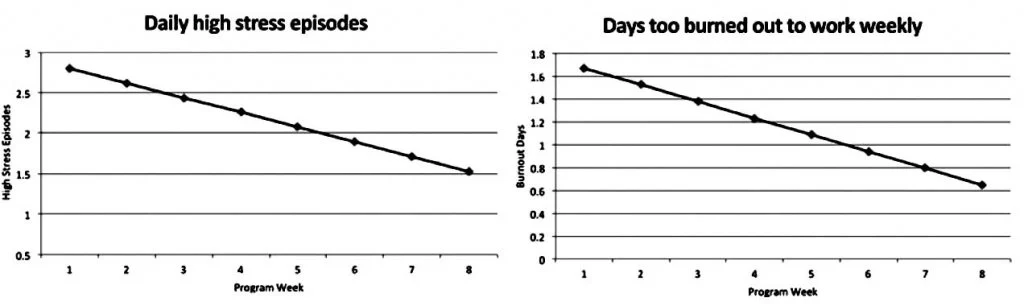
Mindfulness training also offers employees a number of advantages: an online intervention with mindfulness exercises for employees was associated with reduced stress and increased resilience and vitality. Although participants slept the same amount as before, there were also fewer days on which they felt too “burned out” to work (Aikens et al., 2014). It stands to reason that productivity increases when you are less stressed, can make better use of your potential and feel good at the same time. According to the study, productivity rose by 20% in this case.
Can mindfulness contribute to a good company culture?
Overall, it becomes clear that mindfulness training is more than a stress management method for companies; it can have a much broader impact, as the atmosphere, the communication and the state of each individual change over time. Of course, the overall wellbeing of a company does not depend solely on the use of measures that promote mindfulness, but it seems a sensible step to empower each individual to deal independently with demanding working conditions and the challenges of the working world while maintaining their own mental health.
Regularity is key
The benefits of training mentioned above do not, of course, appear overnight; they are part of a comprehensive development process that requires a certain consistency in practice and intrinsic motivation. Given the beneficial effects and the simplicity of mindfulness practices, however, it should not be difficult to motivate employees to take them up. Anything in everyday life can easily be turned into a meditation, into “single-tasking”: eating, walking and even sitting can be done mindfully and help slow down the pace of everyday life.

What are the benefits of mindfulness in the workplace? – Key takeaways from this article
- Mindfulness can strengthen wellbeing at work, thereby reducing stress and increasing productivity.
- Regular mindfulness exercises enable more creative problem-solving, e.g. through thinking outside the box.
- Mindfulness has a positive effect on the atmosphere in meetings.
- Mindful leadership is characterised not only by health- and performance-enhancing effects but also by social ones: more conscious action, recognising and taking into account employees’ needs, reducing narcissistic tendencies and making reflective decisions.
- Mindfulness interventions are associated with reduced stress and increased resilience and vitality.
Mindfulife helps companies integrate mindfulness into their everyday work. If we have sparked your interest, feel free to take a look at our offer for companies or try out a meditation yourself on our YouTube channel .
Deepen your meditation practice with Mindfulife
Meditation can be more than a short break in your everyday life. If you would like to understand more deeply how meditation works, how to build a steady practice of your own and how to guide others mindfully, our meditation teacher training is the next step. There you will not only get to know meditation in theory, but also develop more confidence, clarity and trust in your own practice.
Would you like to find out more about the training first? In our weekly webinar you will get an insight and learn more about what your path to becoming a meditation teacher could look like.
For regular support in your everyday life, you can also use our online meditation studio and join guided meditations flexibly via Eversports.
We look forward to accompanying you on your journey.
You can find more mindfulness inspiration on our channels too
References
Aikens, K. A., Astin, J., Pelletier, K. R., Levanovich, K., Baase, C. M., Park, Y. Y., & Bodnar, C. M. (2014). Mindfulness goes to work: Impact of an online workplace intervention. Journal of Occupational and Environmental Medicine, 56(7), 721–731. https://doi.org/10.1097/JOM.0000000000000209
Pieter, A., & Wolf, G. (2014). Effekte betrieblicher Interventionen zur Stressreduktion auf das Wohlbefinden: Ein metaanalytischer Review. Prävention und Gesundheitsförderung, 9(2), 144–150. https://doi.org/10.1007/s11553-013-0416-1
Romhardt, K. (2016). Achtsame Kommunikation in Meetings. OrganisationsEntwicklung, 35(4), 17–19.
Sauer, S., Andert, K., Kohls, N., & Müller, G. F. (2011). Mindful leadership: Sind achtsame Führungskräfte leistungsfähigere Führungskräfte? Gruppendynamik und Organisationsberatung, 42(3), 339–349. https://doi.org/10.1007/s11612-011-0151-3