What is the best way to learn? Effective tips for studying

 · 4 min read

Imagine you are sitting at your desk, studying for an exam. Despite your best intentions, your thoughts keep drifting off. Your phone beeps, everyday worries push their way to the forefront and you feel increasingly stressed. External stimuli distract you and make it harder to concentrate. In this article, you will find out how you can use meditation and mindfulness to learn more effectively, improve your concentration and strengthen your memory! But first: what is actually behind it?
How does learning work?
Learning is a complex process through which we acquire or change knowledge, skills and behaviours. We take in information, process it cognitively and connect new concepts with our existing knowledge. Our brain learns better when we take in information through touch, sight and hearing at the same time and then repeat it. To learn effectively, you need interest, attention and concentration. Cognitive strategies and suitable learning methods are also important. This is the only way newly acquired knowledge will stick in your memory. So how can meditation and mindfulness support you with this?

Improving concentration through meditation
Meditation is an effective way to improve your concentration while studying. With regular meditation practice, you can learn to direct your attention deliberately and tune out distracting thoughts. During meditation, we train not only our mindfulness but also our ability to focus on a specific task and on the present moment. By letting go of distracting thoughts, you create space for clarity and productivity.
A meta-analysis of 23 individual studies confirms the benefits of meditation: there is a positive link between meditation experience and improved cognitive abilities, as well as structural changes in the brain that are important for the learning process. How far along you are on your mindfulness journey plays an important role here. It was also found that regular meditation practice leads to improvements in selective and executive attention – both crucial factors for your ability to concentrate. By improving your mindfulness, you can develop your ability to focus and tune out distractions more easily.

Positive effects of mindfulness on memory
Mindfulness and meditation strengthen the neural connections in your brain that are important for learning. This has a particularly positive effect on working memory, even in beginners! You use your working memory to hold, manipulate and relate pieces of information to one another during cognitive tasks, for example when doing maths or understanding texts.
There are well-founded scientific findings on this too: researchers have found that meditation and mindfulness exercises strengthen short-term and working memory and can also support long-term memory. By improving your mindfulness, you lay a solid foundation for a better memory and can recall and learn information more effectively.
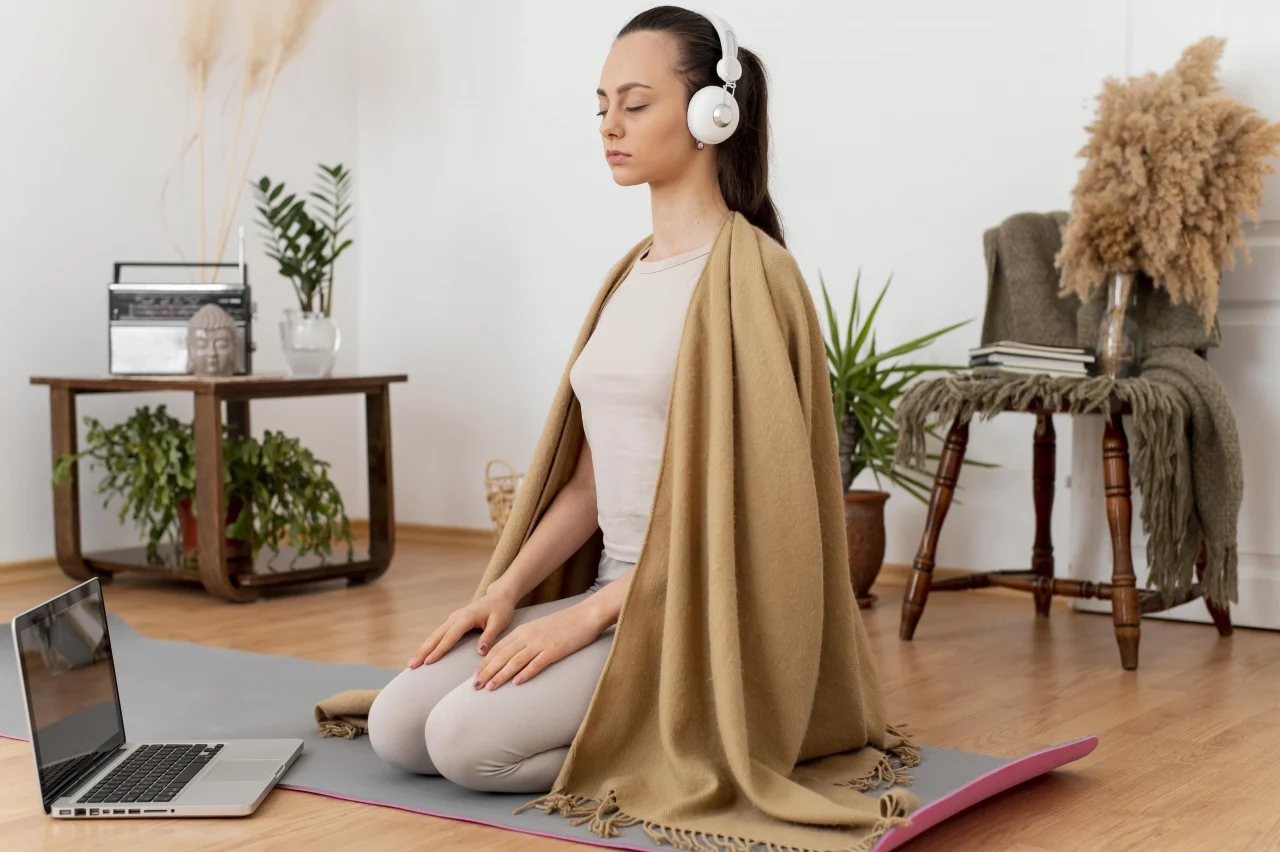
Mindful everyday tips for effective learning
If you have no experience with meditation and mindfulness exercises yet, getting started can be difficult at first. Where should you begin? Here are a few simple, short exercises that you can easily integrate into your daily life to improve your concentration:
Calm abiding:
- Choose a comfortable position, sitting or lying down.
- Consciously direct your attention to an object, for example the sensations in your body connected with your breathing, or a physical object.
- Sooner or later, your mind will wander. As soon as you notice your thoughts drifting, acknowledge the distraction without judgement. Then stop engaging with it and gently bring your attention back to the original object.
Body scan:
- Again, choose a position that is comfortable for you, sitting or lying down.
- Direct your attention to your body and mentally move through it from top to bottom.
- Consciously tune in to the different areas: notice how your head, your neck and your shoulders feel. Slowly move on to your arms, your chest and your belly. Feel the sensations in your legs and feet.
If your thoughts drift off, simply notice this and gently bring your attention back to the area you were focusing on.
Walking meditation:
- Begin by walking slowly and mindfully at your own pace.
- Direct your attention to each step: feel your feet touching the ground and notice the sensation in your legs. Pay attention to the movements of your body and to your surroundings, such as the sounds or smells.
- When your thoughts drift off, simply acknowledge this and gently bring your attention back to walking.
- This exercise is a good way to bring some extra movement into your meditation practice.
The same applies to all of these meditation exercises: how often and for how long you practise them, whether for just 5 or a full 30 minutes, is entirely up to you. Listen to your feelings and only do what feels right for you. Don’t be too hard on yourself when thoughts come up. That is a completely natural part of it and an important part of the exercise!
Conclusion
Mindfulness exercises and meditation can help you improve your concentration and strengthen your (working) memory. On top of that, you also gain the other positive effects and benefits of meditation: stress reduction, relief from anxiety, more positive thoughts, emotion regulation and much more. All of these are also connected to the learning process. Exercises such as calm abiding, the body scan and walking meditation can support you in everyday life. They make it easier to focus and to take in and process information and learn new things. For lasting results, it makes sense to integrate mindfulness exercises or meditation into your daily life regularly and over the long term. Why not give it a try and get started right away?
Leana S. (psychology student)
Deepen your meditation practice with Mindfulife
Meditation can be more than a short break in your everyday life. If you would like to understand more deeply how meditation works, how to build a steady practice of your own and how to guide others mindfully, our meditation teacher training is the next step. There you will not only get to know meditation in theory, but also develop more confidence, clarity and trust in your own practice.
Would you like to find out more about the training first? In our weekly webinar you will get an insight and learn more about what your path to becoming a meditation teacher could look like.
For regular support in your everyday life, you can also use our online meditation studio and join guided meditations flexibly via Eversports.
We look forward to accompanying you on your journey.
You can find more mindfulness inspiration on our channels too
References
Basso, J. C., McHale, A., Ende, V., Oberlin, D. J. & Suzuki, W. A. (2018). Brief, daily meditation enhances attention, memory, mood, and emotional regulation in non-experienced meditators. Behavioural Brain Research, 356, 208-220. https://doi.org/10.1016/j.bbr.2018.08.023
Chiesa, A., Calati, R. & Serretti, A. (2010). Does mindfulness training improve cognitive abilities? A systematic review of neuropsychological findings. Clinical Psychology Review, 31(3), 449–464. https://doi.org/10.1016/j.cpr.2010.11.003
Jha, A. P., Denkova, E., Zanesco, A. P., Witkin, J. E., Rooks, J. & Rogers, S. L. (2019). Does mindfulness training help working memory ‘work’ better? Current Opinion in Psychology, 28, 273–278. https://doi.org/10.1016/j.copsyc.2019.02.012
Malinowski, P. (2019). Vielfalt Meditation: Ein Überblick über Meditations- und Achtsamkeitsübungen. Springer.
Schulze, S., Wittich, C. & Kuhl, (2022). Kognitive Lernvoraussetzungen – Aufmerksamkeit und Gedächtnis. In M. Gebhardt, D. Scheer & M. Schurig (Hrsg.), Handbuch der sonderpädagogischen Diagnostik. Grundlagen und Konzepte der Statusdiagnostik, Prozessdiagnostik und Förderplanung (S. 147‐162). Universität Regensburg. https://doi.org/10.5283/epub.53149.
van Vugt, M. K. (2015). Cognitive benefits of mindfulness meditation. In Brown, K. W., Creswell, J. D. & Ryan, R. M., Handbook of Mindfulness: Theory, Research, and Practice (pp. 190-207). Guilford Press.