MBTI Personality Test: What Exactly Is It and What Lies Behind It?

 · 10 min read
“Which MBTI type are you?” – Perhaps that is exactly why you have landed here: someone has asked you this question and you weren’t quite sure how to answer. For many years, the Myers-Briggs Type Indicator (MBTI) has been one of the best-known and most widely used personality tests in the world. It works like a compass: easy to understand and a helpful guide in many areas of life – at work, in teams, in relationships or in personal development. No wonder it still fascinates millions of people today.
In this article, you will find out how the MBTI works, why self-reflection is so important when using it, what it is used for and where its limits lie.
What is the MBTI?
The idea behind the MBTI is based on the personality research of Carl Gustav Jung. He assumed that although every person is individual and unique, each of us shows certain preferences – that is, favoured inclinations – much like a preferred hand (being right- or left-handed).
Jung distinguished four basic psychological functions that are present in everyone but can be more or less pronounced: thinking, feeling, sensation and intuition. These were complemented by two further attitudes: extraversion and introversion.
Building on this, Katharine Briggs and her daughter Isabel Myers developed the Myers-Briggs Type Indicator (MBTI) in the 1930s and 1940s. They expanded Jung’s theory of types and set out the following pairs of opposing preferences:
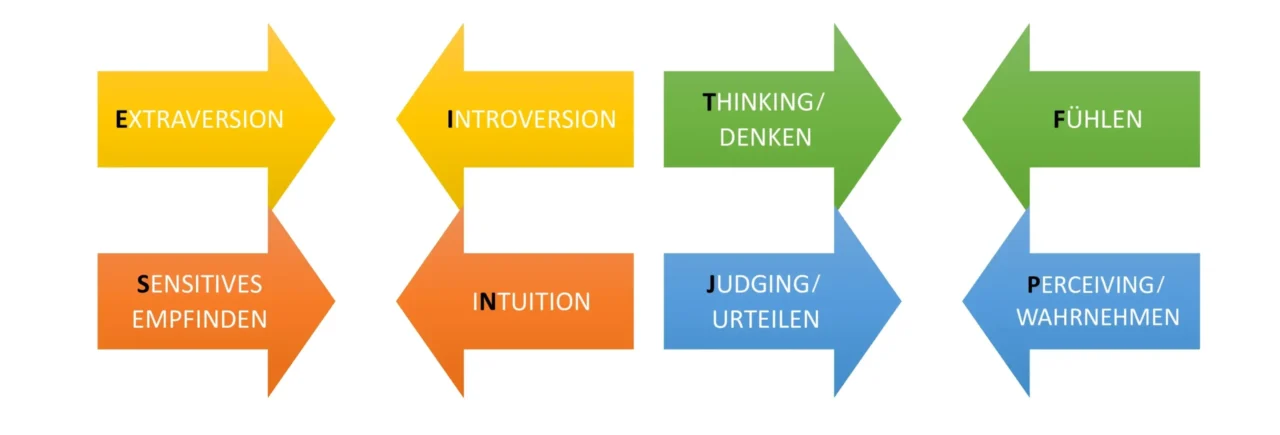
The MBTI therefore describes four different dichotomous (two-part) personality traits. Each of us has a natural preference for one of the two poles. When we use our preferred side, we usually feel more confident and authentic – just like writing with our preferred hand, while using the other feels unfamiliar and effortful.
How does the MBTI test work?

The personality types in the MBTI are classified according to four central questions. These give rise to eight MBTI preferences:
Where do I get my energy from?
- (E=Extraversion) Extraverts draw their energy from interacting with people and from activity. They are sociable, easy to get to know, expressive and often take the initiative.
- (I=Introversion) Introverts draw energy from their own inner world of thoughts, emotions and impressions. They prefer privacy, are more reserved, harder to get to know and only take the initiative when something seems important to them.
How do I take in information?
- (S=Sensing) People who lean towards sensing take in information about real, tangible events – what is actually happening, the present reality. They focus on facts and details, are practical and realistic, proceed step by step and trust experience.
- (N=Intuition) People who rely on intuition take in information by looking at the bigger picture and focusing on connections. They turn their attention to what could be – future possibilities. They think in images, are full of ideas, creative and trust inspiration.
How do I make decisions?
- (T=Thinking) Rational thinking types make decisions on the basis of logic and objectivity. They are analytical, objective and let their feelings play less of a role.
- (F=Feeling) Feeling types make decisions based on personal, subjective considerations and values, and tend to go with their gut. They are highly empathetic and place great value on harmony.
How do I deal with the outside world?
- (J=Judging) Judgers prefer structure, planning and routines – in short, an organised lifestyle. They feel comfortable when “things are settled”, whether through fixed appointments or clear commitments, and they are also decisive.
- (P=Perceiving) Perceivers prefer openness, spontaneity and change, and would rather lead a flexible lifestyle. They often find detailed plans and final decisions restrictive or controlling. As a result, they find it hard to commit and like to keep their options open.
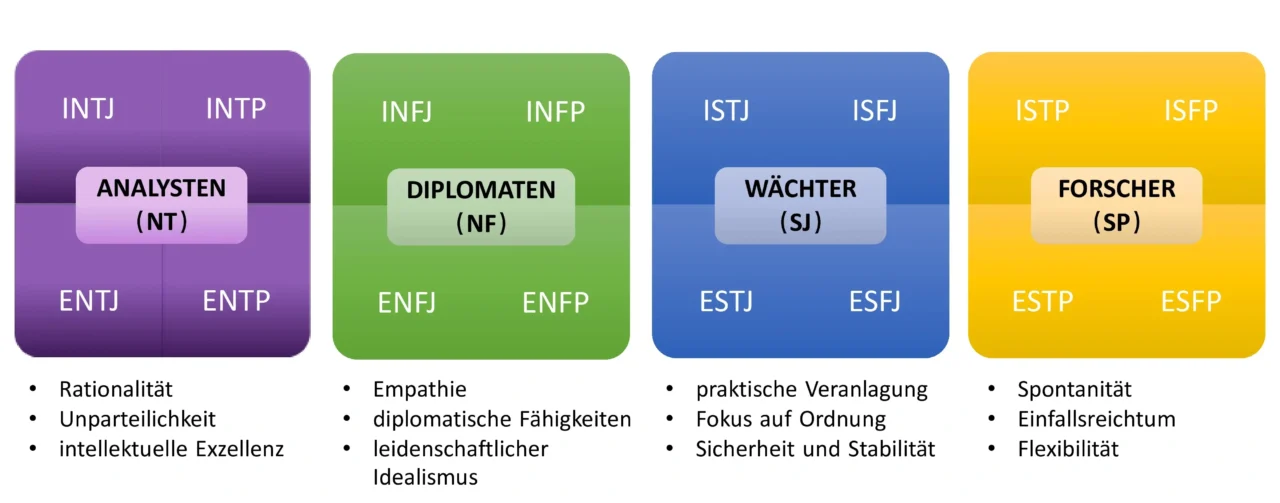
Combining these four dimensions produces a four-letter “code” as shorthand for the type (e.g. Extraversion + Intuition + Feeling + Perceiving = ENFP). Altogether, this results in 16 different personality types that reflect typical patterns of thinking, feeling and acting.
These 16 types can in turn be grouped into four main groups:
Self-assessment and self-reflection with the MBTI
Exploring your own “self” opens many doors: it helps you understand yourself and others better, recognise your own patterns of behaviour and take steps in your personal development.
However, self-reflection isn’t always easy. It can often be difficult to pin down your own preference clearly. Before you take the MBTI test, it is worth thinking of specific situations in which you felt “completely yourself” – free from pressure or outside expectations. As a general rule, you are the best judge of yourself.
This is where mindfulness comes in as a helpful tool: consciously pausing and observing. Ask yourself the following reflective questions:
- What is closest to my natural behaviour?
- How do I behave when I don’t have to fulfil any roles or expectations?
- How was I seen in the past – for example as a child or teenager?
- How do I react under mild stress?
The important thing is not to judge. Whatever answers or thoughts come up – even if they are not socially “desirable” – notice them mindfully and accept them, without embellishing your self-image. There are no “right” or “wrong” answers. What matters is how you actually are – not how you would like to be.
To recognise your preferences even more clearly, small everyday exercises can help:
- Diary / journaling: Note down when you feel energised – and when you feel drained.
- Observe stressful situations: Pay conscious attention to the patterns that emerge (e.g. withdrawal, analysis, gut feeling).
- Ask for feedback: Ask people you trust for honest feedback and compare it with your own perception.

Deliberately set aside 20-30 minutes of quiet time for this self-reflection. This allows you to gather your thoughts, observe yourself mindfully and gain a clearer picture of yourself before you start the test. When filling it in, however, you should answer the questions as quickly and spontaneously as possible and not dwell too long on individual items, as overthinking can distort the results.
Once you know your personality type, it is worth continuing to explore: each MBTI type comes with its own strengths, typical problem-solving strategies and possible areas for development. Recognising and engaging with these opportunities can drive your personal development in the long term.
What is the MBTI used for – and what are its benefits?
The MBTI is used in both professional and personal contexts.
It is used to gain insight into differences in personality and to open up opportunities for growth and development.
Professional context
The MBTI is particularly widespread in the workplace. Companies benefit when they not only know about the differences between their members but also make deliberate use of them:
1. Improved communication: The MBTI helps make communication with employees better and more efficient by adapting the communication style to their respective preferences.
- Example: With realistic types (S), it is best to communicate using clear facts and details, while with introverts (I) you can use the written communication they often prefer.
2. Transparent decision-making styles: The MBTI makes visible what individual personalities need in order to make decisions, creating transparency about decision-making styles. This makes processes clearer, more effective and often faster.
- Example: Thinkers (T) are best convinced by precise, objective and logical arguments, while a feeling type (F) is more likely to be moved to a decision by an appeal to personal values.
3. Targeted career guidance: In career coaching, the MBTI is an effective way to analyse (hidden) strengths, identify typical patterns of behaviour and highlight potential areas for improvement. This allows career paths to be shaped in a way that supports the individual.
- Example: A perceiver (P) can really flourish in their professional development when given tasks that offer flexibility and variety.
4. Ideal team composition: The MBTI can serve as a compass when putting teams together. Different preferences are combined so that they complement each other, creating “best performing” teams in which everyone’s strengths come into their own.
- Example: An intuitive (N) spots new possibilities and the bigger picture, while a sensor (S) keeps an eye on feasibility and resources – so they complement each other perfectly.
5. Conflict prevention: The MBTI makes preferred learning and working styles visible, fostering an understanding of differences and making it easier to work together. This helps avoid misunderstandings and prevent conflicts early on.
- Example: A judger’s (J) working style is characterised by a steady pace and meeting deadlines, while a perceiver (P) tends to find rigid schedules restrictive and prefers a flexible way of working.
6. Adapted leadership style: Understanding how your personal leadership style affects employees’ motivation and commitment is enormously important.
- Example: Managers can motivate feeling-oriented employees (F) through appreciative communication and a harmonious environment, while thinkers (T) respond above all to clear structures and realistic goals.
Personal context
Beyond the world of work, the MBTI test can also offer valuable food for thought. Some insights can be transferred directly to your private life:
1. Communication: Knowing your own communication style and that of the other person gives you valuable pointers for interacting respectfully and appropriately.
2. Understanding conflict: The MBTI can help you better understand conflicts in relationships or partnerships – for instance when different needs, different ways of showing appreciation or different “love languages” collide, or when conflict styles differ.
- Example: Personality types such as “Diplomats” show love through strong affection and expressions of emotion, while “Analysts” express their love for their partner less through physical closeness and more through lively conversation and genuine interest.

3. Personal growth: Every type has particular strengths, but also “blind spots”. We tend to focus on our strengths and familiar problem-solving strategies and therefore keep using our preferred functions, while the opposite function remains untrained. That is comfortable at first, but in the long run it can make us one-sided. Those who also consciously train their less preferred sides, however, gain flexibility and more room for manoeuvre.
4. Recognising stressors: Exploring your own MBTI preferences mindfully can help you become more aware of what triggers your stress. Since preferences also affect how we deal with and react to stress, this knowledge can help you develop strategies for effective and productive stress management in everyday life.
Criticisms and misconceptions about the MBTI
Although the MBTI is based on years of research that supports its validity, it repeatedly attracts criticism and is not recognised as a professional tool within psychology.
- No scientific training on the part of its developers: Neither Katharine Briggs nor Isabel Myers was a psychologist. Critics see this as a lack of scientific foundation. However, history offers many examples (e.g. Steve Jobs) showing that people without formal training can also achieve great things.
- Limited reliability: Repeating the test sometimes produces different results, as your mood on the day or current life circumstances can influence your self-assessment. At the same time, test-retest studies with the MBTI Global Step I show correlations of between 0.81 and 0.86 over several weeks – which indicates high reliability (Myers, McCaulley, Quenk & Hammer, 2018).
- Barnum effect: Because the type descriptions are often worded in rather general and positive terms, the MBTI test is often subject to the so-called Barnum effect: people readily perceive such statements as particularly accurate for themselves – much like horoscopes.
- No predictive value for success: Critics point out that the MBTI cannot establish a demonstrable link between personality type and professional success. In fact, it was never designed to predict success in a particular profession. The MBTI describes preferences but says nothing about abilities, skills or actual job performance. For this reason, it is even considered unethical to use it as a basis for hiring decisions or selecting applicants.
Conclusion
Exploring the MBTI personality types makes the differences between people easier to understand and relate to. In our everyday dealings with the people around us – whether partners, colleagues, friends, parents, children or bosses – it is often precisely these differences that either lead to misunderstandings and conflict or contribute to inspiring collaboration and mutual growth.
Combined with a little mindfulness, it can help you become more aware of your own strengths, use them in a targeted way and thereby foster self-reflection as well as personal and professional development. At the same time, it is important to keep the criticisms in mind and to see the MBTI only as a guide – without putting people straight into rigid boxes. After all, every person is truly unique thanks to their individual disposition, life experiences, abilities and cultural and social background, and far more than just a “type”.
And now back to my opening question: Which MBTI type are you? Find out with the free MBTI personality test.
Da-Yong K. (psychology student)
Deepen your meditation practice with Mindfulife
Meditation can be more than a short break in your everyday life. If you would like to understand more deeply how meditation works, how to build a steady practice of your own and how to guide others mindfully, our meditation teacher training is the next step. There you will not only get to know meditation in theory, but also develop more confidence, clarity and trust in your own practice.
Would you like to find out more about the training first? In our weekly webinar you will get an insight and learn more about what your path to becoming a meditation teacher could look like.
For regular support in your everyday life, you can also use our online meditation studio and join guided meditations flexibly via Eversports.
We look forward to accompanying you on your journey.
You can find more mindfulness inspiration on our channels too
References
Bradford, V. (2023). MBTI®: Fakten und häufige Kritikpunkte. The Myers-Briggs Company. Zuletzt abgerufen am 9. September 2025 von https://eu.themyersbriggs.com/de-DE/Knowledge-centre/Blog/mbti-fakten-und-haufige-kritikpunkte
Kemter, M. (2025). Was ist der MBTI-Persönlichkeitstest? – Das Wichtigste im Überblick. Stuttgarter Nachrichten. Zuletzt abgerufen am 9. September 2025 von https://www.stuttgarter-nachrichten.de/inhalt.mbti-persoenlichkeitstest-mhsd.6d234f00-46a7-4d79-b5da-9efb87e3c1ff.html
Lorenz, T., & Oppitz, S. (2012). 30 Minuten Selbst-Bewusstsein: Mit dem Myers-Briggs-Typenindikator (MBTI). GABAL Verlag.
Myers, I. B., McCaulley, M. H., Quenk, N. L., & Hammer, A. L. (2018). MBTI® manual for the global Step I™ and Step II™ assessments. The Myers-Briggs Company.
Rawitzer, H., & Hefti, J. (2017). Die Myers-Briggs-Typologie: Mithilfe von Persönlichkeitstypologie effizienter zusammenarbeiten. Zeitschrift Führung + Organisation (zfo), 86(5), S. 319–322.
Reynvaan, C. H. H. (2022). Selbstreflexion. In Wie geht Industrie? Erfahrungswissen eines Managers für Absolventen der MINT-Fächer (S. 289–297). Springer Spektrum. https://doi.org/10.1007/978-3-662-65850-5
Scharlau, C. (2004, 1. März). Myers-Briggs Typenindikator - ein ressourcenfokussierendes Instrument für Coaching und Karriereberatung. Organisationsberatung, Supervision, Coaching, 11(1), S. 13-25. https://link.springer.com/content/pdf/10.1007/s11613-004-0003-4.pdf
The Myers-Briggs Company. (2020). Myers-Briggs Typen Indikator® Bericht zur Wirkung auf andere (Beispielbericht, Typ ENTP). The Myers-Briggs Company. Zuletzt abgerufen am 9. September 2025 von https://eu.themyersbriggs.com/-/media/Files/PDFs/Reports-in-other-languages/MBTI-Step-I/MBTI_Personal_Impact_Report_ENTP_German_2020.pdf
The Myers-Briggs Company (2025). Myers-Briggs Typen Indikator® Bericht zur Wirkung auf andere (Beispielbericht, Typ ISTJ). The Myers-Briggs Company. Zuletzt abgerufen am 9. September 2025 von https://ap.themyersbriggs.com/content/Sample%20Reports/MBTI®Complete_MBTI®_Personal_Impact_Report_Combo_(German)_Sample_DE_DE_266520.pdf