Environmental protection through mindfulness – small steps with a big impact

 · 8 min read
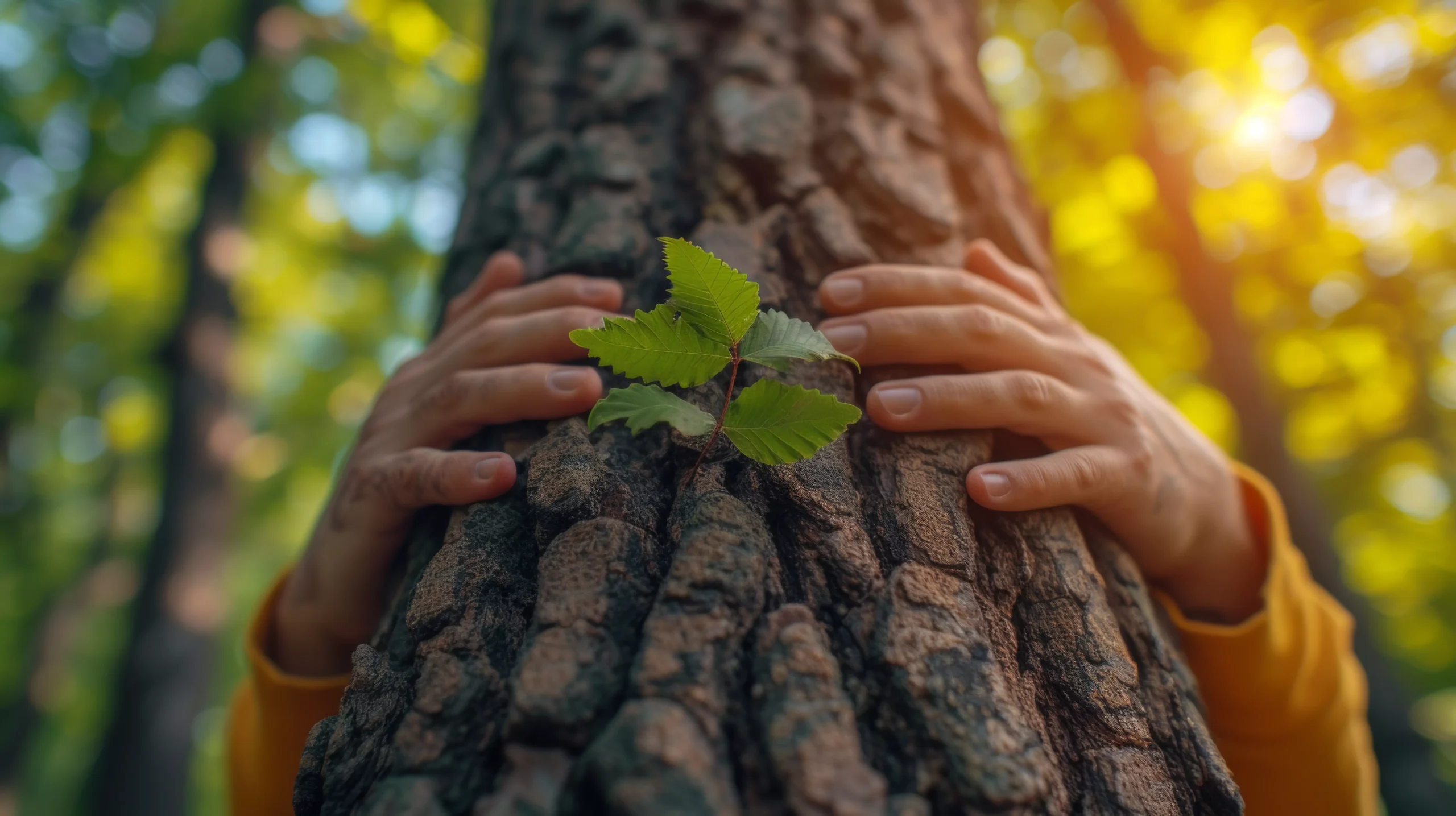
“Yes, protecting the environment and the climate is very important to me.” – More than half of the respondents (54 %) said this in the 2024 Environmental Awareness Study. The study shows that environmental awareness among the German population remains very high. Perhaps you feel the same way?
But actually turning this environmentally friendly attitude into action is not always as easy as it sounds. The hustle and bustle of everyday life, or simple convenience, often make it difficult to live in an environmentally conscious way.
In this blog article, I would like to show you how mindfulness can help you support environmental protection and make this lifestyle easier to achieve.
How are environmental protection and mindfulness connected?
Pro-environmental behaviour refers to any behaviour that “harms the environment as little as possible or even benefits it”. But what exactly does environmental protection have to do with mindfulness? Mindfulness helps us to become consciously aware of our thoughts, feelings and actions. This self-awareness in turn enables us to recognise, question and change our inner beliefs, routines or goals – and so bring our behaviour more closely into line with our ecological values

How can I live in a more environmentally friendly way?
An environmentally friendly – or, more broadly, sustainable – lifestyle can look very different from person to person. What matters most is what it means to you. For some, this lifestyle begins with buying unpackaged fruit to avoid plastic. Others get on their bike instead of driving to work every day. Others again go a step further and have avoided flying for years or follow a strictly vegan diet. How far you personally want to go is entirely up to you.
Above all, one thing is important: an environmentally protective, sustainable lifestyle is not a short-lived trend that is forgotten again after a few days. No – sustainability and environmental protection are a long-term development that can change both our precious planet and our individual lives for the better in the long run.
6 mindful steps towards an environmentally friendly and sustainable lifestyle

Understanding the following psychological aspects can help you not only to start an environmentally friendly and sustainable lifestyle, but also to really put it into practice in everyday life and maintain it.
1. Inner beliefs
Our inner beliefs can support us, but they can also hold us back. This depends entirely on whether we shape them positively or negatively.
Positive beliefs about our own abilities, such as “I can make a difference to a healthier planet”, encourage us to try out new, environmentally friendly behaviour & stick with it. A negative belief such as “I can’t make a difference on my own anyway”, on the other hand, often means that we don’t even try to act in a more environmentally friendly way, or that we quickly give up again. As a result, environmental protection seems out of reach.
Henry Ford summed it up perfectly:
“Whether you think you can, or you think you can’t – you’re right.”
If we also think “Other people aren’t doing anything either”, we are more likely to sit back and stick to old patterns of behaviour that harm the environment. In contrast, a positive belief about responsibility, such as “I am responsible for my actions”, strengthens our environmental commitment. That is why, in everyday life, we should focus on the helpful, positive and encouraging beliefs.
Tip: First, mindfully turn your attention to the thoughts you have had so far. Write them down or talk to others about topics such as environmental protection or sustainability. Then try to work out which of these thoughts are helpful and which are not, and, if necessary, adopt new, more constructive thoughts.
2. Goal setting
Having a clear picture of our own goals is an important precondition for really putting our intentions into practice. As with beliefs, it makes sense to focus on positively phrased goals about what we want and where we want to go – rather than about what we don’t want and don’t want to achieve.
So before you try to change your behaviour, it is worth asking yourself as specifically as possible: “What exactly do I want to achieve?” (behavioural goal). Instead of simply thinking in general terms, “I want to do more for environmental protection.”, set a concrete goal such as “I’ll cycle to work 3 days a week.”
Ambitious but, above all, realistic goals that can be achieved in a short time are particularly effective. You could break a somewhat bigger goal down into several smaller ones – this gives you a sense of progress, which in turn can have a positive effect on your self-efficacy and motivation.
Tip: Combine your positive goal with a reward or with a commitment to friends or in a journal. This creates accountability and helps you stick with it.
3. Intrinsic motivation
Intrinsic motivation comes from within. It is particularly effective & stable in the long term, because we do something out of conviction, that is, because we want to, and not because of external incentives such as money, laws or penalties, because we have to.
What can spark intrinsic motivation? For example:
- Enjoying the activity: cycling not only because it is environmentally friendly, but also because you enjoy being active
- A sense of meaning: supporting animal welfare and the good feeling of doing something worthwhile
- Challenge and growth: using less plastic to challenge yourself and grow beyond your limits
The important thing is that what motivates pro-environmental behaviour is different for every person.
Tip: Take a mindful moment to consciously reflect on your own reasons. Feel free to write them on small sticky notes and put them in clearly visible places – that way, you will keep reminding yourself why acting sustainably matters to you.
4. The cost of change
The “cost of change” refers to the effort it takes to change ingrained habits – whether that is time, money or energy. Precisely because habits make our everyday lives easier, we often cling to them – even when they harm the environment. But to really play our part in protecting the environment and creating a healthier planet, we need to change certain behaviours.
A helpful strategy:
Reduce the “cost of change”. This means making it easier for ourselves to build more environmentally friendly habits into our everyday lives. If you always carry a cloth bag with you, you not only avoid buying a new plastic bag, you automatically make the more environmentally friendly choice – without much effort.
Or the other way round:
Increase the “pain of not changing”. This in turn means making environmentally harmful habits less attractive to ourselves. If you only buy meat from a high-quality, rather expensive organic supplier, you will often automatically eat it less frequently and consume more consciously.
Tip: Ask yourself mindfully: which method suits me better for changing ingrained habits step by step?
5. Fear of failure
A widespread psychological factor that can make lasting behavioural change more difficult is the fear of failure. It describes the irrational worry about failing, making mistakes or not living up to other people’s expectations or our own. This feeling can stop us from even trying out new behaviours in the first place.

An example: if you are used to hiring cars that run on fossil fuels, feeling unsure about how to handle an electric car may mean you never even try one.
What helps against this fear of failure? A helpful attitude is: mistakes are not failures, but opportunities to learn. Perhaps your first drive in an electric car is a little bumpy because the processes are still somewhat new. But it is precisely through these experiences that you learn, over time, how it works. So you are not failing – you are developing step by step.
When we act, then reflect and learn from the outcome, we can decide more consciously what we want to do differently in future. As long as we keep this cycle going, it is impossible to fail.
Tip: Feel free to start small – and allow yourself to make mistakes. Mindfully acknowledge the small steps forward that come from your mistakes. Every attempt takes you further – as long as you see it as part of your learning process.
6. Consistency
The last important point to consider in our efforts to protect the environment is consistency. It means that we don’t just put environmentally friendly behaviour into practice once, but keep it up in the long term. After all, many small steps over time add up to a big impact.
For example, if you regularly organise a litter pick with friends, it becomes a routine with a real impact. The longer you keep it up, the greater the effect.
But staying consistent takes discipline and self-control. That is why it helps if sustainable behaviour can happen automatically.
For example through:
- Smart technology: sensors that switch off the light when nobody is in the room
- Subscriptions for organic food: automated deliveries support sustainable consumption in the long term
- Digital reminders for short moments of mindfulness: mindfulness helps us to become more aware of our behaviour and its effects on the environment.
Tip: Make it easy for yourself. Whatever can be automated hardly gets noticed in everyday life – and so becomes not only easier, but also lasting. After all, consistency over time is essential for long-lasting positive change in everyday life.
Conclusion: environmental protection through mindfulness
Change starts small and, above all, with attention. Closely linked to this is mindfulness: it helps you to recognise your beliefs, goals, feelings and patterns of behaviour more consciously – and so, step by step, to shape them in a more environmentally conscious way and integrate them into your everyday life.
Of course, you are free to go at your own pace. Nobody has to do everything perfectly. Change also happens when many mindful people take many small steps. Be brave enough to contribute to the environment in your own way and to stand up for environmental protection – and when things get challenging, remember these psychological insights.
Feel free to share your thoughts or experiences in the comments or on Instagram! Which mindful steps towards protecting the environment have you already managed to build into your everyday life?
Da-Yong K. (psychology student)
Deepen your meditation practice with Mindfulife
Meditation can be more than a short break in your everyday life. If you would like to understand more deeply how meditation works, how to build a steady practice of your own and how to guide others mindfully, our meditation teacher training is the next step. There you will not only get to know meditation in theory, but also develop more confidence, clarity and trust in your own practice.
Would you like to find out more about the training first? In our weekly webinar you will get an insight and learn more about what your path to becoming a meditation teacher could look like.
For regular support in your everyday life, you can also use our online meditation studio and join guided meditations flexibly via Eversports.
We look forward to accompanying you on your journey.
You can find more mindfulness inspiration on our channels too
References
Bentler, D. (2023). „Fake it till you make it“ – Von der grünen Einstellung zum ökologischen Handeln. TransFAIR, 2, 20–21. https://www.zeitschrift-praeview.de/fileadmin/redakteur/download/transfaer/02-23/transfaer_2-2023.pdf.
Frick, V., Fülling, J., Harms, C., Grothmann, T., & Marken, G. (2025). Umweltbewusstsein in Deutschland 2024: Kurzbericht zur Bevölkerungsumfrage. Umweltbundesamt. https://www.umweltbundesamt.de/sites/default/files/medien/479/publikationen/uba_umweltbewusstsein_in_deutschland_2024_kurzbericht_bf_0.pdf.
GASAG AG. (2022). Umweltfreundlich leben: 15 Tipps für einen nachhaltigen Lebensstil. GASAG Magazin – Nachhaltigkeit. https://www.gasag.de/magazin/nachhaltigkeit/umweltfreundlich-leben/#sid6894.
Hamann, K., Baumann, A., & Löschinger, D. (2016). Psychologie im Umweltschutz: Handbuch zur Förderung nachhaltigen Handelns. oekom. https://doi.org/10.14512/9783960061182.
Schulz, C. (2019). Nachhaltig leben für Einsteiger: Schritt für Schritt den Unterschied machen – für ein umweltfreundliches und plastikfreies Leben mit ökologischen Tipps für mehr Nachhaltigkeit im Alltag. mvg.
van Genuchten, E. (2024). Der Weg zu einem gesünderen Planeten: Wissenschaftliche Erkenntnisse und konkrete Schritte für eine nachhaltige Zukunft. Springer. https://doi.org/10.1007/978-3-031-58961-4.