How does meditation ease chronic pain?

 · 7 min read

Most of us have experienced pain at some point – whether it’s the nagging back after a long day at the office or the intense pain in a leg after a fracture. Acute pain like this serves as a warning signal from our body that something needs our attention. But what happens when this warning function is no longer needed, yet the pain remains?
What is chronic pain?
The term chronic comes from Greek and roughly means “long-lasting” or “constant”.
In medical terms, pain is described as chronic when it lasts longer than three months or keeps recurring. Unlike acute pain, which has a clear cause and function, chronic pain often becomes a condition in its own right. The causes are many and varied: it can occur with or without tissue damage and is influenced by biological, psychological and social factors.

Pain memory: why doesn’t pain go away?
The development of chronic pain is a complex, multifactorial process. It often arises from an acute pain event that is unconsciously maintained by certain patterns of behaviour. Fear, for example, can encourage avoidance behaviour, which in turn promotes poor posture and muscle tension. On the other hand, ignoring pain can lead to overexertion and long-term damage.
Chronic pain can bring about profound changes in the nervous system that affect the way pain is perceived. On a physiological level, the nerves become increasingly sensitive, which leads to heightened pain perception. Over time, a so-called “pain memory” develops, in which pain continues to be experienced even after the original cause has subsided. These changes mainly affect the somatosensory cortex – the area of the brain that, among other things, processes pain. With persistent pain, the nerve cells here undergo a lasting reorganisation, so that pain continues to be felt even without an external stimulus.
This reorganisation affects not only the brain but also the spinal cord and the nerve endings. Repeated pain processing strengthens the activation of the pain-conducting pathways, which can mean that pain persists even without an actual cause – a phenomenon known as pain memory.
Chronic pain is widespread. In Germany alone, more than 3 million people are affected by severe chronic pain. It can occur in almost any part of the body. The most common forms include back pain, headaches, migraine and joint pain.

How pain and the mind reinforce each other
Chronic pain shows up quite differently from person to person. What is undisputed, however, is that it can have a considerable impact on working and private life. These experiences are often accompanied by feelings such as hopelessness, social isolation, irritability and other symptoms. So it is hardly surprising that chronic pain is also frequently accompanied by mental health conditions such as depression, anxiety disorders, post-traumatic stress disorder and somatoform disorders. Somatoform disorders manifest as physical complaints for which no organic cause can be found.
Prevalence rates of up to 56% are found for the combination of depression and back pain, while anxiety and abdominal pain show a prevalence of up to 51%. These figures illustrate how often chronic pain occurs together with mental health conditions. The term prevalence describes how many people in a particular group are affected by a disease at a given point in time or over a certain period. A mutual influence has been reported. Particularly striking is that people with an anxiety disorder have a two to three times higher risk of developing migraine than people without an anxiety disorder.
The close connection between pain and the mind is impossible to overlook; it is taken into account in pain therapy and continues to be researched. Stress, emotional strain and even the mere expectation of pain can intensify the sensation of pain and trigger pain.
A range of therapies: holistic paths to pain relief
A holistic approach is crucial in treating chronic pain. Alongside medication and physical therapies such as physiotherapy, holistic pain treatment also includes psychological methods, among them psychotherapy, relaxation techniques and meditation.
Meditation and mindfulness as inner tools against pain?
The effects of meditation and mindfulness have already been examined in a number of studies, and they represent promising approaches.
They have effects on both a psychological and a physical level:
- Pain perception is reduced: Studies have shown that mindfulness techniques can measurably reduce perceived pain intensity.
- Improved quality of life: By reducing anxiety and depression, regular mindfulness practice can contribute to a considerable improvement in quality of life.
- Stress and emotional strain are reduced: Meditation helps to reduce stress and ease emotional strain, which has a positive effect on coping with pain in general.
- No risk of dependency: Unlike drug therapies, which can carry a high potential for dependency, meditation is a low-risk alternative.
- Additional improvement in accompanying conditions: Studies also show that mindfulness meditation can not only relieve pain but also has positive effects on accompanying conditions such as anxiety disorders or depression.
How to get started: practical tips for your path to greater mindfulness
- Start with guided meditations: For beginners, guided meditations are helpful for training your focus on the breath and on sensations.
- Regularity is key: Participants who meditated regularly over a period of eight weeks, on average 4.3 days a week, experienced clear improvements in pain acceptance and physical functioning. This regular practice is crucial because it promotes lasting change in pain memory and pain processing. Through continued practice, the brain reorganises itself, leading to reduced pain perception and improved overall wellbeing.
- Practise acceptance: Learn to perceive pain consciously without judging it. This helps to reduce the emotional burden of pain. Studies show that deliberately practising acceptance in chronic pain helps people experience the pain as less distressing. By learning to accept the pain rather than constantly fighting against it, emotional strain can be reduced and wellbeing improved. Even if these methods are not always more effective than traditional therapies, they can be a valuable alternative.
- Combine with other approaches: Meditation is particularly effective when combined with exercise therapy, cognitive therapy or other forms of treatment.
- Individuality: Everyone is different. Try out different methods to find out what works best for you.
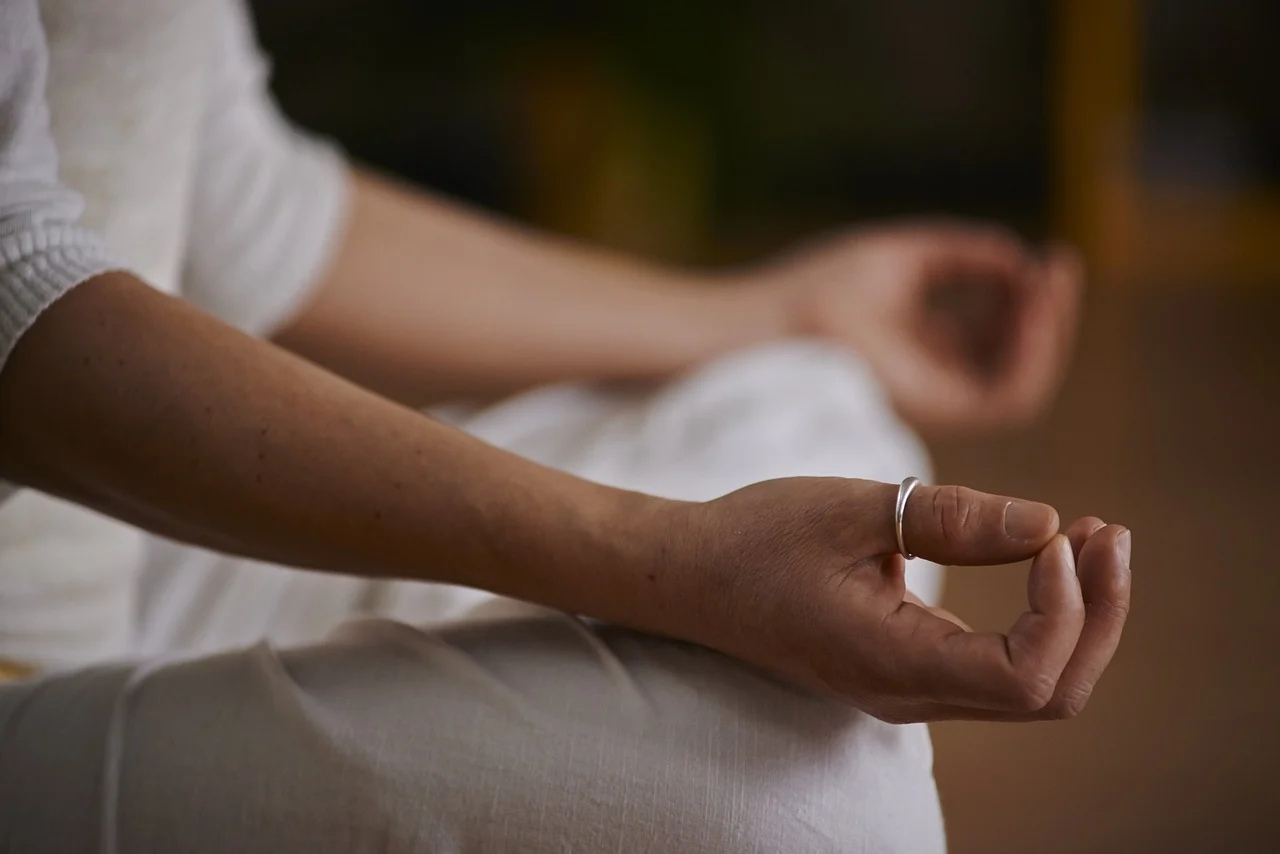
Why not try a body scan exercise or a sitting meditation:
Body scan exercise:
The body scan is an effective way to become consciously aware of your body and relax deeply. You can do this exercise sitting or lying down. Choose the position that feels most comfortable for you.
Here’s how:
- Begin with your head: First, direct your attention to your head. Notice whether there is any tension there, without judging it.
- Slowly work your way down: Let your attention travel from your head through your neck, shoulders, arms and hands, down to your torso, your legs and finally the tips of your toes.
- Stay in the here and now: When thoughts arise, simply let them come and go without judging them. Bring your attention back to your body.
Sitting meditation:
Sitting meditation is ideal for calming your mind and being mindfully present in the moment. All you need is a comfortable chair or a cushion and a little time for yourself.
Here’s how:
- Sit comfortably: Choose a sitting position that feels pleasant. Your feet should touch the floor, and your back should be straight but relaxed. Make sure you adopt a posture you can hold without effort for a longer period.
- Focus on your breath: Direct your attention to your breath. Feel the air flowing into your body and out again.
- Count your breaths: To stay focused, count each breath. For example: breathe in – “one”, breathe out – “two”.
- Be patient: When your thoughts wander, which is completely normal, simply notice it and gently bring your attention back to your breath.
Tip: Meditation and mindfulness are not a competition. You are doing something for yourself and your wellbeing. Don’t be too hard on yourself if thoughts keep intruding – that’s completely normal. The more often you practise, the easier it will become.
Conclusion
Meditation and mindfulness are effective, low-risk approaches to managing pain that show promising results, particularly for chronic pain. They not only reduce pain intensity but can also have a positive effect on accompanying psychological complaints such as anxiety and depression. A holistic approach should always be considered, because, as mentioned above, the causes are usually multifactorial and should be treated accordingly comprehensively. Combining these different approaches can optimise the success of treatment. A further advantage of mindfulness and meditation is that they can help to break the vicious circle of chronic pain and psychological strain and improve overall wellbeing in the long term.
Take the first step today and start with a short 5-minute mindfulness meditation to experience the positive effect on your wellbeing.
This article was written by Kim Rein.
Deepen your meditation practice with Mindfulife
Meditation can be more than a short break in your everyday life. If you would like to understand more deeply how meditation works, how to build a steady practice of your own and how to guide others mindfully, our meditation teacher training is the next step. There you will not only get to know meditation in theory, but also develop more confidence, clarity and trust in your own practice.
Would you like to find out more about the training first? In our weekly webinar you will get an insight and learn more about what your path to becoming a meditation teacher could look like.
For regular support in your everyday life, you can also use our online meditation studio and join guided meditations flexibly via Eversports.
We look forward to accompanying you on your journey.
You can find more mindfulness inspiration on our channels too
References
Arbeitsgemeinschaft der Wissenschaftlichen Medizinischen Fachgesellschaften (AWMF). (2023). S1-Leitlinie Chronischer Schmerz [Leitlinie]. Arbeitsgemeinschaft der Wissenschaftlichen Medizinischen Fachgesellschaften (AWMF). https://register.awmf.org/assets/guidelines/053-036l_S1_Chronischer_Schmerz_2023-12.pdf
BVSD – Bundesverband der Sachverständigen in der Medizin. (2016, Juni 10). 3,4 Millionen Patienten mit schweren chronischen Schmerzen-Zunahme um 21 Prozent. BVSD - Berufsverband der Ärzte und Psychologischen Psychotherapeuten in der Schmerz- und Palliativmedizin in Deutschland e.V. https://www.bvsd.de/34-millionen-patienten-mit-schweren-chronischen-schmerzen-zunahme-um-21-prozent/
Gard, T., Hölzel, B. K., Sack, A. T., Hempel, H., Lazar, S. W., Vaitl, D., & Ott, U. (2012). Pain attenuation through mindfulness is associated with decreased cognitive control and increased sensory processing in the brain. Cerebral Cortex (New York, N.Y.: 1991), 22(11), 2692–2702. https://doi.org/10.1093/cercor/bhr352
Hilton, L., Hempel, S., Ewing, B. A., Apaydin, E., Xenakis, L., Newberry, S., Colaiaco, B., Maher, A. R., Shanman, R. M., Sorbero, M. E., & Maglione, M. A. (2017). Mindfulness Meditation for Chronic Pain: Systematic Review and Meta-analysis. Annals of Behavioral Medicine: A Publication of the Society of Behavioral Medicine, 51(2), 199–213. https://doi.org/10.1007/s12160-016-9844-2
Hooten, W. M. (2016). Chronic Pain and Mental Health Disorders: Shared Neural Mechanisms, Epidemiology, and Treatment. Mayo Clinic Proceedings, 91(7), 955–970. https://doi.org/10.1016/j.mayocp.2016.04.029
Jäger-Becker, D. (2018). Schmerzgedächtnis muss überschrieben werden. Schmerzmedizin, 34(3), 58–58. https://doi.org/10.1007/s00940-018-0819-1
Köppe, C., & Flor, H. (2005). Schmerzgedächtnis und kortikale Plastizität. psychoneuro, 31, 81–83. https://doi.org/10.1055/s-2005-865114
Majeed, M. H., Ali, A. A., & Sudak, D. M. (2018). Mindfulness-based interventions for chronic pain: Evidence and applications. Asian Journal of Psychiatry, 32, 79–83. https://doi.org/10.1016/j.ajp.2017.11.025
Morone, N. E., Greco, C. M., & Weiner, D. K. (2008). Mindfulness meditation for the treatment of chronic low back pain in older adults: A randomized controlled pilot study☆. PAIN, 134(3), 310. https://doi.org/10.1016/j.pain.2007.04.038
Veehof, M. M., Trompetter, H. R., Bohlmeijer, E. T., & Schreurs, K. M. G. (2016). Acceptance- and mindfulness-based interventions for the treatment of chronic pain: A meta-analytic review. Cognitive Behaviour Therapy, 45(1), 5–31. https://doi.org/10.1080/16506073.2015.1098724
Was ist chronischer Schmerz? - Schmerzmedizin Berlin. (o. J.). Abgerufen 15. Januar 2025, von https://www.schmerzmedizin.berlin/was-ist-chronischer-schmerz.html