Chronic Pain: What Really Helps? 8 Effective Tips for Relief

 · 5 min read

Chronic pain is more than just a physical complaint – it also affects how we think, feel and act. Anyone who lives with it knows that even simple everyday tasks such as shopping, working or sleeping can become a challenge. Studies show that chronic pain can impair attention, memory and cognitive flexibility.
That is why it is worth addressing pain not only medically, but also mentally and emotionally. With the right strategies, it is possible to reduce pain sensations, ease psychological strain and significantly improve quality of life.
What is chronic pain?
Pain is a subjective, unpleasant sensation designed to protect the body from harm. Acute pain has a clear warning function: a cut, an inflammation or an injury immediately triggers a pain response that prompts us to rest or seek treatment.
Chronic pain differs in that it persists for at least three months or keeps recurring, often without any acute cause.
Here, biological, psychological and social factors interact. This means that people who are in constant pain may also develop anxiety, low mood or sleep problems, which in turn intensify the pain.
Chronic pain is therefore a multidimensional problem that calls for both physical and mental strategies.
What types of chronic pain are there?
Under the World Health Organization’s International Classification of Diseases (ICD), the new ICD-11 divides chronic pain into new categories:
- Chronic primary pain – pain with no identifiable cause, e.g. fibromyalgia
- Chronic cancer-related pain – pain caused by tumours or their treatment
- Chronic postsurgical or post-traumatic pain – e.g. after operations or injuries
- Chronic neuropathic pain – nerve damage, e.g. in diabetes or after surgery
- Chronic headache and orofacial pain – migraine or trigeminal neuralgia
- Chronic visceral pain – pain in the organs, e.g. with irritable bowel syndrome
- Chronic musculoskeletal pain – back, joint or muscle pain
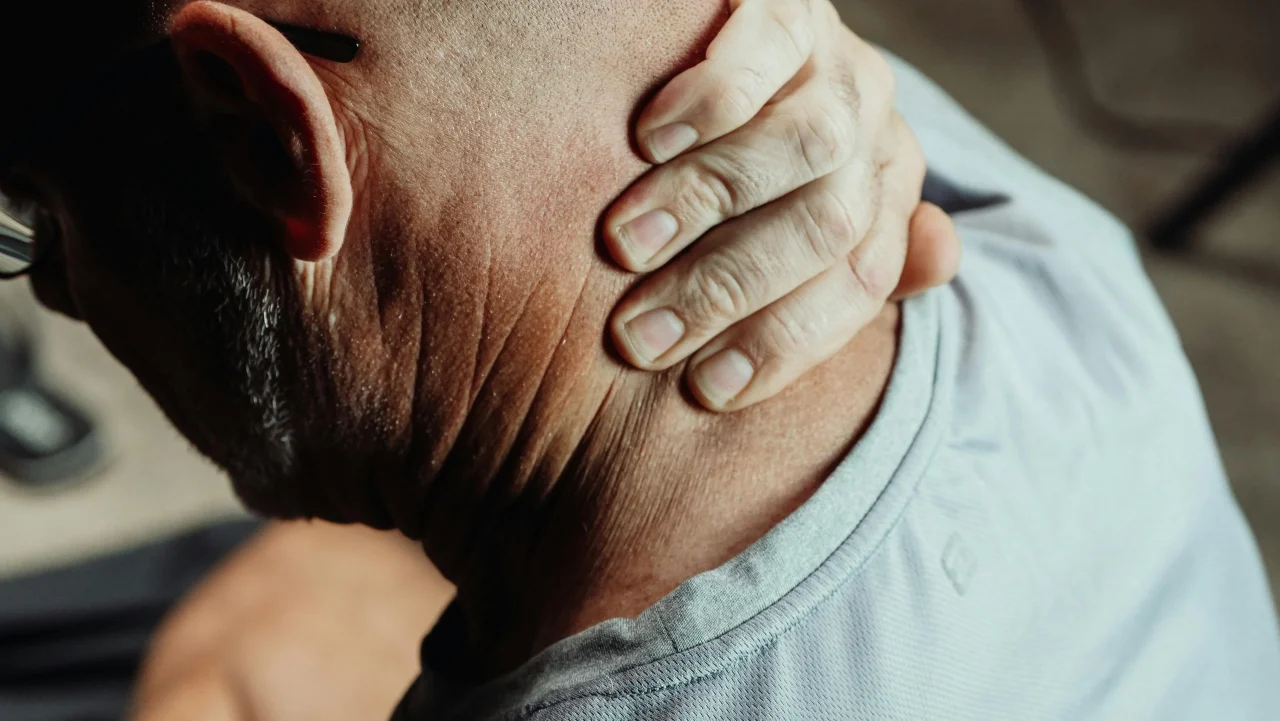
Among the most common complaints are back pain, neck pain, joint problems and migraine. In the long term, they can severely impair physical function and quality of life.
How do body and mind interact?
Chronic pain is closely linked to our emotional and mental state. Studies show that pain, emotions and cognition influence one another.
Factors that can intensify the perception of pain:
- Stress
- Anxiety
- negative thoughts
- low mood
Chronic pain is therefore not just a physical problem – it also has a strong impact on our mental and emotional state. Stress, anxiety, negative thoughts or low mood can significantly intensify the perception of pain. At the same time, long-lasting pain can trigger psychological strain such as sleep problems, difficulty concentrating, emotional exhaustion or social withdrawal.
This bidirectional relationship means that pain affects the mind, and the mind affects pain. Psychosomatic pain is one example of this – physical complaints arise or worsen as a result of emotional strain. Positive mental states such as calm, mindfulness or equanimity, on the other hand, can reduce the sensation of pain.
For this reason, it is essential for those affected to combine physical and mental strategies in order to relieve pain in the long term and reduce psychological strain.
Positive mental states such as calm, mindfulness or equanimity, on the other hand, can reduce the sensation of pain. Mindfulness in particular can help you to perceive pain consciously without automatically reacting to it negatively – you can find out exactly how this works in our article on mindfulness and pain.

8 helpful tips for chronic pain
There are several ways of dealing with chronic pain, not least to prevent further psychological problems and possibly even to relieve the pain if it has been caused by psychological factors.
1. Mindful meditation
Meditation helps you shift your focus away from the pain and consciously direct your attention to the present moment. Studies show that people who practise mindfulness regularly experience less pain and psychological strain.
In practice: sit quietly for 10-20 minutes a day, pay attention to your breathing and let your thoughts drift by. Important: don’t fight the pain, simply observe it without judgement.
2. Breathing exercises
Deep, conscious breathing activates the parasympathetic nervous system, lowers cortisol levels and reduces physical tension.
In practice: breathe in for 4 seconds, breathe out for 6 seconds. 5-10 minutes a day, or whenever you experience acute pain or stressful situations.
3. Visualisation exercises
Imagine a safe, peaceful place. Take mental journeys into nature or to a place where you feel relaxed. This helps to reduce stress and lessen the perception of pain.
Tip: combining this with music or nature sounds makes it even more effective.
4. Yoga, qigong and tai chi
Gentle forms of movement improve flexibility, posture and muscle strength, activate the relaxation response and help relieve pain.
In practice: 20-30 minutes a day or several times a week. Focus on slow movements, breathing and mindfulness.

5. Regular exercise
Moderate physical activity boosts endorphins, circulation and wellbeing [Zou et al., 2019⁹].
Examples: walking, swimming, Pilates, cycling. Even short bursts of daily movement are helpful.
6. Progressive muscle relaxation
By consciously tensing and relaxing your muscles, you can recognise and release tension.
In practice: tense each muscle group in turn for 5-10 seconds, then release. 15-20 minutes a day.
7. A balanced diet
A healthy diet can influence inflammatory processes, mood and stress responses.
Tips:
Sweet treats occasionally and in moderation
Plenty of fruit, vegetables and wholegrains
Healthy fats (nuts, avocado, olive oil)
Drink enough water
If you are interested in this topic, feel free to read our article on mindful eating.
8. Professional support
Interdisciplinary care has both a preventive and a therapeutic effect:
- Physiotherapy – mobility, muscle strengthening
- Occupational therapy – adapting everyday life
- Psychotherapy / pain therapy – coping with emotional strain
- Mind-body therapies – meditation, mindfulness
Getting help early can prevent pain from becoming chronic and significantly improve quality of life.

Conclusion
Chronic pain affects body and mind alike. A combined strategy of exercise, breathing exercises, meditation, diet and professional support delivers the best results.
Important: take pain seriously, use these strategies regularly and seek professional help when needed. Small daily steps can, in the long term, positively change how you experience pain and your quality of life.
revised by Katharina Richter (psychology student)
on 12 March 2026
Meditation for back pain
Are you also interested in how you can relieve your back pain with meditation? Then we have just the right article for you here. See you there!
Deepen your meditation practice with Mindfulife
Meditation can be more than a short break in your everyday life. If you would like to understand more deeply how meditation works, how to build a steady practice of your own and how to guide others mindfully, our meditation teacher training is the next step. There you will not only get to know meditation in theory, but also develop more confidence, clarity and trust in your own practice.
Would you like to find out more about the training first? In our weekly webinar you will get an insight and learn more about what your path to becoming a meditation teacher could look like.
For regular support in your everyday life, you can also use our online meditation studio and join guided meditations flexibly via Eversports.
We look forward to accompanying you on your journey.
You can find more mindfulness inspiration on our channels too
References
Adan, R. A. H., van derBeek, E. M., Buitelaar, J. K., Cryan, J. F., Hebebrand, J., Higgs, S., Schellekens, H., &Dickson, S. L. (2019). Nutritional psychiatry: Towards improving mental health by what you eat. European Neuropsychopharmacology, 29(12), 1321–1332. https://doi.org/10.1016/j.euroneuro.2019.10.011
Aziz, Q., Barke, A., Bennett, M. I., Benoliel, R., Cohen, M., Evers, S., Finnerup, N. B., First, M. B., Giamberardino, M. A., Kaasa, S., Kosek, E., Lavand’homme, P., Nicholas, M., Perrot, S., Rief, W., Scholz, J., Schug, S., Smith, B. H., Svensson, P., …Wand, S.-J. (2015). A classification of chronic pain for ICD-11. Pain, 156(6), 1003–1007.
Bushnell, M. C., Čeko, M., &Low, L. A. (2013). Cognitive and emotional control of pain and its disruption in chronic pain. In Nature Reviews Neuroscience (Vol. 14, Issue 7, pp. 502–511). https://doi.org/10.1038/nrn3516
DeBoer, M. J., Steinhagen, H. E., Versteegen, G. J., Struys, M. M. R. F., &Sanderman, R. (2014). Mindfulness, acceptance and catastrophizing in chronic pain. PLoS ONE, 9(1), 1–6. https://doi.org/10.1371/journal.pone.0087445
Gard, T., Hölzel, B. K., Sack, A. T., Hempel, H., Lazar, S. W., Vaitl, D., &Ott, U. (2012). Pain attenuation through mindfulness is associated with decreased cognitive control and increased sensory processing in the brain. Cerebral Cortex, 22(11), 2692–2702. https://doi.org/10.1093/cercor/bhr352
Rashbaum, I. G., & Sarno, J. E. (2003). Psychosomatic concepts in chronic pain. Archives of Physical Medicine and Rehabilitation, 84(3), 76–80. https://doi.org/10.1053/apmr.2003.50144
Ma, X., Yue, Z. Q., Gong, Z. Q., Zhang, H., Duan, N. Y., Shi, Y. T., Wei, G. X., &Li, Y. F. (2017). The effect of diaphragmatic breathing on attention, negative affect and stress in healthy adults. Frontiers in Psychology, 8(JUN), 1–12. https://doi.org/10.3389/fpsyg.2017.00874
McCracken, L. M. (2021). Beyond therapy types: Mindful self-compassion and the future of process-based therapy for chronic pain. European Journal of Pain (United Kingdom), 25(4), 729–730. https://doi.org/10.1002/ejp.1739
Torrijos-Zarcero, M., Mediavilla, R., Rodríguez-Vega, B., DelRío-Diéguez, M., López-Álvarez, I., Rocamora-González, C., & Palao-Tarrero, Á. (2021). Mindful Self-Compassion program for chronic pain patients: A randomized controlled trial. European Journal of Pain (United Kingdom), 25(4), 930–944. https://doi.org/10.1002/ejp.1734
Toussaint, L., Nguyen, Q. A., Roettger, C., Dixon, K., Offenbächer, M., Kohls, N., Hirsch, J., &Sirois, F. (2021). Effectiveness of Progressive Muscle Relaxation, Deep Breathing, and Guided Imagery in Promoting Psychological and Physiological States of Relaxation. Evidence-Based Complementary and Alternative Medicine, 2021. https://doi.org/10.1155/2021/5924040
Woodyard, C. (2011). Exploring the therapeutic effects of yoga and its ability to increase quality of life. International Journal of Yoga, 4(2), 49. https://doi.org/10.4103/0973-6131.85485
Zou, L., Zhang, Y., Yang, L., Loprinzi, P. D., Yeung, A. S., Kong, J., Chen, K. W., Song, W., Xiao, T., &Li, H. (2019). Are mindful exercises safe and beneficial for treating chronic lower back pain? A systematic review and meta-analysis of randomized controlled trials. Journal of Clinical Medicine, 8(5), 1–15. https://doi.org/10.3390/jcm8050628