4 Types of Psychotherapy: A Comprehensive Guide
Are you looking for a place in therapy but have no idea what types of therapy there are, or which one would suit you best?

 · 10 min read
Are you looking for a place in therapy but have no idea what types of therapy there are, or which one is right for you? Then you’ve come to the right place! We’ll give you an overview of everything you need to know. Enjoy reading!
What types of therapy are there?
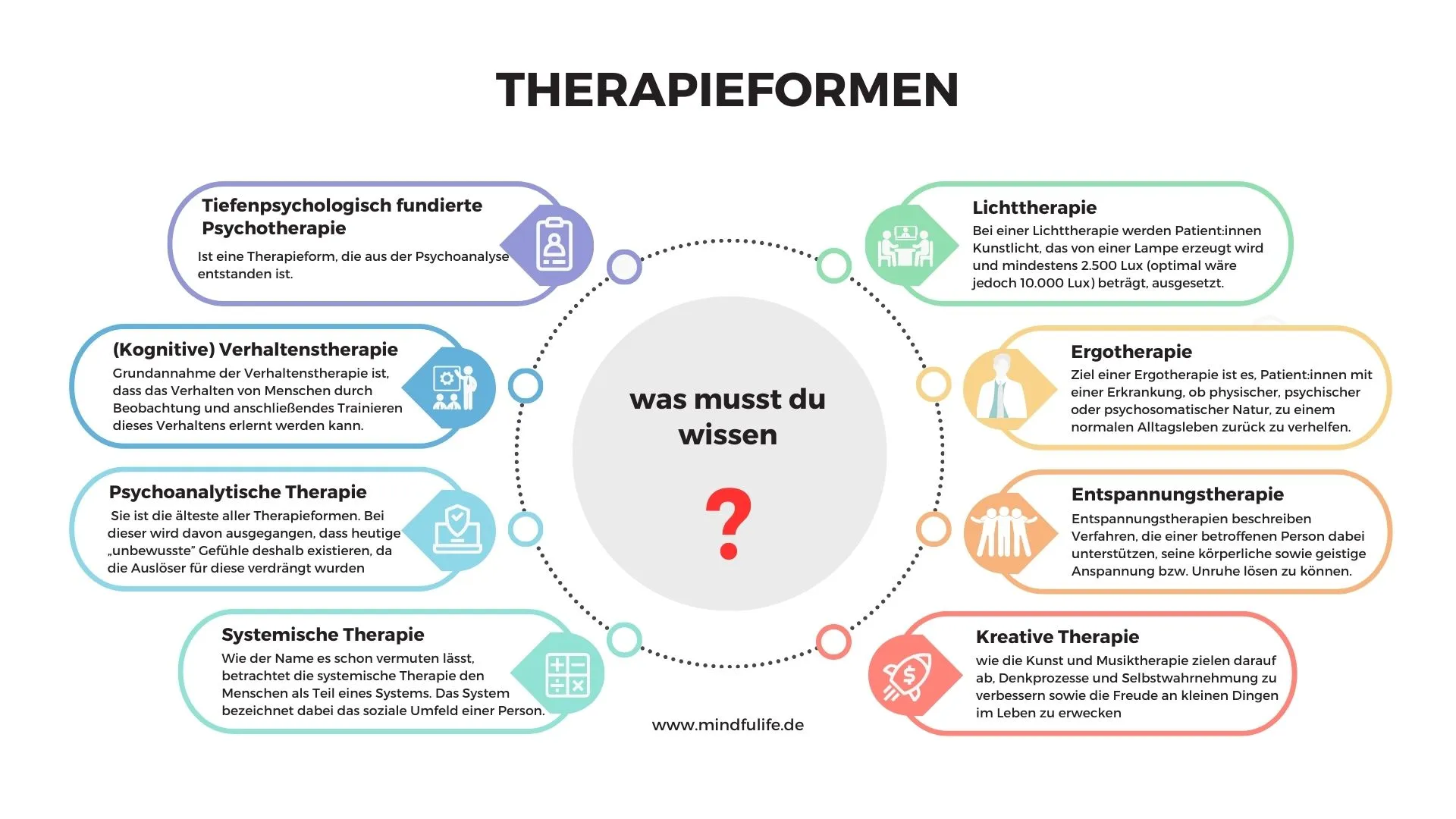
In psychotherapy, there are essentially four guideline-approved methods:
- Psychodynamic psychotherapy
- (Cognitive) behavioural therapy
- Psychoanalytic therapy
- Systemic therapy
Which one is chosen depends on the type of mental illness(es), the goals of treatment and the personal preference of the person affected. The costs of these four types of therapy are usually covered by health insurance, too.
To show you which one is best suited to you and your situation, we’ll give you an overview of all four guideline-approved methods below!
What is psychodynamic psychotherapy?
Depth psychology-based psychotherapy (also known as psychodynamic therapy) is one of the types of therapy that grew out of psychoanalysis. In this approach, a psychologist tries to trace the reasons for their patient’s current dysfunctional patterns of thinking and behaviour back to the patient’s past. Unlike psychoanalysis, however, the focus is on the one ‘central conflict‘ that triggers the person’s present difficulties in managing their life. Goals are then set for how the person would like to deal with this conflict in the future.
The therapist can offer advice and support to help the patient evaluate past situations. The aim of this kind of therapy is to give the person a range of tools for everyday life that will support them in the long term in coping with difficult situations as they arise.
A therapy session usually lasts 50 minutes, with patient and therapist sitting opposite each other on chairs as they talk. There are usually one or two therapy sessions per week, depending on what the patient needs and how much capacity the therapist has.
What is (cognitive) behavioural therapy?
The basic assumption of behavioural therapy is that people learn behaviour by observing it and then practising it. Building on this, it should also be possible to unlearn a learned behaviour. In psychotherapy, we speak of dysfunctional behaviour patterns, which can develop into a mental illness if they take up too much space in a person’s life and therefore seriously impair their daily functioning. These dysfunctional behaviour patterns then need to be unlearned so that the person’s everyday life can return to normal.

In cognitive behavioural therapy (CBT) for depression, for example, it is assumed that negative thoughts are followed by negative feelings. Accordingly, targeted psychotherapy should weaken the formation of these negative thoughts, or the emotional reaction to them, in order to bring about a change in behaviour. The original behavioural therapy is thus extended to include the factors of feelings and thoughts, in order to find a more precise explanation for a person’s behaviour.
Alongside CBT, ‘SSRIs‘ (selective serotonin reuptake inhibitors), a type of antidepressant, may also be prescribed. As the name suggests, these inhibit the reuptake of the neurotransmitter serotonin, which makes the brain better able to learn new patterns of thinking and behaviour.
In (cognitive) behavioural therapy, then, a patient works out new ways of thinking and behaving that help them deal with difficult situations or stresses in their life. The aim is to develop lasting strategies that prevent the illness from returning even after therapy has been successfully completed.
Behavioural therapy sessions usually last 50 minutes and should take place at least once a week in order to bring about a lasting change in the person’s behaviour.
What is psychoanalytic therapy?
Psychoanalysis, developed by Sigmund Freud, is the oldest of all types of therapy. It assumes that present-day ‘unconscious‘ feelings exist because their triggers have been repressed. These triggers are unresolved conflicts and experiences from a person’s past, usually from childhood.

The aim of this therapeutic method is to uncover these conflicts and then work through them together with a therapist. Methods such as ‘free association‘ or ‘dream interpretation‘ are often used. Dream interpretation, for example, aims to establish the connection between dreams and a person’s life story.
This type of therapy is traditionally carried out with the patient lying on a couch or sofa. The therapist, however, sits on a chair and, from the patient’s position, cannot be seen, only heard. This is meant to encourage the person lying down to immerse themselves fully in their thoughts and feelings and talk about them without being influenced by their surroundings.
Psychoanalysis is only suitable for patients who have a strong willingness to analyse themselves and can stay motivated over a longer period of time, with up to three therapy sessions per week. The length of each session is agreed jointly.
What is systemic therapy?
As the name suggests, systemic therapy views people as part of a system. Here, the system refers to a person’s social environment. This can span all areas of life (work, family, friends) or cover just one of them. In any case, the environment must have a negative impact on the thoughts and feelings of the person affected, who then tries to compensate for these burdens through all kinds of behaviours.
For example, an eating disorder could develop if, during their upbringing, a person was given the impression by their parents that they have to be thin, or else other people would avoid them. But addictions or psychosomatic illnesses can also be a form of compensation, a way of coping better with a social environment that is perceived as flawed or stressful.

In systemic therapy, the process might involve creating a representation of this system together with a therapist, using figures or other symbols. This allows the environment to be analysed more closely and, on that basis, an explanation to be found for the ‘compensating’ behaviours. These system-related behaviours can then be reframed, opening up new basic assumptions and perspectives on the social environment. In this way, it becomes possible to change the person’s dysfunctional behaviours by showing how inappropriate they are in relation to the system.
Systemic therapy sessions last 50 minutes and can take place as individual or group therapy (involving, for example, family members from the system). Here, too, you should attend at least one therapy session per week in order to achieve a lasting improvement in symptoms.
💡Psychotherapy and statutory health insurance
Statutory health insurers also cover the costs of other types of therapy, however. These include talking therapy, couples or family therapy and EMDR for the treatment of post-traumatic stress disorder. For the costs to be covered, though, the person must have a mental illness or a disorder ‘of clinical significance‘. The costs of treating, for example, mild mood swings that do not meet the classification of a mental disorder, or of treatment by a non-medical alternative practitioner, are not covered by statutory health insurance.
Types of therapy: group therapy or individual therapy
Therapy and its various forms can take place not only as individual therapy but also as group therapy, together with other people affected by mental illness. It is also common for a combination of individual and group therapy to be used. This type of therapy is particularly suitable when several disorders are present at the same time.
For example, a person with obsessive-compulsive disorder could undergo exposure and response prevention in individual therapy to tackle their compulsive symptoms, and also take part in group therapy to better understand their social phobia and the fears behind it by talking with others affected, and to have their first corrective experiences.
💡The difference between counselling and therapy
The difference between therapy and psychological counselling is that therapy is used to treat mental disorders such as depression or anxiety disorders. Psychological counselling, on the other hand, addresses other psychological difficulties, such as problems in a relationship or in bringing up children. Such difficulties can only be treated with psychotherapy once they lead to a mental illness.
What other types of therapy are there?
Besides the four guideline-approved methods described above, there is a much wider range of other types of therapy. However, these are mostly used as a complement and only rarely as a stand-alone treatment for mental illness.
Below, we give you a list of some of these types of therapy:
What is light therapy?
Light therapy is a type of therapy in which patients are exposed to artificial light produced by a lamp, with an intensity of at least 2,500 lux (ideally, however, 10,000 lux). The distance from the lamp should be around 80 centimetres. The therapy is carried out both in psychotherapy practices under the supervision of a professional and at home by the person themselves.
It is used especially for patients with seasonal affective disorder (also known as winter depression), as the lack of sunlight in the autumn and winter months leaves them with a serotonin deficiency. This in turn has a negative effect on mood. However, the symptoms of 60 to 90% of those affected can be noticeably reduced after two to three weeks of treatment with light therapy.
What is occupational therapy?
The aim of occupational therapy is to help patients with an illness, whether physical, mental or psychosomatic in nature, return to normal everyday life. This includes, for example, people who have suffered a stroke or paraplegia as the result of an accident, but also people with severe addictions (drug or medication dependency) who need help with rehabilitation back into their ‘old’ life.
Such illnesses often go hand in hand with limitations of physical or mental abilities. Occupational therapy therefore focuses on the specific impairments of the person affected and tries to overcome them. These impairments can range from mild difficulties with concentration and memory to paralysis or other restrictions of movement.
During treatment, where possible, either old ways of doing things are relearned or alternative solutions are developed that make an independent life possible.
Types of therapy such as occupational therapy are usually carried out on an inpatient basis in hospital so that the patient can be monitored more closely, especially if they are in a critical medical condition. If the situation allows, however, treatment in day-patient facilities such as a day clinic is also possible.
What is relaxation therapy?
Relaxation therapies are methods/types of therapy that help a person release physical and mental tension or restlessness. Such tension is usually caused by long, stressful periods, e.g. at work or at university, during which those affected are often also under great pressure to perform. If the symptoms are not recognised early enough, such periods can lead to sleep and concentration problems in everyday life, but also to anxiety disorders or what is known as burnout.
Relaxation therapy tries to counteract the development of such symptoms or to ease them. This includes mindfulness-based methods such as meditation, but muscle relaxation exercises such as yoga or autogenic training are also typical relaxation techniques. To achieve lasting success, however, these methods need to be practised regularly and, as far as possible, without pressure. In other words, the person must do these exercises of their own free will; only then can a sense of relaxation and calm be achieved.
What is creative therapy?
Creative types of therapy, such as art or music therapy, aim to reactivate or strengthen simple thought processes, self-perception and the perception of others, and with them a person’s joy in the little things in life.
These types of therapy are particularly helpful, for example, in treating severe depressive episodes, as people with this illness have often lost all their zest for life and, with it, their connection to their previous everyday life. Through this kind of therapy, however, they can begin to build their first daily routines again and, in the long term, find their way back to a normal life.
Creative types of therapy are used especially in (day-)patient and inpatient settings such as day clinics, as these provide the opportunity to share experiences with other people. This communication can also support a patient’s path to recovery, as they realise they are not alone with their worries. In this way, this type of therapy can also give the person affected a sense of security and belonging.
Which therapy do I need?
Which types of therapy are best suited to you and your individual situation depends on many factors. What matters, though, is that if you notice symptoms of a mental illness, you really should seek out a psychotherapy practice. Together with the therapist there, you can then decide which therapy suits you best.
So don’t worry, you will find a way!
Social phobia
You now know what general types of therapy there are and how they work. Would you also like to learn more about mental disorders such as social phobia? Then we have just the article for you. See you there!
Deepen your meditation practice with Mindfulife
Meditation can be more than a short break in your everyday life. If you would like to understand more deeply how meditation works, how to build a steady practice of your own and how to guide others mindfully, our meditation teacher training is the next step. There you will not only get to know meditation in theory, but also develop more confidence, clarity and trust in your own practice.
Would you like to find out more about the training first? In our weekly webinar you will get an insight and learn more about what your path to becoming a meditation teacher could look like.
For regular support in your everyday life, you can also use our online meditation studio and join guided meditations flexibly via Eversports.
We look forward to accompanying you on your journey.
You can find more mindfulness inspiration on our channels too
References
Ermann, M. (2015). Freud und die Psychoanalyse: Entdeckungen, Entwicklungen, Perspektiven (2. Aufl.). Stuttgart: Kohlhammer.
Maderthaner, R. (2021). Begriffe der Psychologie. Stuttgart: Kohlhammer.
Paulitsch, K., & Karwautz, A. (2019). Grundlagen der Psychiatrie (2. Aufl.). Wien: Facultas.
Schnell, T., & Meyer, S. (2016). Praxisbuch: Moderne Psychotherapie – Der Guide bei komplexen Störungsbildern. Berlin Heidelberg: Springer.
Teismann, T., et al. (2017). Kognitive Verhaltenstherapie depressiven Grübelns (2. Aufl.). Berlin Heidelberg: Springer.
Trautmann-Voigt, S., Voigt, B., & Armbruster, M. (2017). Psychodynamische Psychotherapie und Verhaltenstherapie: Ein integratives Praxishandbuch. Stuttgart: Kohlhammer.
Unterholzer, C. C., & Gröger, H. (2022). Handbuch der systemischen Gruppentherapie: Ansätze, Methoden, Zielgruppen, Störungsbilder. Heidelberg: Springer.
Waldhauser, G. T. (2021). Neuropsychoanalyse: Eine Einführung in Neurowissenschaft und psychodynamische Therapie. Wiesbaden: Springer.