Mindful planning: your to-do list without pressure or stress
Do you know that feeling when the week is finally over - but you can't really feel proud of yourself because, once again, too many tasks have been left undone? Mindful planning can help you organise your to-dos more realistically and put yourself under less pressure in the process. Unfinished items on your to-do list can quickly spoil your mood. You feel frustrated and disappointed in yourself. But: it's okay.

 · 8 min read

Do you know that feeling when the week is finally over – but you can’t really feel proud of yourself because, once again, too many tasks have been left undone? Mindful planning can help you organise your to-dos more realistically and put yourself under less pressure in the process. Unfinished items on your to-do list can quickly spoil your mood. You feel frustrated and disappointed in yourself. But: it’s okay.
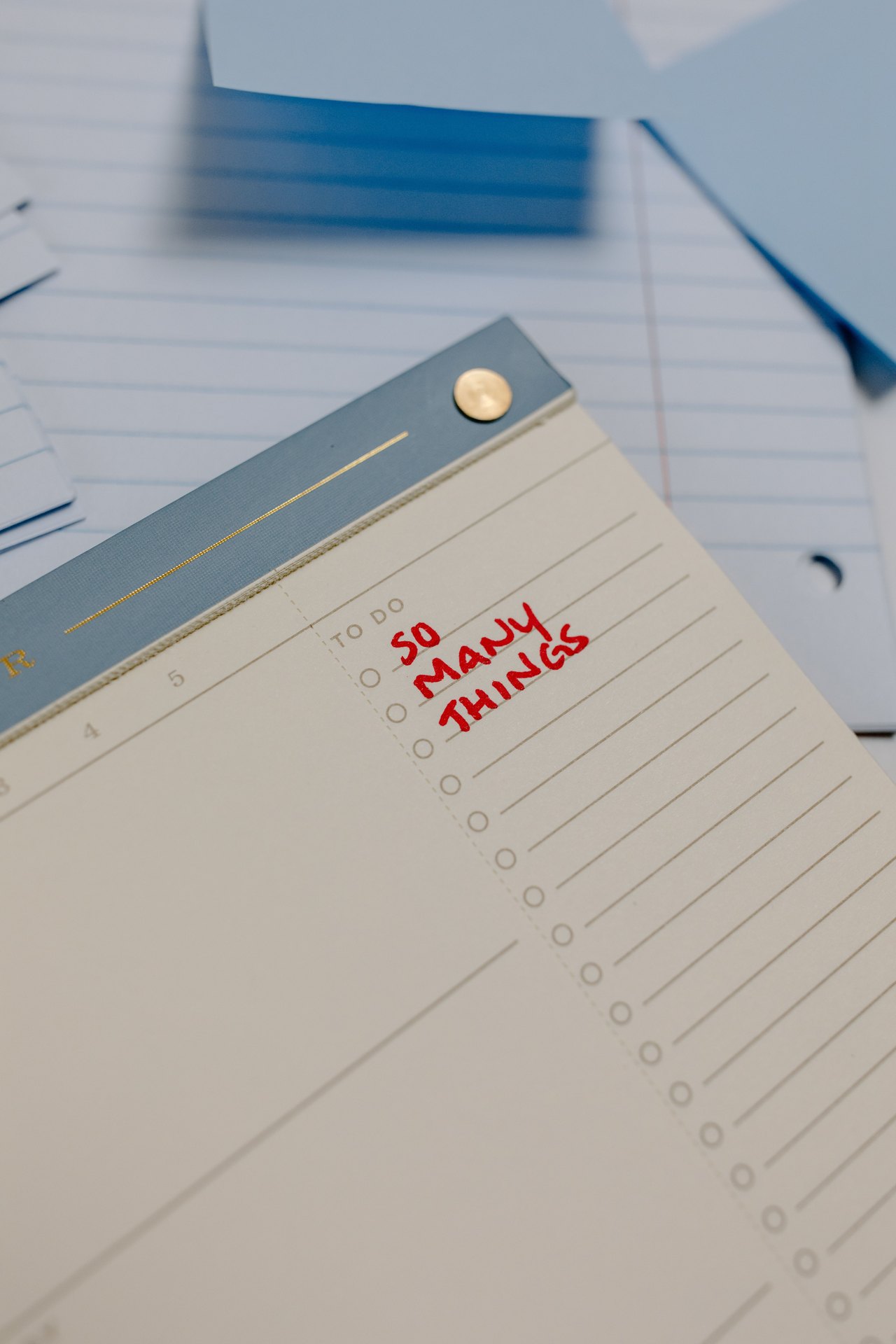
An analysis by the software company iDoneThis shows that 41% of all items on a to-do list are never completed – so almost half are left undone (Stillman, 2014). But far more important than getting annoyed about it or feeling guilty is the question: why do certain tasks remain unfinished? What is behind it? With the right attitude and a well-designed to-do list, however, you can work productively – without putting yourself under pressure.
In the following article, you will find out what the real reasons are and get helpful tips on how to boost your productivity and manage your tasks more efficiently – mindfully, realistically and without pressure.
The dilemma of to-do lists
What are the benefits of to-do lists?
To-do lists are a valuable tool for keeping track of things and not drowning in chaos. Before a task is forgotten, it gets quickly jotted down on a piece of paper or in a notes or reminder app. This creates the feeling that you won’t forget anything and can keep an eye on your tasks at all times.
To-do lists can also reduce stress: responsibility is, in a sense, “handed over” to the paper or app. This effect has even been demonstrated scientifically. In a study, researchers at Florida State University found that people who use to-do lists work in a more focused way and feel less anxious about big tasks (Florida State University, 2016).
Sleep can benefit too: a team led by researcher Michael Scullin at Baylor University in Texas showed in a study that participants fell asleep faster and more calmly when they had written down a list of upcoming tasks the evening before (Scullin et al., 2018).
Writing things down also provides relief, because structuring the mountain of tasks makes it seem less overwhelming. On top of that, ticking off completed items gives a tangible sense of satisfaction.
What problems do to-do lists cause?
As helpful as to-do lists can be, they also come with a number of problems. Psychologist Prof. Scheel of the Europa-Universität Flensburg warns: “Writing lists can turn into a form of procrastination in itself. Instead of getting tasks done, the list is constantly updated and extended.” The feeling of having to get too much done can thus create additional stress.
Here are some typical problems with to-do lists:
- No consideration of time: All tasks look the same – regardless of whether they would take five minutes or five hours. Without time planning, projects can hardly be carried out realistically. Complex tasks in particular are therefore often left undone.
- Lack of prioritisation: To-do lists are often mere collections with no connection to overarching goals. Urgent and important items sit side by side as equals. Successful self-management, however, requires clear prioritisation.
- Unimportant things first: With to-do lists, the focus is often solely on getting tasks done. Ticking things off feels good – which is why we tend to tackle quick and easy items first. This may make us look productive, but the truly important tasks often fade into the background as a result.
- Overwhelm: A list that doesn’t get shorter – but actually keeps growing – can quickly feel crushing. Instead of providing an overview and a sense of control, it creates feelings of overwhelm and powerlessness.
- To-do lists are unspecific: Tasks of very different complexity often sit next to each other – such as “take out the rubbish” and “write bachelor’s thesis”. While one is clear and done quickly, the other involves numerous individual steps and can’t be ticked off in a single day. Unless such complex projects are broken down into smaller subtasks, the to-do list remains hard to manage and quickly becomes overwhelming.

How can you plan your to-do list mindfully?
1. Step: Preparation
Before you start on the actual list, a little preparation is worthwhile.
- Find a quiet spot: Choose a place where you feel comfortable and can also concentrate well.
- Choose the right medium:
Paper: A notebook or Post-its are ideal. A beautiful notebook can boost motivation, and coloured paper can underline importance. Try to write as legibly as possible and use colours or symbols to structure your tasks clearly
Phone app: Many people prefer an app, as their phone is always to hand and spontaneous ideas can be noted down straight away. What matters, though, is choosing the right app: it should be easy to use and appeal to you visually – otherwise you’ll hardly use it regularly.
Computer: There are also tools for the computer that let you create virtual to-do lists. Tasks can be flexibly moved, deleted or shared with other people.
2. Step: Creating the list
- Start mindfully: Take a quiet moment to begin your day consciously. Create a relaxed atmosphere – perhaps with a cup of tea – and take a few deep breaths before you start writing. Ask yourself: What really matters today? Then set a clear goal for the day ahead.
- Keep the list short: Many people make the mistake of simply putting everything on a to-do list. But an overly long list doesn’t automatically mean more productivity – quite the opposite: the sheer number of tasks can quickly become overwhelming. So only write down what you can realistically achieve. The list should therefore be short and to the point. For example, plan a maximum of 3 to 5 main tasks per day – depending on their complexity. That way you keep track of things, your list stays manageable and, as a result, feels motivating.
- Sort by topic: Create separate lists for different areas of life – for example, categories such as “Work”, “Household”, “Personal” and “Other”. Try not to mix private and work tasks.
- Organise by priority: Arrange your to-dos by importance and urgency. You could use the simple Eisenhower method, for example. This sorts tasks into “important”/”not important” and “urgent”/”not urgent”.
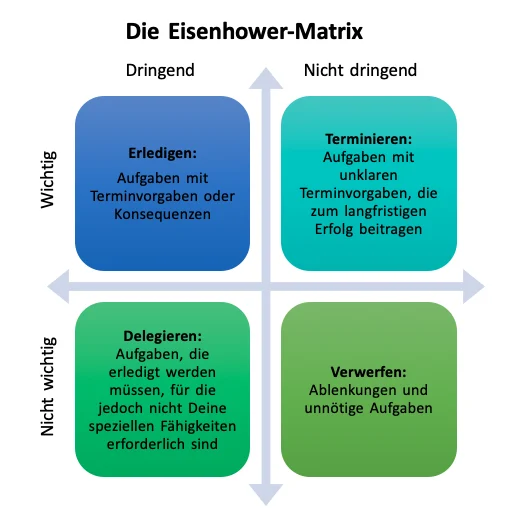
Based on this sorting, you can create 3 lists:
- Now list: tasks that need to be done today (a maximum of 3 items)
- Soon list: tasks coming up in the next few days.
- Can-wait list: important tasks that don’t need to be done within the next week. This way, long-term tasks don’t get forgotten either.
- Precise wording: Write your to-dos as precisely as possible. Instead of “finish project”, note down concrete steps such as “pay invoices” or “call Mr X”. This makes the list clearer and ticking things off easier.
- Planning breaks: Rest belongs on the to-do list too. Our bodies and minds need regular short breaks to stay productive. So plan short breaks between tasks – such as a coffee break, a short mindfulness exercise or brief bursts of movement. Ideally, mark these breaks in the same colour so they don’t get overlooked in everyday life.
3. Step: Putting it into practice
- Work in time blocks: Plan your tasks in time slots. During that time, work on one task with full concentration and then consciously treat yourself to a break.
- Keep the list up to date: Check the status of your list regularly. What might no longer be important? Which tasks have become more urgent? Does a project need to be broken down into smaller steps? And of course: cross out, tick off or scrunch up completed tasks. Calmly carry unfinished tasks over to the next day.
- Set deadlines: Many tasks remain undone because there is no fixed deadline. When it comes to getting things done, it helps to set your own time limits, even for projects without an official deadline. This creates commitment and stops important tasks from being put off.
- The right attitude: There’s no place for perfectionism here. It’s perfectly fine to postpone tasks. We are not machines – personal factors such as how we feel on the day, our emotions or external circumstances affect our productivity. Be kind to yourself, even if not everything gets done. The only thing that matters is not to avoid tasks permanently.
- Mindful self-reflection: End your day or week mindfully with a brief review to reflect on your progress.
– What worked well?
– What did you find difficult?
– Where can you improve?
Celebrate your successes, pause for a moment and, if you like, treat yourself to a small reward. This motivates you and creates positive incentives.

What is a not-to-do list?
A not-to-do list is the counterpart to the classic to-do list. Instead of writing down tasks that need to be done, it contains things you want to consciously avoid – such as time-wasters, bad habits or unnecessary distractions. It is a helpful addition to your to-do list for keeping your focus on what matters most.
Many people only realise late on how much unimportant tasks dominate their everyday lives. A not-to-do list gives you clarity by recording what slows you down or overwhelms you (e.g. procrastination, multitasking). This lets you direct your energy purposefully towards what really counts – while also giving you a reminder to make mindful decisions.
How to create a not-to-do list
Observe your everyday (working) life mindfully and note down things that weigh on you or distract you:
- Unhealthy habits: smoking, excessive drinking, unnecessary spending
- Distractions: smartphone, social media or constantly checking emails.
- Sources of error: Note down mistakes you don’t want to repeat – this will help you avoid them better in future.
- Personal development: holding fewer grudges, being able to say “no” and not taking on every extra task
Benefits of a not-to-do list
- Clear focus on essential tasks
- Less stress and pressure to perform
- Identifying and eliminating time-wasters
- Better self-organisation
- Increased productivity
Conclusion
To-do lists are helpful – provided they are kept mindfully and realistically. An additional not-to-do list reduces stress and distractions. Mindfulness helps you set priorities, plan in breaks and be kinder to yourself.
The important thing is: don’t overwhelm yourself with too many tasks at once. Instead, try to do your best – without criticising yourself if not everything gets done. Your productivity grows like a garden – step by step: there’s no point drenching all the flowers with lots of water at once to make them bloom. What matters more is regular, mindful care and plenty of warm sunlight. The same goes for you:
Warm words instead of reproach.
Da-Yong K. (psychology student)
Deepen your meditation practice with Mindfulife
Meditation can be more than a short break in your everyday life. If you would like to understand more deeply how meditation works, how to build a steady practice of your own and how to guide others mindfully, our meditation teacher training is the next step. There you will not only get to know meditation in theory, but also develop more confidence, clarity and trust in your own practice.
Would you like to find out more about the training first? In our weekly webinar you will get an insight and learn more about what your path to becoming a meditation teacher could look like.
For regular support in your everyday life, you can also use our online meditation studio and join guided meditations flexibly via Eversports.
We look forward to accompanying you on your journey.
You can find more mindfulness inspiration on our channels too
References
Asana. (2025). The Eisenhower Matrix: How to prioritize your to-do list. Zuletzt abgerufen am 9. September 2025 von https://asana.com/de/resources/eisenhower-matrix
Backovic, L. (2019). Warum es nicht schlimm ist, wenn Sie Ihre To-Do-Liste nicht schaffen. karriere.de.
Barmer. (2024). To-Do-Listen: Tipps für mehr Produktivität. Redaktion Barmer. Zuletzt abgerufen am 9. September 2025 von https://www.barmer.de/gesundheit-verstehen/psyche/stress/to-do-listen-1054816#1_Verwenden_Sie_fu00FCr_die_ToDoListe_nur_ein_System-1054816
Florida State University. (2016, 5. Januar). Organize your to-do list from worst to best. Florida State University News. Zuletzt abgerufen am 9. September 2025 von https://news.fsu.edu/fsu-makes-news/organize-list-worst-best/
Mühlenbäumer, E. (2024). Selbstmanagement mit To-do-Listen: Struktur statt Stress – Tipps fürs Selbstmanagement: Wie sinnvoll sind To-do-Listen? ZDFheute. Zuletzt abgerufen am 9. September 2025 von https://www.zdfheute.de/ratgeber/selbst-management-tipps-gegen-stress-to-do-liste-100.html
Scullin, M. K., Krueger, M. L., Ballard, H. K., Pruett, N., & Bliwise, D. L. (2018). The effects of bedtime writing on difficulty falling asleep: A polysomnographic study comparing to-do lists and completed activity lists. Journal of Experimental Psychology: General, 147(1), 139–146. https://doi.org/10.1037/xge0000374
Sigel. (2025). Achtsam organisiert: Deine To-do-Liste für mehr Klarheit im Arbeitsalltag. Sigel GmbH. Zuletzt abgerufen am 9. September 2025 von https://www.sigel-office.com/de/magazin/achtsam-organisiert-deine-do-liste-fuer-mehr-klarheit-im-arbeitsalltag/
simplify. (o. J.). Die Not-to-do-Liste: Der Schlüssel zu mehr Produktivität und Fokus. Zuletzt abgerufen am 9. September 2025 von https://www.simplify.de/selbstmanagement/achtsamkeit/not-to-do-liste/
Simplizist. (2023). Das Problem mit To-do-Listen und wie sie trotzdem helfen. Zuletzt abgerufen am 9. September 2025 von https://simplizist.de/to-do-liste/
Bischoff, S. (2024). To-Do-Liste in 7 Minuten: Weniger Stress und mehr Fokus. Zuletzt abgerufen am 9. September 2025 von https://www.steffenbischoff.com/2024/09/to-do-liste-in-7-minuten-weniger-stress-und-mehr-fokus/
Stillman, J. (2014). Trade Your To-Do List for a Done List. Inc. Zuletzt abgerufen am 9. September 2025 von https://www.inc.com/jessica-stillman/trade-your-to-do-list-for-a-done-list.html