Mudras: How Do They Improve Your Meditation?
Whether you're a seasoned meditator or still in tutorial mode, you know: meditators rest their hands on their knees! Or do they? Let's find out!

 · 9 min read
Maybe you’re a real pro when it comes to meditation – or maybe you already feel overwhelmed when someone tells you that you don’t even need a yoga mat for it. But whether you’re advanced or still a beginner: meditators always have their hands on their knees … don’t they?
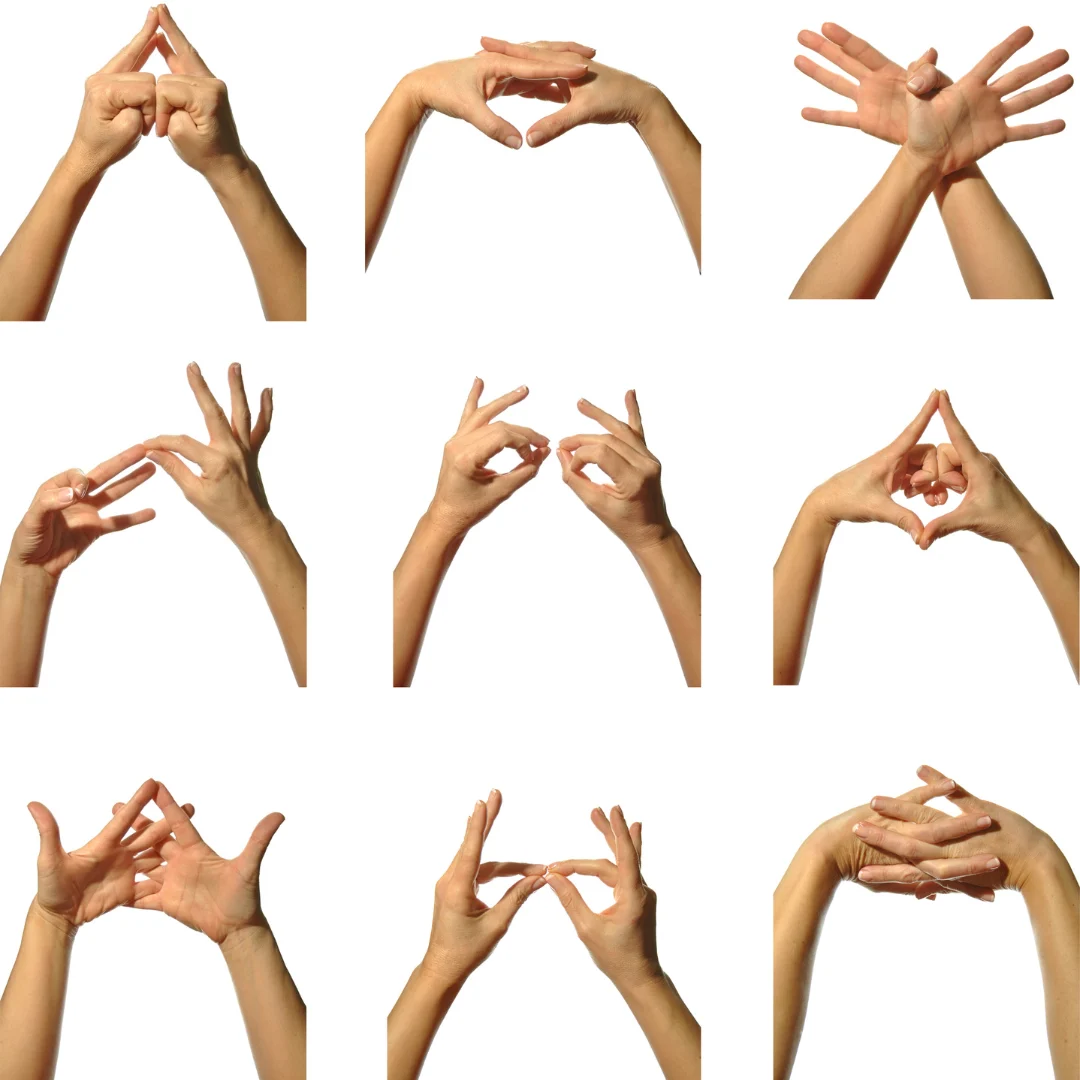
An intriguing question, and one we need to explore further in this blog article. When you think of meditation, your mind probably conjures up images of the meditating Buddha or very relaxed-looking yoga personalities. All sitting cross-legged, of course. But what’s going on with their hands? Hardly any other part of the body sparks more debate during meditation! So in this article, let’s simply take a look at your hands. Let’s take your meditation to another level with a mudra – here we go!
What actually is a mudra?
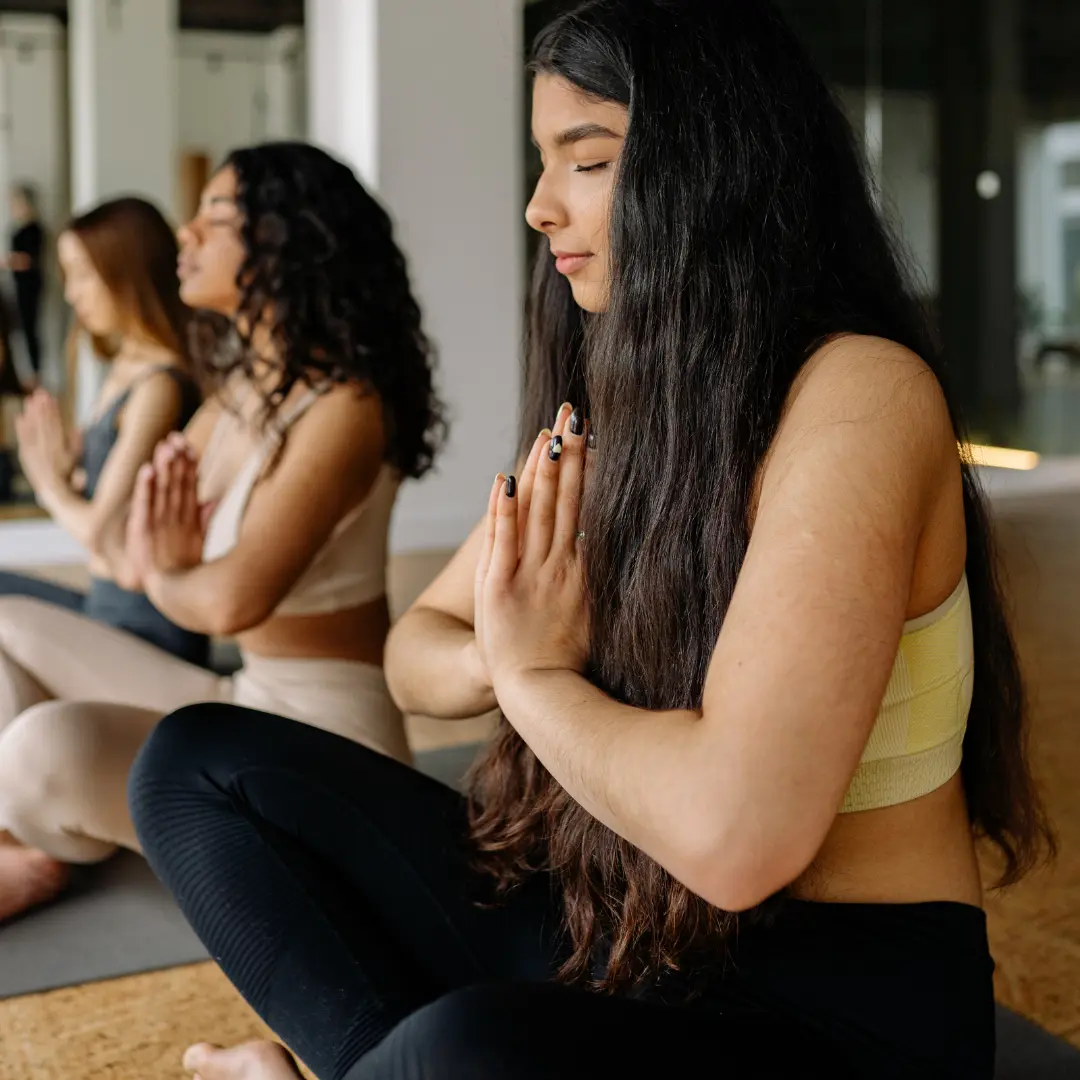
Namaste (“The light that dwells in me greets the light in you”) – this is how not only a yoga practice, but also many a meditation begins and ends. And with the joining of the hands, we’ve arrived at today’s topic: mudras!
Mudras are hand or finger positions that give your meditation the finishing touch. In the yoga tradition, they are described as deliberate gestures that support meditation and pranayama and are associated with positive effects such as stress reduction and improved regulation of bodily functions (Ahlawat et al., 2025). After all, mudra translates as “gift”. And depending on how you join your hands or fingers, you give your mind particular energies that support your meditation.
Each finger of your hand represents one of the five elements (Frawley, 1999):
1. Thumb: fire
2. Index finger: air
3. Middle finger: space/ether
4. Ring finger: earth
5. Little finger: water
Anjali or Namaskar Mudra
Let’s start with the classic of all classics: the Anjali or Namaskar Mudra – from the Sanskrit for devotion, reverence, blessing, offering. In classical yoga, these meanings stand for respect and inner alignment (Feuerstein, 2012). If you don’t know it from your own practice yet, why not simply give it a try next time? You’ve almost certainly seen it before. And it’s really easy. Bring your palms together in front of your heart and let your thumbs touch your breastbone.
You can spread your fingers as in the picture below, or keep them together as you can see a little further up. When you spread your fingers, you quite literally let the energy radiate from your heart; with your fingers together, you centre your energy more within yourself.
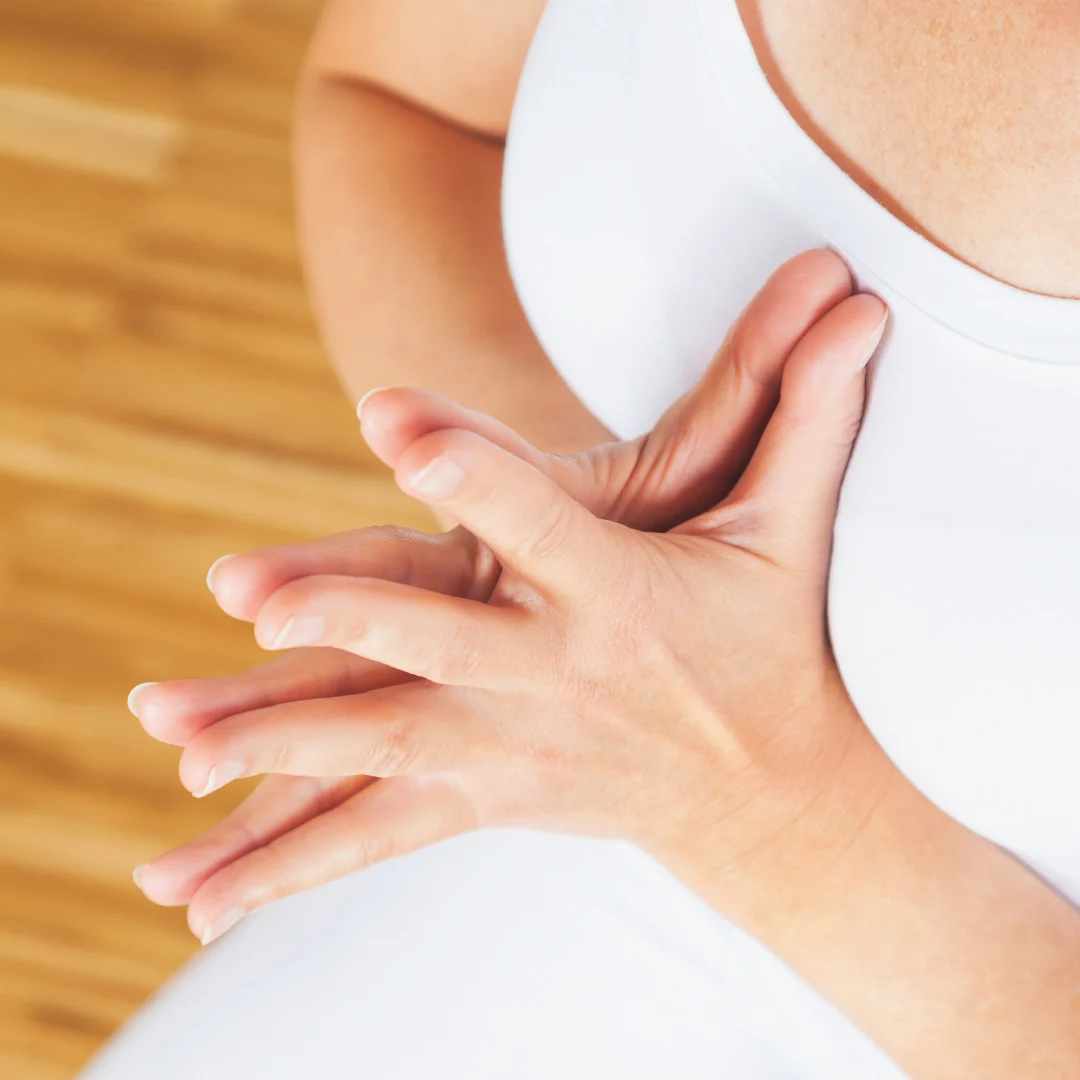
And the positive effects are hard to wave away. By joining both hands and making contact with your heart, you synchronise the two halves of your body, connect all the elements with yourself and allow your energy to circulate. You feel whole and sense inner calm. You are ready to receive and give love, compassion and openness.
Chin Mudra
The Chin Mudra is one of the best-known hand positions, and you have probably seen it or practised it yourself. It represents the gesture of knowledge. Chin, or more accurately Chit, translates from Sanskrit as consciousness, knowledge or wisdom. If the palm faces upwards, it becomes the Jnana Mudra (Sanskrit) or Gyana Mudra (Hindi).
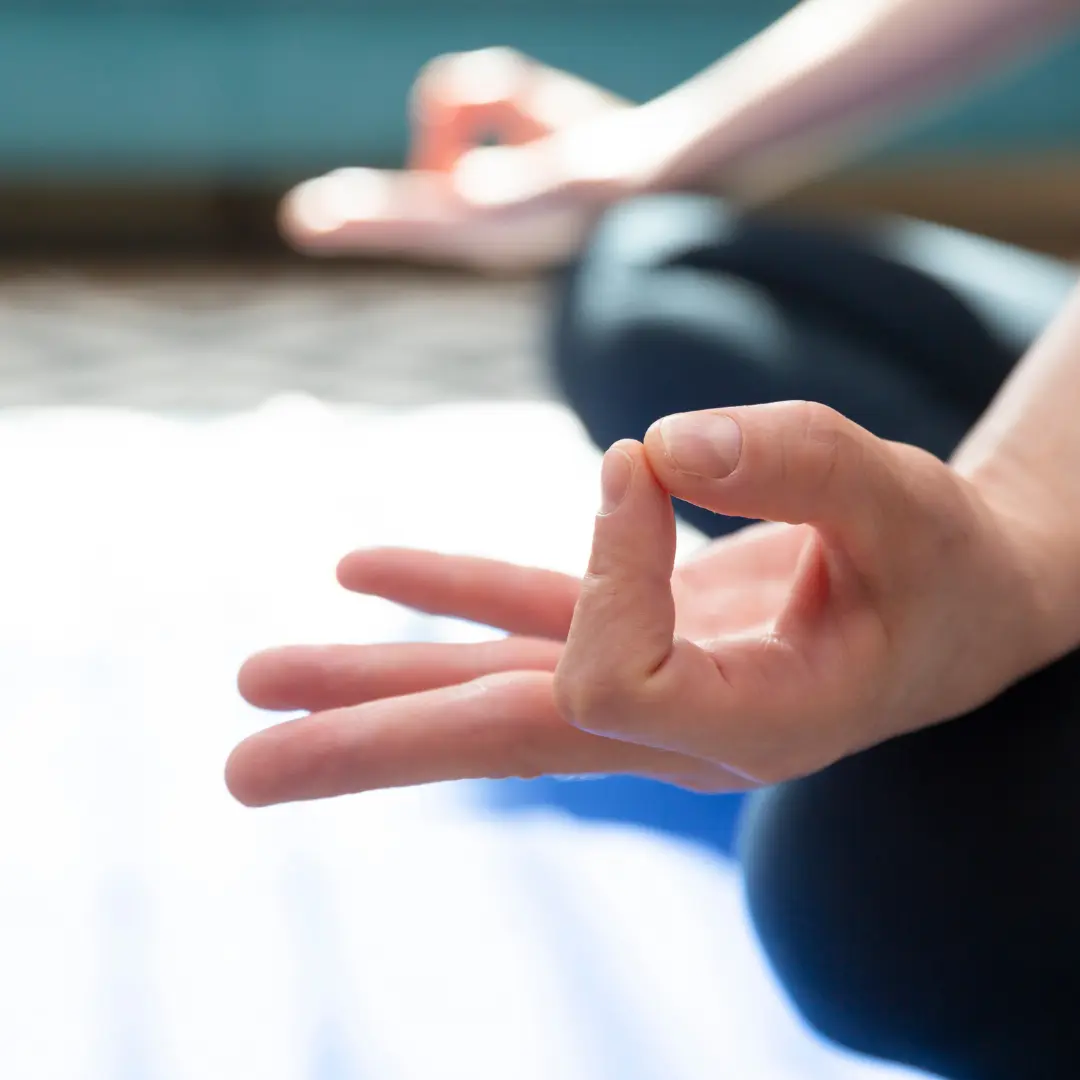
This mudra connects the thumb, fire, with the index finger, air. Here, air also stands for your breath, which creates the connection between you and your surroundings. The connection with fire focuses your “airy/flighty” mind. Besides the elements that extend through our fingers, there is another set of associations. It sounds a little complicated at first, but don’t worry!
Everyday life already shows us that a thumbs up or thumbs down tells the person opposite us exactly how we feel. With an outstretched index finger, we can admonish, draw attention to something or even threaten. And, of course, we’re told it’s rude to point at people.
And this is exactly what the two fingers stand for in Vedanta – the philosophy of oneness. In this Indian mythology, the thumb represents Brahman: universal, absolute consciousness and infinite knowledge. The index finger, on the other hand, represents the ego: individual consciousness.
Alongside them are the three gunas: Tamas (middle finger): inertia, Sattva (ring finger): purity, and Rajas (little finger): restlessness. They symbolise the qualities of nature that can be found in everything. Human beings are meant to strive for purity and are influenced by inertia and restlessness. Food, lifestyle and colours are examples of areas in which you encounter these qualities and can steer them yourself. If you’re interested in how to consciously increase your sattva, I recommend exploring Ayurveda.
But back to the Chin Mudra. By joining your thumb and index finger, your ego “bows” before the divine and, by extending the other fingers, turns away from the three gunas. A circle is formed, and with it a connection between universal and individual consciousness.
Much like in the Anjali Mudra, your energy circulates through your body thanks to the connection of your fingers. Through the Chin Mudra, you become aware of yourself and strive towards infinity, independent of all the qualities of this world.
Dhyana Mudra
Translated from Sanskrit, dhyana means meditation. In the Buddhist tradition, dhyana refers to a state of deep concentration that can lead to samadhi – complete absorption (Gethin, 1998). Not least because the Buddha himself attained enlightenment (samadhi) in this posture.
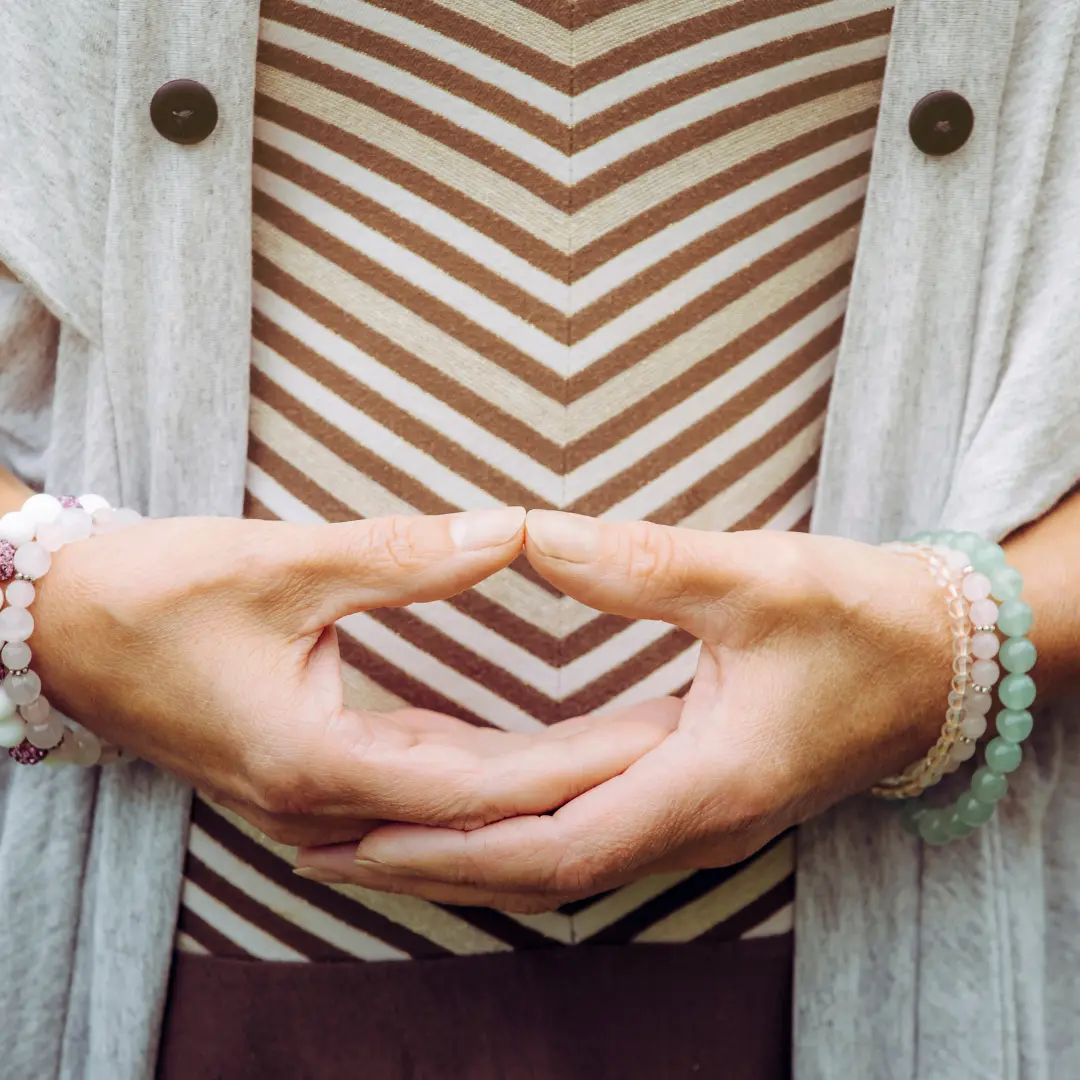
The reason I’m only telling you about the Dhyana Mudra now is that you should first get to know the elements and Vedanta and feel their effect before you meet the real pop star.
And the Dhyana Mudra takes you one step further still. Because with it, you get to know your whole body: your chakras.
And yes, that sounds very esoteric, but since your own practice of the other mudras has let you feel their effects on your body – you are now ready to open yourself up completely.
The chakras are the energy centres of your body. There are seven of them and, as you can see, they run along the midline of your body, or rather your spine (Judith, 2004) – more on that another time. Depending on how you position your hands, fingers or your body in general, you nurture a different chakra. The wonderful thing about this mudra is that you activate all the chakras at the same time and bring them into harmony. In this position, you are working with the elements, Vedanta and your chakras – so it’s no wonder the Dhyana Mudra is considered the mother of all mudras.
How do you practise it? Sit in a meditation position – cross-legged works well for this mudra – and straighten your upper body. Rest your hands one inside the other and bring the tips of your thumbs together, forming a triangle or a circle. Both symbols strive for unity.
By touching your thumbs together, you harmonise your fire energy and connect with universal consciousness. Much as with the Anjali Mudra, you will feel physical calm, and as with the Chin Mudra, mental awareness – you create a balance between body and mind.
Prithivi Mudra
This mudra bears the name Prithivi or Bhumi, which means nothing less than Mother Earth. That’s why it’s one of my personal favourite mudras.
In this often hectic world, we have to consciously relearn how to find our way back to ourselves, to be present and not drift away with the clouds of our mind. Although hardly any other mudra can ground us as well during our everyday highs and nosedives, it shouldn’t be practised extensively by everyone.
Why is that, when you thought all mudras only bring good things? Basically that’s true, but as you’ve learned, mudras influence your flow of energy. This is the foundation of your personal being – the expression of your chakras, elements and qualities.
They come together in the doshas, of which there are three different types. The dosha model is a central concept in Ayurveda and is used to describe individual physical and mental tendencies (Sharma et al., 2007).
– Vata: element wind, loves movement, cold, delicate/slender, imbalance leads to restlessness and nervousness
– Pitta: element fire, transformation, hot, sharp, intense and assertive, imbalance leads to anger and hastiness
– Kapha: element water/earth, heavy, cool, stable, calm, peaceful, imbalance leads to sluggishness or depression
Now you can probably guess that people of the Kapha type shouldn’t ground themselves even further, as they already have plenty of stability and would otherwise become sluggish. In contrast, the Pitta type, with their intense way of life, could benefit greatly from the grounding effect of this mudra. Why not test which type you are?
How do you practise it? Get into your meditation posture. Bring the tips of your thumbs together with the tips of your ring fingers. If you like, you can apply a little pressure. Your index, middle and little fingers are stretched out straight. Close your eyes and breathe in deeply.
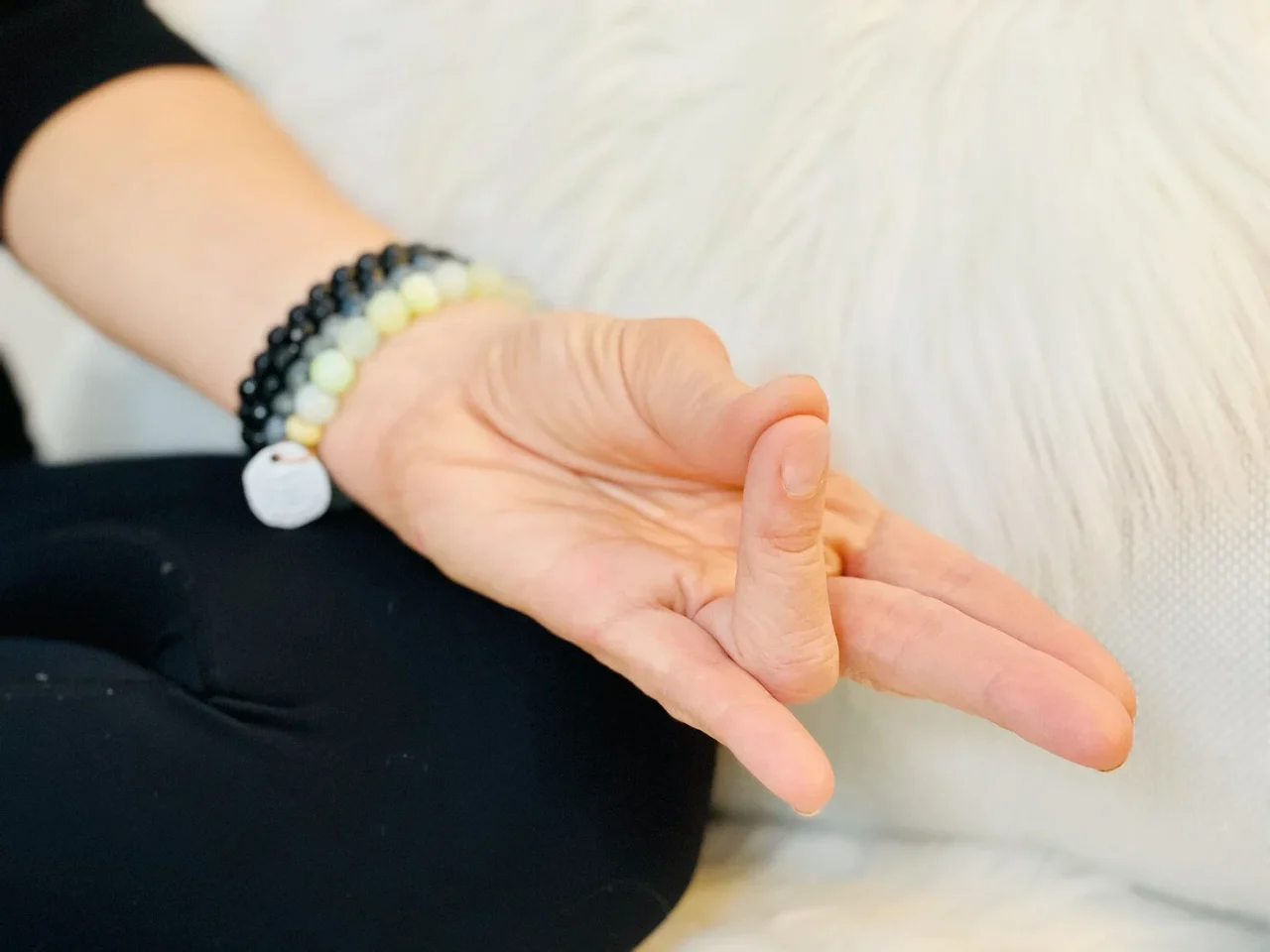
By connecting the thumb – fire and universal being – with the ring finger – earth and sattva (purity) – you create a powerful partnership. Quite often, you’ll immediately feel a strong sense of connection with your surroundings. This mudra nourishes your physical and mental body with strength, healing and, above all, a return to the here and now. Proverbial flights of fancy come to an end. Find your way back to yourself and Mother Nature in complete contentment.
Vishnu Mudra: the specialist among the classics
Finally, let’s turn to a very special mudra: the Vishnu Mudra. Its name comes from the Hindu deity Lord Vishnu, the preserving energy of the universe. The Vishnu Mudra is probably not one you’ll recognise straight away, but it should definitely find its way into your practice, if it hasn’t quietly done so already! In traditional yoga manuals, this hand position is described as a key tool for breathing exercises (Saraswati & Hiti, 1996).
That’s because the Vishnu Mudra is used above all in pranayama. Prana-what? you’re probably wondering now.
Like all the other mudras, the Vishnu Mudra can also be used in your meditation posture, but its real strength lies in supporting breathing exercises, or pranayama: the guiding of your life energy. “Prana” means life energy and “ayama” means control, so through pranayama you control your life energy.
How do you practise it? As the Vishnu Mudra isn’t a classic mudra, its technique is also a little more “complicated” to explain. Don’t be put off – just give it a go! As you can see, your thumb, ring finger and little finger should be stretched out straight. Bend your index and middle fingers towards your palm. Bring your nose into the resulting gap so that, in rhythm with your breathing, you can alternately close one nostril while breathing in through the other. Your little finger plays a lesser role, since you are working with your thumb and ring finger.
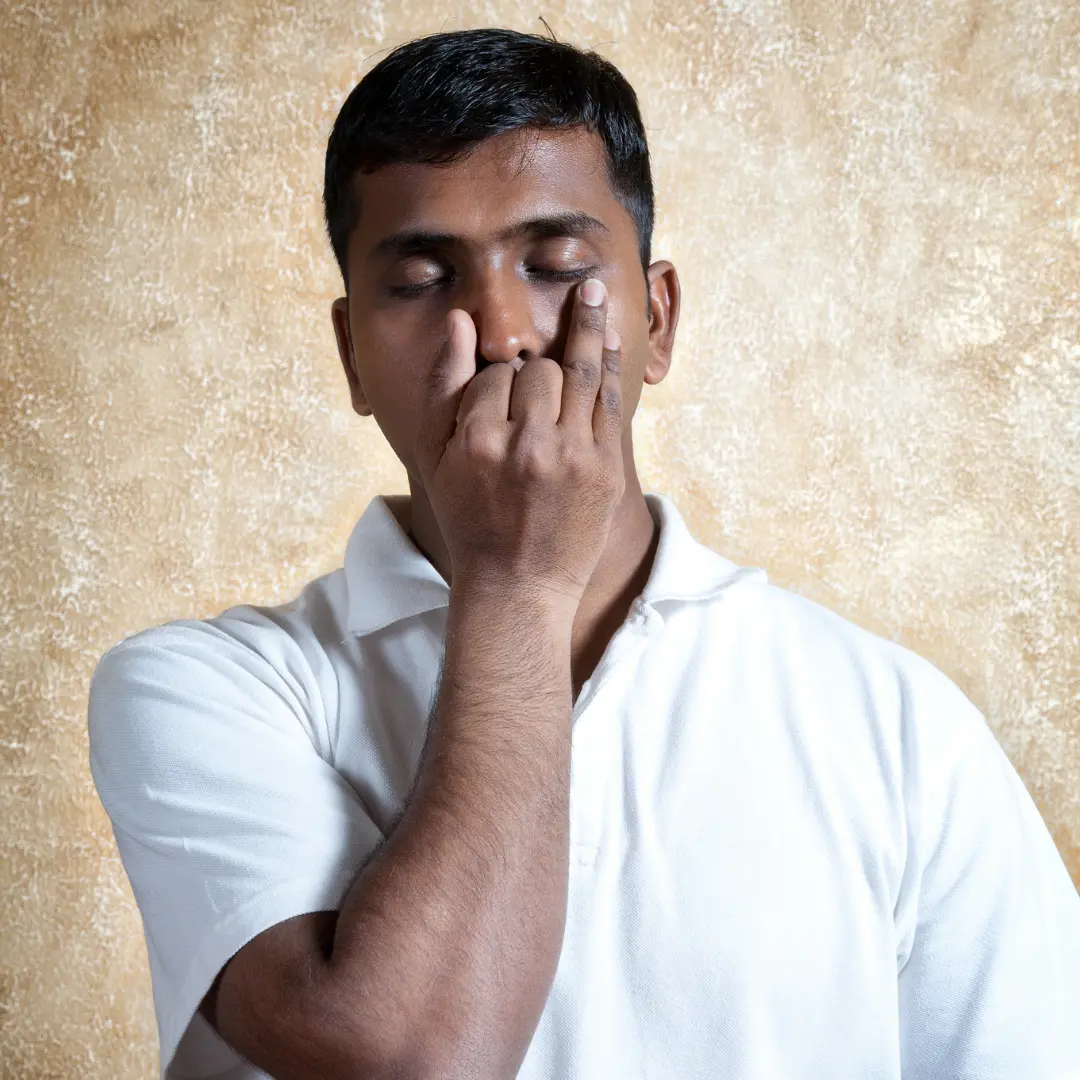
This practice is called Nadi Shodhana or Anuloma Viloma. There are various counts for inhaling and exhaling, as well as for holding the breath. These depend on your experience and your intention, but we’ll come to that in later articles.
Let’s look at the fingers. You connect fire (thumb) with earth (ring finger) and create a calming, balancing energy. In addition, you connect universal consciousness (thumb) with purity (ring finger) and bend ego (index finger) and inertia (middle finger), which helps ensure that nothing stands in the way of your energy on its path towards enlightenment in complete calm.
revised by Friederike S. (media communication student)
on 16 May 2026
Can you learn this online?
Online, you’ll find lots of great guides showing you how to use the mudras presented here. For example, you’ll find short, concise instructional videos here.
Deepen your meditation practice with Mindfulife
Meditation can be more than a short break in your everyday life. If you would like to understand more deeply how meditation works, how to build a steady practice of your own and how to guide others mindfully, our meditation teacher training is the next step. There you will not only get to know meditation in theory, but also develop more confidence, clarity and trust in your own practice.
Would you like to find out more about the training first? In our weekly webinar you will get an insight and learn more about what your path to becoming a meditation teacher could look like.
For regular support in your everyday life, you can also use our online meditation studio and join guided meditations flexibly via Eversports.
We look forward to accompanying you on your journey.
You can find more mindfulness inspiration on our channels too
References
Ahlawat, S., K, A., Shetty, A., Sharma, V., & T, V. (2025). Yoga Mudras and Physiological Benefits: A Narrative Review of Their Role in Cardiopulmonary Function. Journal of Ayurveda and Integrated Medical Sciences, 10, 169–174.
Feuerstein, G. (2012). The Yoga Tradition: Its History, Literature, Philosophy and Practice. SCB Distributors.
Frawley, D. (1999). Yoga & Ayurveda: Self-Healing and Self-Realization. Lotus Press.
Gethin, R. (1998). The Foundations of Buddhism. Oxford University Press.
Judith, A. (2004). Eastern Body, Western Mind. Celestial Arts.
Philipp Pham (2024). Experteneinschätzung aus der praktischen Yoga- und Meditationslehre. Persönliche Kommunikation.
Saraswati, S. S., & Hiti, J. K. (1996). Asana Pranayama Mudra Bandha. Yoga Publications Trust.
Sharma, H., Chandola, H. M., Singh, G., & Basisht, G. (2007). Utilization of Ayurveda in health care. The Journal of Alternative and Complementary Medicine, 13(9), 1011–1020.