The power of journaling – gain inner clarity with these 5 techniques

 · 3 min read

Do you sometimes feel a lack of inner clarity too?
Don’t we all know the feeling that something is at work inside us, yet we can’t quite put our finger on what it is? Our thoughts go round in circles, our feelings are in a muddle, and we often try to find a solution as quickly as possible.
Yet it is sometimes far more helpful to first gain clarity about what it actually is that’s on our mind. This is exactly where meditation and journaling can make a very valuable combination.

What exactly is journaling?
Journaling often seems similar to simply keeping a diary, but it is much more than that. It isn’t about writing beautiful prose or recording the day’s events so you can look back on them later. Instead, the point is to make your thoughts visible.
Once they land on paper, they no longer have to be processed solely inside your head. This often creates distance, a better overview and new perspectives, which can give you clarity. Especially when feelings are hard to grasp, writing helps you to name them step by step.
Research also shows the positive effects of writing things down. According to a review by Pennebaker (2018), consciously putting personal thoughts and feelings into writing can support emotional processing and have a positive effect on psychological wellbeing. Journaling can therefore be a valuable tool for gaining more clarity about how you feel.
What journaling techniques are there?
There are various techniques for putting your thoughts and feelings down on paper. Here I’ll introduce you to a few of the best known.
- Gratitude journal – This method is fairly minimal and works well as a daily ritual. For example, you can note down 3 things you are grateful for – the key is to focus on the positive.
- Reflection questions – For this, you can pick one or more questions and answer them honestly for yourself. Examples include ‘How am I feeling today?’ or ‘What’s on my mind right now?’
- Bullet journal – When keeping a bullet journal, you can cover a range of different things. These might include your thoughts or reflections, or tasks and goals you would like to complete.
- Guided journaling – With this method, you work with set questions or prompts. For instance, you can use a ready-made journal that you ‘just’ have to fill in.
- Free writing – With free writing, the idea is simply to start writing. Try not to think too much and to lift your pen off the paper as little as possible. You don’t need to pay attention to grammar or structure – just let your thoughts flow.
These different methods suit different situations to varying degrees. Science doesn’t assume there is a single ‘best’ writing technique either. What matters far more is that writing is used to consciously reflect on your own thoughts and feelings. Which form is best suited to this can vary greatly from person to person (Baikie & Wilhelm, 2005).
Why do meditation and journaling complement each other so well?
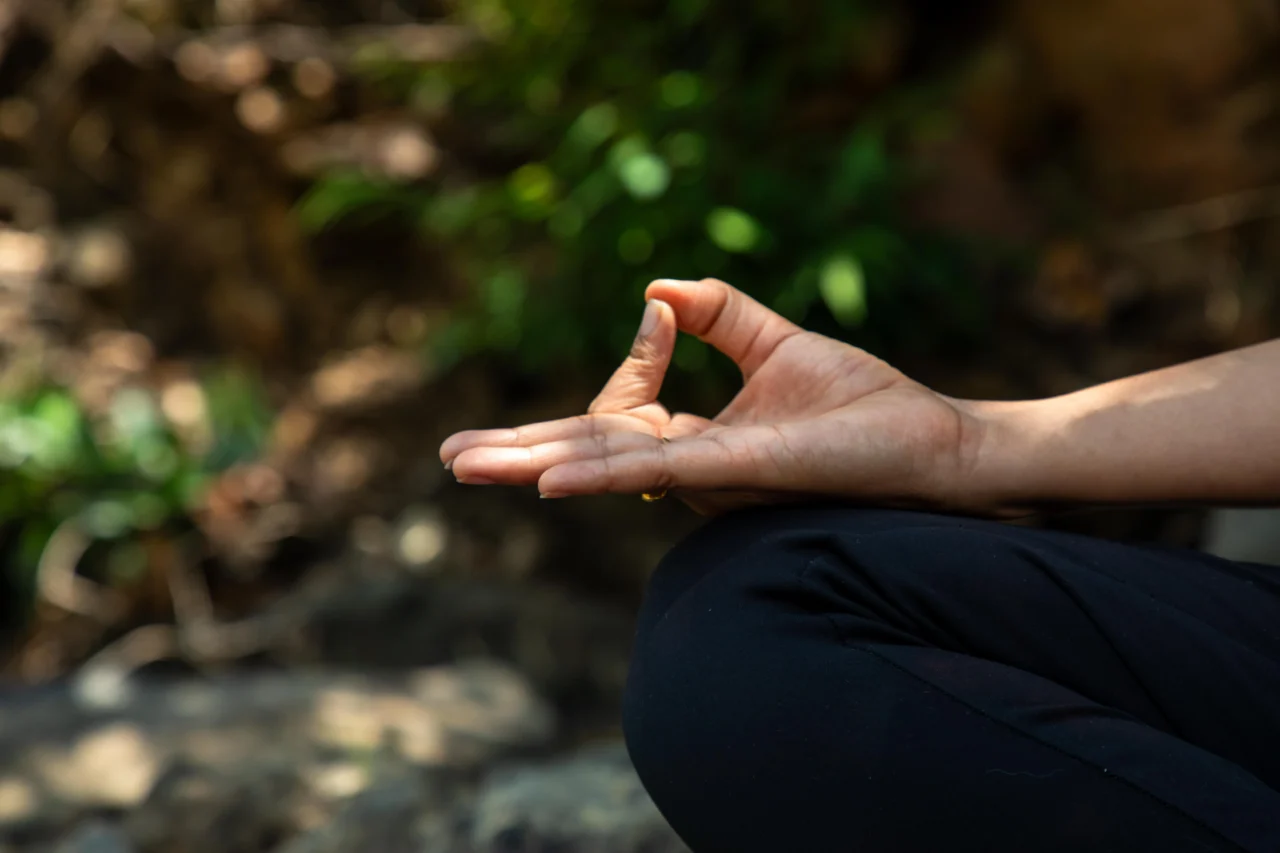
Meditation and journaling go well together. Through meditation, you can shift your attention from the outside world inwards and so become aware of your own experience. This fosters your self-awareness and a more conscious way of relating to your thoughts and feelings (Hölzel et al., 2011).
This process also interrupts habitual patterns of thinking and reacting, which can support forms of cognitive and emotional flexibility (Fox et al., 2016). As a result, it is often only during meditation that you notice what is actually present for you right now.
Journaling then helps you to put these impressions into words. In doing so, you give them new space and open yourself up to other perspectives. In short: meditation creates awareness and journaling creates order.
Would you like to try the combination straight away?
You can try it right now with a short exercise. Find a quiet place, have something to write with to hand and set aside around 10-15 minutes.
At the YouTube link below you’ll find a suitable video that guides you through a meditation followed by journaling. Why not give it a go and find out whether you, too, can feel and benefit from the many positive effects of this combination!
Friederike Schuh (Media Communication student)
Deepen your meditation practice with Mindfulife
Meditation can be more than a short break in your everyday life. If you would like to understand more deeply how meditation works, how to build a steady practice of your own and how to guide others mindfully, our meditation teacher training is the next step. There you will not only get to know meditation in theory, but also develop more confidence, clarity and trust in your own practice.
Would you like to find out more about the training first? In our weekly webinar you will get an insight and learn more about what your path to becoming a meditation teacher could look like.
For regular support in your everyday life, you can also use our online meditation studio and join guided meditations flexibly via Eversports.
We look forward to accompanying you on your journey.
You can find more mindfulness inspiration on our channels too
References
Baikie KA, Wilhelm K. Emotional and physical health benefits of expressive writing. Advances in Psychiatric Treatment. 2005;11(5):338-346. doi:10.1192/apt.11.5.338
Fox, K. C., Kang, Y., Lifshitz, M., & Christoff, K. (2016). Increasing cognitive-emotional flexibility with meditation and hypnosis: The cognitive neuroscience of de-automatization. arXiv preprint arXiv:1605.03553. https://doi.org/10.48550/arXiv.1605.03553
Hölzel, B. K., Lazar, S. W., Gard, T., Schuman-Olivier, Z., Vago, D. R., & Ott, U. (2011). How does mindfulness meditation work? Proposing mechanisms of action from a conceptual and neural perspective. Perspectives on psychological science, 6(6), 537-559. https://doi.org/10.1177/1745691611419671
Pennebaker, J. W. (2018). Expressive writing in psychological science. Perspectives on Psychological Science, 13(2), 226-229. https://doi.org/10.1177/1745691617707315