Monday Blues? No Thanks! Starting the New Week with Calm

 · 5 min read
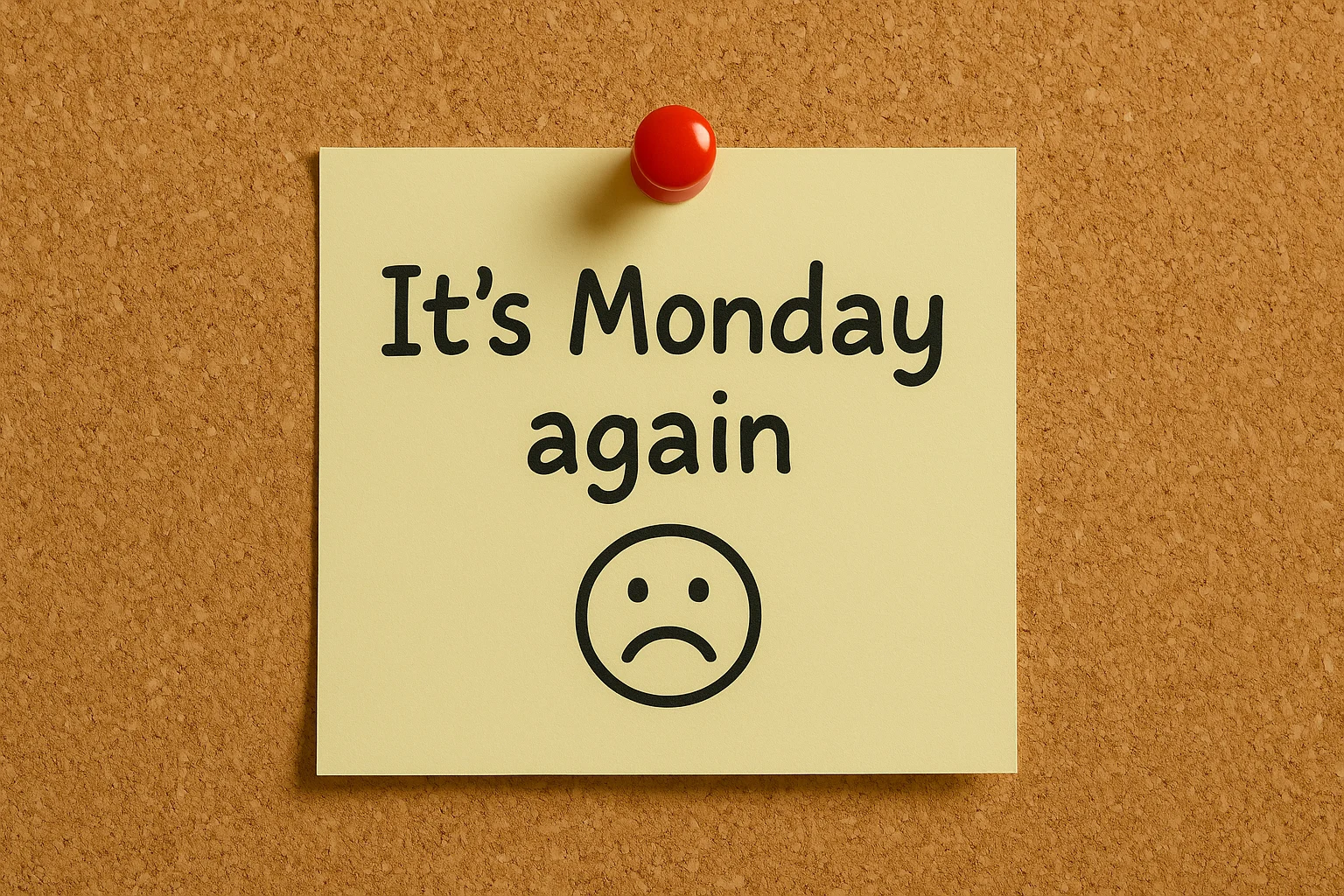
Monday morning – for many people, the least popular moment of the week. As soon as the alarm goes off, everything feels heavy and sluggish. The so-called Monday blues are not a myth but a widespread phenomenon that can make the start of the week harder. Yet there are ways to make the beginning of the week easier: with small mindfulness exercises, meditation and psychological insights, you can gently guide yourself into Monday. In this article, you will learn how to better understand and overcome the Monday blues.
What are the Monday blues – and why do they affect so many people?
The term “Monday blues” describes a low mood that many people experience at the start of the week. The symptoms range from lack of drive and irritability to physical heaviness or inner restlessness, and they often begin as early as Sunday evening.
Our modern everyday lives rarely leave room for genuine rest, a sense of purpose or emotional balance. The weekend often offers a brief retreat, whereas Monday abruptly confronts us with to-do lists, expectations and inner pressure. If there was room for autonomy, calm or joy over the weekend, the start of the week feels like a sudden break, which many people find stressful.
The psychology behind it: What lies behind Monday frustration?
Monday separates the self-determined weekend from an everyday life shaped by others. From a psychological perspective, transitions like this are particularly sensitive: the switch from free time to obligation can be experienced as a loss of control, especially if the working day is emotionally demanding.
Last but not least, the perceived contrast also plays a role: the more positively the weekend is experienced, the harder the shift on Monday feels. Research shows that sudden changes – even when they involve positive experiences – can intensify the perception of stress.
Our circadian rhythm is also a decisive factor here: anyone who sleeps in or goes to bed late at the weekend often starts Monday with social jet lag. The internal clock lags behind the external structure, and poor sleep quality, irritability or a sense of overwhelm can be the result.

Meditation for the Monday blues: Inner calm instead of stress
When Monday feels hard, meditation can be a valuable counterbalance. Instead of starting the week on autopilot, a short mindfulness practice can help you pause and consciously take a deep breath.
Meditation strengthens the capacity for self-regulation, has been shown to reduce stress and improves mood – even during transitions perceived as negative, such as the start of the week. Studies show that just a few minutes a day can be enough to stabilise emotional balance and reduce reactive behaviour. Many people therefore make deliberate use of mindfulness programmes or stress management courses to cope better with the demands of everyday life in the long term – especially when the start of the week regularly feels stressful.
The positive effects of such methods can be seen in the following mechanisms, among others:
- Calming the nervous system (less cortisol, more calm)
- Distance from ruminating thoughts (instead of being swept along by stress straight away)
- Fostering presence (clarity instead of Monday panic playing out in your head)
Especially if Monday frustration keeps coming back, it is worth establishing mindful morning rituals, whether that is a few conscious breaths, a guided meditation or a short body scan.

Mindful morning routines: How can I start the week more relaxed?
How you begin Monday often shapes the course of the whole week. The morning in particular gives you the chance to consciously steer in a different direction before stress or a bad mood sets the tone. Mindfulness and meditation can act as a foundation here. They give structure to the start of your day and give you a sense of control and inner stability.
These simple rituals will help you make the start of the week gentler:
- Start the day offline: avoid emails or messages for the first half hour. This protects your focus.
- Write down three things you are grateful for: this strengthens a positive focus and boosts your motivation in the morning.
- A few conscious breaths at an open window: the body wakes up and the mind can arrive.
- A short morning meditation (5-10 minutes): particularly effective for becoming mentally present.
Small rituals like these can help you see Monday not as a hurdle but as a new opportunity. And remember: a good morning routine does not have to be perfect. It can adapt to your everyday life – and lay the foundation for a stress-free day.
Tips for Sunday evening: Prevention instead of gritting your teeth
The Monday blues often begin on Sunday evening with brooding, restlessness or the feeling that the weekend has gone by too quickly. This is exactly where you can steer in a different direction. Winding down consciously creates distance and prepares you mentally for the new week.
These strategies can help:
- Plan consciously, but lightly: fix the most important appointments, but don’t overload your Monday.
- Make relaxation a ritual: a warm bath, gentle music or a meditation signal to your body: “You can come to rest now.”
- Digital detox: cut down on screen time in the evening, especially work emails or social media.
- Write your thoughts down: that way, they find their place on paper – and not in your head.
This way, you start the week with more calm and less inner resistance.

Conclusion
The Monday blues don’t have to be a fixed part of your week. If you shape the start of your week more consciously – with small rituals, mindful self-awareness and realistic expectations – a lot can change. Meditation, self-care and an understanding of your inner processes help you reduce stress and regulate your emotions better.
It’s not about loving every Monday, but about beginning it with kindness. Step by step – week by week.
Do you know the feeling of the Monday blues? Do you have any tips for a lovely start to the week?
Feel free to share your thoughts in the comments or on Instagram. We look forward to hearing about your experiences!
Silke K. (B.Sc. Psychology)
Deepen your meditation practice with Mindfulife
Meditation can be more than a short break in your everyday life. If you would like to understand more deeply how meditation works, how to build a steady practice of your own and how to guide others mindfully, our meditation teacher training is the next step. There you will not only get to know meditation in theory, but also develop more confidence, clarity and trust in your own practice.
Would you like to find out more about the training first? In our weekly webinar you will get an insight and learn more about what your path to becoming a meditation teacher could look like.
For regular support in your everyday life, you can also use our online meditation studio and join guided meditations flexibly via Eversports.
We look forward to accompanying you on your journey.
You can find more mindfulness inspiration on our channels too
References
Caliandro, R., Streng, A. A., Van Kerkhof, L. W. M., Van Der Horst, G. T. J., & Chaves, I. (2021). Social jetlag and related risks for human health: A timely review. Nutrients, 13(12), 4543. https://doi.org/10.3390/nu13124543
Patel, H., & Fagan, S. (2020). More than just the Monday blues. Dental Nursing, 16(4), 164–166. https://doi.org/10.12968/denn.2020.16.4.164
Pindek, S., Zhou, Z. E., Kessler, S. R., Krajcevska, A., & Spector, P. E. (2021). Workdays are not created equal: Job satisfaction and job stressors across the workweek. Human Relations, 74(9), 1447–1472. https://doi.org/10.1177/0018726720924444
Praharso, N. F., Tear, M. J., & Cruwys, T. (2017). Stressful life transitions and wellbeing: A comparison of the stress buffering hypothesis and the social identity model of identity change. Psychiatry Research, 247, 265–275. https://doi.org/10.1016/j.psychres.2016.11.039
Ryan, R. M., Bernstein, J. H., & Brown, K. W. (2010). Weekends, work, and well-being: Psychological need satisfactions and day of the week effects on mood, vitality, and physical symptoms. Journal of Social and Clinical Psychology, 29(1), 95–122. https://doi.org/10.1521/jscp.2010.29.1.95
Völker, J., Wiegelmann, M., Koch, T. J. S., & Sonnentag, S. (2024). It is Monday again: Weekend sleep differentially relates to the workweek via reattachment on Monday. Journal of Organizational Behavior, 45(6), 800–817. https://doi.org/10.1002/job.2788